

The « short walks » on the Las Vegas Strip are an illusion, designed to exhaust you and your wallet.
- The massive scale of resorts and clever architecture creates the « Vegas Effect, » making distances seem 3-4 times shorter than they are.
- Free, climate-controlled tram systems connect major resort clusters, but you have to know how to find and chain them together strategically.
Recommendation: Instead of walking head-on, treat the Strip like a chessboard. Use the free tram network as your primary mode of transport and choose a « hub » hotel that minimizes your time outdoors.
You’re in your hotel room, looking out the window at the Bellagio Fountains. It looks so close—a pleasant five-minute stroll, surely. You grab your room key and head out, ready for an easy evening walk. Forty-five minutes later, you’re drenched in sweat, your feet are aching, and you’ve only just crossed the street. You’ve just become a victim of the Las Vegas Strip’s greatest illusion, what veterans call the « Vegas Effect. » It’s a carefully crafted combination of immense scale, architectural misdirection, and a brutal desert climate designed to disorient and exhaust first-time visitors.
Most guides will give you the same tired advice: wear comfortable shoes and drink water. While true, that’s like telling a sailor to « bring a bucket » to cross the ocean. It fundamentally misunderstands the problem. The key to surviving, and even enjoying, the Strip isn’t about endurance; it’s about strategy. It’s about understanding the hidden transportation network, recognizing the physiological traps of the desert, and choosing your battles wisely. This isn’t a sidewalk; it’s a sprawling, multi-level maze of casinos, pedestrian overpasses, and hidden corridors.
This guide pulls back the curtain. We will dismantle the « Vegas Effect » piece by piece, revealing the systems you can use to your advantage. We will show you how to leverage the three free tram systems like a local, explain the critical difference between the Monorail and the bus, and pinpoint the exact times of day when the Strip is miraculously empty. Forget the 20,000-step nightmare. It’s time to learn how to navigate the Strip with the cool, calculated efficiency of a casino pit boss.
To help you master this unique environment, we’ve broken down the essential strategies into a clear, actionable guide. The following sections will equip you with the insider knowledge needed to transform your Las Vegas trip from an exhausting march into a seamless adventure.
Summary: Your Strategic Guide to Navigating the Las Vegas Strip
- Why the « Short Walk » to the Next Casino Takes 20 Minutes in Reality?
- How to Utilize the 3 Free Tram Systems to Save Your Feet?
- South Strip or North Strip: Which Base Suits a 3-Day Weekend Trip?
- The Dehydration Mistake That Sends 100s of Tourists to the ER Every Summer
- When to Explore the Strip: The 4-Hour Window with Minimal Crowds
- Monorail vs. The Deuce Bus: Which is Faster for Strip Travel?
- Why You Don’t Feel Yourself Sweating Until It’s Too Late?
- Resort Atmospheres: How to Choose a Hotel That Matches Your Party Vibe?
Why the « Short Walk » to the Next Casino Takes 20 Minutes in Reality?
The core reason your « quick walk » turns into a marathon is a phenomenon we’ll call the « Vegas Effect »: an architectural and psychological illusion of scale. From your hotel window, the neighboring resort looks like it’s right next door. On the ground, you discover the truth. The buildings are so monumental that your brain’s depth perception is thrown off. What looks like a 200-foot gap is actually a quarter-mile, and that’s before you account for the required detours. The entire Strip, from Mandalay Bay in the south to the STRAT in the north, is a staggering 4.2 miles long.
You can’t just walk in a straight line. The Strip is sliced by massive eight-lane boulevards like Tropicana and Flamingo. Crossing at street level is often impossible and always dangerous. You are funneled up escalators, across crowded pedestrian overpasses, and then back down again, adding hundreds of steps and precious minutes to your journey. These bridges are rarely direct; they often divert you through the entrance of a casino’s shopping promenade, adding another layer to the maze.
Finally, the casinos themselves are the biggest obstacle. They are designed to be sprawling, self-contained worlds. To get from the Bellagio to Caesars Palace, you must first navigate the labyrinthine interior of the Bellagio to find an exit, cross a long pedestrian bridge, and then traverse the equally vast expanse of The Forum Shops or casino floor at Caesars just to reach the main property. That « next door » casino is, in reality, a 15-to-20-minute trek. Underestimating this is the single most common mistake first-timers make, leading directly to exhaustion and frustration.
How to Utilize the 3 Free Tram Systems to Save Your Feet?
While the Strip’s layout is designed to make you walk, its operators have also provided a secret weapon for those in the know: three distinct, and completely free, automated tram systems. Mastering this network is the single most effective way to save your feet, escape the heat, and cover significant ground. These aren’t just rides; they are vital tools for transportation arbitrage, allowing you to bypass the most grueling walks.
The three systems operate independently and connect different clusters of resorts:
- The Mandalay Bay Tram: Connects Mandalay Bay, Luxor, and Excalibur on the west side of the South Strip. It’s your go-to for moving between these three mega-resorts.
- The Aria Express Tram: This is the crucial connector for the Center Strip. It runs from Park MGM, through the Shops at Crystals/Aria, to the Bellagio. It also offers a stop for Vdara.
- The Mirage-Treasure Island Tram: The shortest of the three, this tram simply connects the Mirage and Treasure Island hotels, saving you a surprisingly long and sun-baked walk.
The key is to « chain » these systems. For example, you can ride the Mandalay Bay Tram to Excalibur, walk across the pedestrian bridges to Park MGM, and then board the Aria Express Tram to get all the way to Bellagio, covering over a mile of the Strip almost entirely in climate-controlled comfort. The relief of stepping into a cool, quiet tram station after battling the sidewalk chaos cannot be overstated.
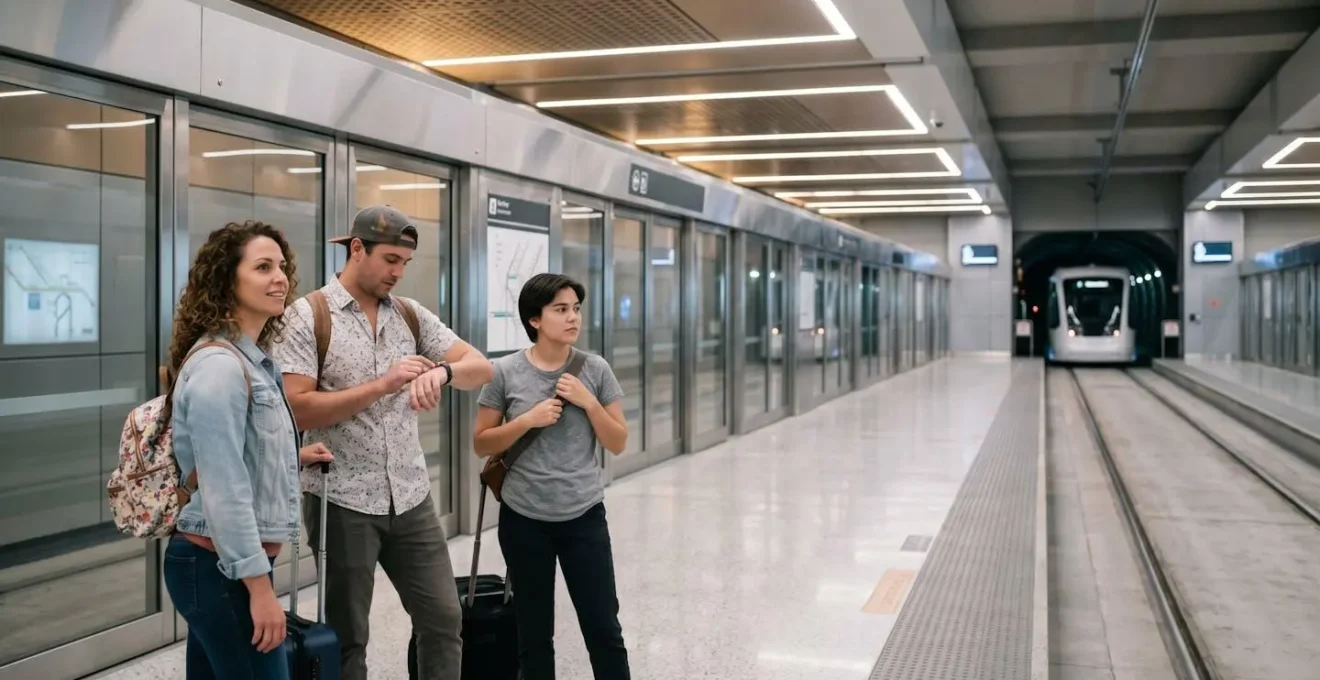
As you can see, these stations are modern, clean, and offer a welcome respite. However, be aware that the stations are almost always located at the very back of the resorts. You’ll still need to navigate through the casino floor to reach them, but this indoor walk is infinitely more pleasant than trekking outside on a 110°F (43°C) day. Learning these routes transforms the Strip from a linear slog into a series of interconnected, manageable hubs.
South Strip or North Strip: Which Base Suits a 3-Day Weekend Trip?
Your choice of hotel location is the most important strategic decision you’ll make. It dictates your primary mode of transportation and defines the « walkability » of your immediate surroundings. For a short trip, you don’t want to spend half your time in transit. The Strip can be roughly divided into three zones, each with a distinct travel profile and suited for a different type of visitor. Choosing the right base camp is essential for minimizing travel friction and maximizing your enjoyment.
Think of it as choosing a home base in a video game. A well-placed base gives you easy access to key resources (in this case, shows, restaurants, and other casinos), while a poorly chosen one means a long, tedious journey every time you want to do something. The South is dominated by trams, the Center is for walkers, and the North requires a commitment to paid transport. Understanding this trade-off is crucial before you book.
The following table breaks down the strategic advantages and disadvantages of each section, helping you align your hotel choice with your travel style.
| Strip Section | Primary Transport Mode | Walkability Density | Ideal Traveler Persona | Tram/Monorail Access |
|---|---|---|---|---|
| South Strip (Mandalay Bay, Luxor, Excalibur) | Tram-Heavy | High attraction density, high crowd density | Resort Dweller – prefers self-contained mega-resorts | Mandalay Bay Tram (free) |
| Center Strip (Bellagio, Aria, Cosmopolitan, Park MGM) | Foot-Heavy (with strategic tram use) | Highest density – attractions within 5-10 min walks | Iconic First-Timer, Foodie/Show-Lover | Aria Express Tram (free) |
| North Strip (Venetian, Wynn, Encore, STRAT) | Bus/Monorail-Heavy | More spread out, less frantic pedestrian flow | Relaxed Explorer – willing to travel for less congestion | Las Vegas Monorail (paid, $5-13) |
As this comparative analysis shows, a first-timer who wants to see the iconic sights is best served by staying Center Strip, where the highest density of attractions is connected by the Aria Express Tram. In contrast, a visitor seeking a more relaxed pace might prefer the North Strip, knowing they will rely on the Monorail or buses for any significant travel.
The Dehydration Mistake That Sends 100s of Tourists to the ER Every Summer
The most dangerous aspect of the « Vegas Effect » isn’t the sore feet; it’s the profound and deceptive risk of dehydration. The dry desert air creates a serious physiological trap. In a humid climate, you feel sweat on your skin, a clear signal to your brain that you’re losing fluids and need to drink. In Las Vegas’s single-digit humidity, sweat evaporates almost instantly. You can be losing a tremendous amount of water without ever feeling « sweaty, » leading you to believe you’re fine until it’s too late.
This is not a minor inconvenience. Heat-related illnesses are a major public health issue in Las Vegas. During the summer months, local emergency rooms see a massive spike in cases, with Clark County officials reporting more than 3,500 visits for heat-related illnesses in a recent year. The vast majority of these are tourists who underestimated the environment. The combination of walking long distances, the intense sun reflecting off concrete, and consuming alcohol (a diuretic that accelerates fluid loss) is a dangerous cocktail.
Relying on thirst is a failed strategy in the desert. The only way to stay safe is with a proactive hydration schedule. You must drink water mechanically, not just when you feel you need it. This means consuming water before you leave your room, during your walk, and even after you’ve returned to the air conditioning. Integrating electrolytes is also non-negotiable, as you lose critical salts and minerals through the sweat you don’t even feel.
Your Proactive Hydration Checklist for the Desert
- Pre-departure hydration: Drink one full 16oz bottle of water in your hotel room before leaving for the day.
- Active hydration: Consume one 16oz bottle per hour while outdoors on the Strip (not just when thirsty).
- Electrolyte integration: Add electrolyte tablets or sports drinks every 2-3 hours to replace minerals lost through sweat.
- Alcohol offset rule: For every alcoholic beverage, drink one full glass of water before ordering the next drink.
- Evening recovery: Drink a hydration recovery drink or electrolyte beverage before bed to prevent next-day dehydration.
When to Explore the Strip: The 4-Hour Window with Minimal Crowds
If distance is one axis of the Strip navigation problem, crowds are the other. From late afternoon until well after midnight, the sidewalks, pedestrian bridges, and casino entrances become a slow-moving river of people. This congestion doesn’t just slow you down; it drains your energy and patience. However, there are predictable lulls in this human tide— »golden windows » when you can explore the Strip in relative peace and cover ground two to three times faster.
Strategic timing allows you to experience the iconic sights without the frustrating crowds. Instead of battling thousands of people for a spot to watch the Bellagio Fountains at 9 PM, imagine having the entire viewing area almost to yourself. This isn’t luck; it’s a conscious choice to operate on a different schedule than the average tourist. This is especially vital in the summer, as these windows coincide with the most bearable temperatures of the day.
Case Study: The « Early Explorer » vs. « Late-Night Stroller » Strategy
Analysis of crowd patterns reveals two optimal low-traffic periods on the Las Vegas Strip. The ‘Early Explorer’ window (7 AM – 10 AM) offers the most tranquil experience: attractions open with minimal lines, outdoor temperatures remain manageable, and the demographic skews toward serious photographers and fitness enthusiasts. During this window, iconic spots are virtually empty. The ‘Late-Night Stroller’ window (after 1 AM on weekdays) provides a different advantage: while some venues are still open, the general pedestrian flow drops dramatically. This period is ideal for covering long distances between properties quickly, though it sacrifices access to most retail and dining. Both windows allow travelers to achieve significantly faster walking speeds compared to peak hours (7 PM – 11 PM).
The ‘Early Explorer’ window, in particular, offers a magical experience. The soft morning light, the quiet, and the sheer emptiness of normally chaotic spaces provide a perspective on Vegas that 99% of visitors will never see. It’s the perfect time for photography or simply soaking in the monumental architecture without being jostled.
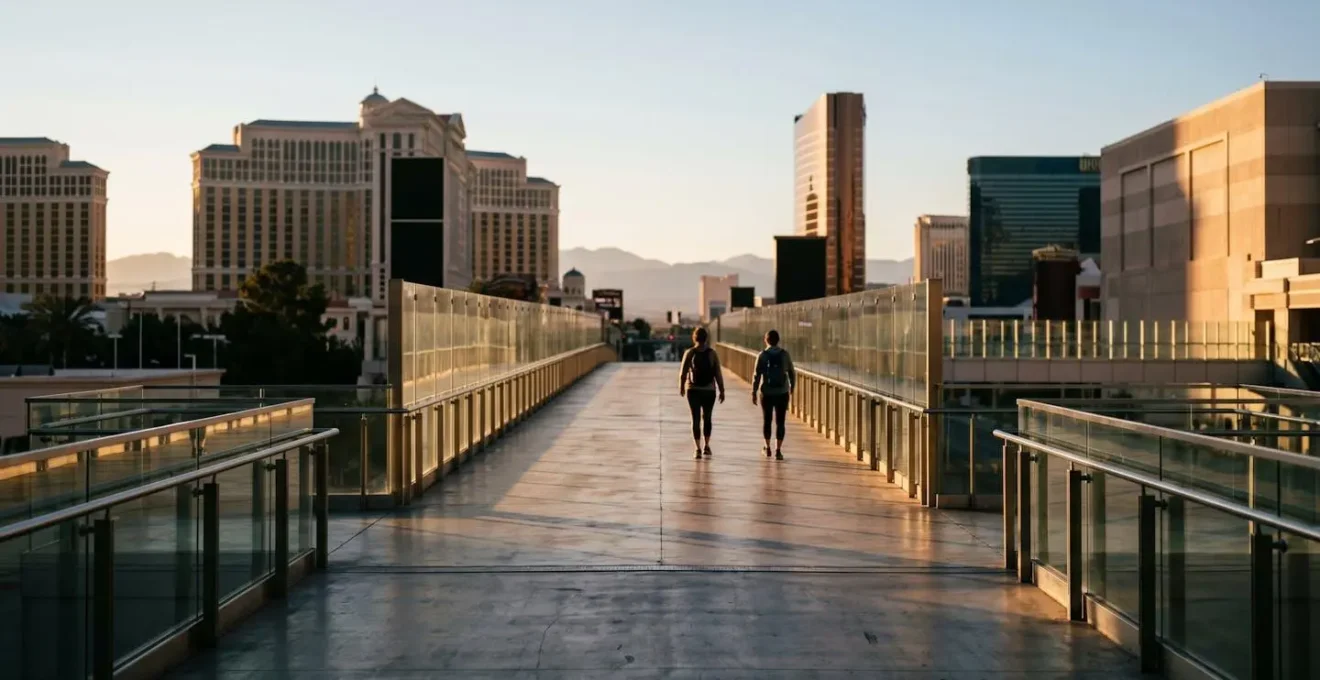
This image of a deserted pedestrian bridge at sunrise isn’t a fluke; it’s the direct result of strategic timing. By aligning your exploration with these low-traffic periods, you trade a few hours of sleep for an infinitely more pleasant and efficient experience. You can see more in these three hours than a typical tourist sees in a full day of battling the crowds.
Monorail vs. The Deuce Bus: Which is Faster for Strip Travel?
When the free trams can’t get you where you need to go, you’ll face a choice between the Strip’s two main paid transportation options: the Las Vegas Monorail and The Deuce double-decker bus. They both run north-south along the Strip, but they offer vastly different experiences in terms of speed, cost, and comfort. Choosing the right one depends entirely on your destination and your tolerance for heat and delays. This is a classic case of transportation arbitrage, where a slightly higher cost can buy you significant time and comfort.
The Deuce has the advantage of convenience; its stops are located directly on the Strip sidewalk, making it easy to hop on and off for short distances. The Monorail, however, runs on an elevated track behind the resorts on the east side of the Strip. This makes it immune to the legendary traffic that can bring the Strip to a standstill, but it also means you have a 5-10 minute walk through a casino just to get to a station.
So, which is truly faster for a long-haul trip from, say, MGM Grand to the Sahara? The answer becomes clear when you factor in all variables: walking time, waiting time, and in-vehicle travel time.
| Transport Option | One-Way Fare | Day Pass | Pure Travel Time (MGM to Sahara) | Walking to Station/Stop | Waiting Time | Total Journey Time | Climate Control |
|---|---|---|---|---|---|---|---|
| Las Vegas Monorail | $5 | $13 | ~15 minutes | 5-10 min (station behind resorts) | 4-8 min (consistent) | 24-33 minutes | Fully air-conditioned |
| The Deuce Bus | $6 (2-hour pass minimum) | $8 | 40 min – 1 hr 23 min (traffic dependent) | 1-3 min (stops on Strip) | 15-20 min (variable) | 56 min – 1 hr 46 min | Wait in outdoor heat |
| Winner for long-haul north-south travel: Monorail (50% faster, climate-controlled). Winner for short hops or west-side destinations: Deuce Bus (stops directly on Strip). | |||||||
The data from this journey time analysis is unequivocal. For any trip covering more than two or three resorts, the Monorail is dramatically faster. The time you « lose » walking to the station is more than made up for by bypassing all traffic and enjoying a shorter, more predictable wait in an air-conditioned environment. The Deuce is best reserved for short hops on the same side of the street, while the Monorail is the clear winner for serious distance travel along the eastern side of the Strip.
Why You Don’t Feel Yourself Sweating Until It’s Too Late?
The single most misunderstood danger in Las Vegas is the phenomenon of evaporative dehydration. Your body is constantly sweating to regulate its temperature, but the desert air is so intensely dry that the moisture evaporates from your skin the instant it appears. This tricks your brain. Without the familiar sensation of being damp or sweaty, your internal warning system doesn’t trigger. You feel dry, so you assume you aren’t losing fluids, which is a critical and potentially dangerous miscalculation.
This is why the common advice to « drink when you’re thirsty » is woefully inadequate in this environment. As public health officials constantly warn, thirst is a lagging indicator of your body’s needs.
By the time you feel thirsty, you’re already dehydrated. The Southern Nevada Health District recommends one glass of water per hour in the heat.
– Southern Nevada Health District, Las Vegas Sun Heat Hydration Guidelines
Because you can’t rely on thirst or the feeling of sweat, you must learn to recognize the earlier, more subtle warning signs of dehydration. Many visitors mistake these symptoms for other common Vegas ailments like a hangover, lack of sleep, or general fatigue from walking. Being able to correctly identify these signals is a crucial survival skill.
Your Early-Warning Dehydration Audit
- Check for a slight, persistent headache often mistaken for a hangover.
- Assess for unusual fatigue or a feeling of heaviness in your legs.
- Notice any mild irritability or difficulty concentrating on simple tasks.
- Examine your lips for unusual dryness, even when indoors.
- Monitor urine color; dark yellow is a clear sign you need to hydrate immediately.
Key Takeaways
- The « Vegas Effect » makes distances look shorter; always assume a walk is 3x longer than it appears.
- Master the three free tram systems (Mandalay, Aria, Mirage) to bypass the most grueling walks.
- Choose a hotel in a « navigational hub » (like Center Strip’s CityCenter) to maximize access with minimal outdoor walking.
Resort Atmospheres: How to Choose a Hotel That Matches Your Party Vibe?
Your hotel is more than just a place to sleep—it’s your navigational hub. Choosing a resort with the right « vibe » is important, but choosing one with the right transportation connections is a game-changer. A hotel with direct tram or Monorail access acts as a « drivetrain hotel, » instantly integrating you into the Strip’s circulatory system and drastically reducing your reliance on walking in the heat. This strategic choice is the final piece of the puzzle to conquering the Strip.
Instead of thinking about a hotel’s pool party, think about its logistical profile. How easily can you escape it? A resort like MGM Grand or Horseshoe offers a direct, indoor walk to a Monorail station, giving you a climate-controlled pathway to a huge portion of the Strip. Similarly, staying at Park MGM or Bellagio plugs you directly into the free Aria Express Tram, connecting the entire CityCenter cluster. This allows for seamless movement between multiple resorts without ever stepping foot on the sun-scorched pavement.
The CityCenter Cluster Strategy
The CityCenter development (Aria, Vdara, Park MGM, Cosmopolitan) is the prime example of a navigational hub. By staying within this ecosystem, a visitor can access dozens of restaurants, shops, and casinos via indoor walkways and the Aria Express Tram. A guest at Park MGM can have dinner at Aria, see a show at Bellagio, and gamble at Cosmopolitan, all while accumulating fewer than 8,000 steps a day. This strategy transforms long outdoor treks into simple indoor strolls by leveraging architectural connectivity, effectively creating a single, massive, air-conditioned mega-resort.
If minimizing walking and avoiding heat is your top priority, you should actively seek out these drivetrain properties. Here are some of the best-connected hotels on the Strip:
- MGM Grand: Direct access to the Las Vegas Monorail.
- Park MGM: Direct station for the Aria Express Tram.
- Bellagio: Northern terminus for the Aria Express Tram.
- The LINQ: Monorail station located directly at the resort.
- Excalibur: Mid-point station on the free Mandalay Bay Tram.
Now that you’re armed with this insider knowledge, your next step is to apply it. Before you book your flight or finalize your itinerary, pull up a map of the Strip and start planning your movements not as a walker, but as a strategist.