
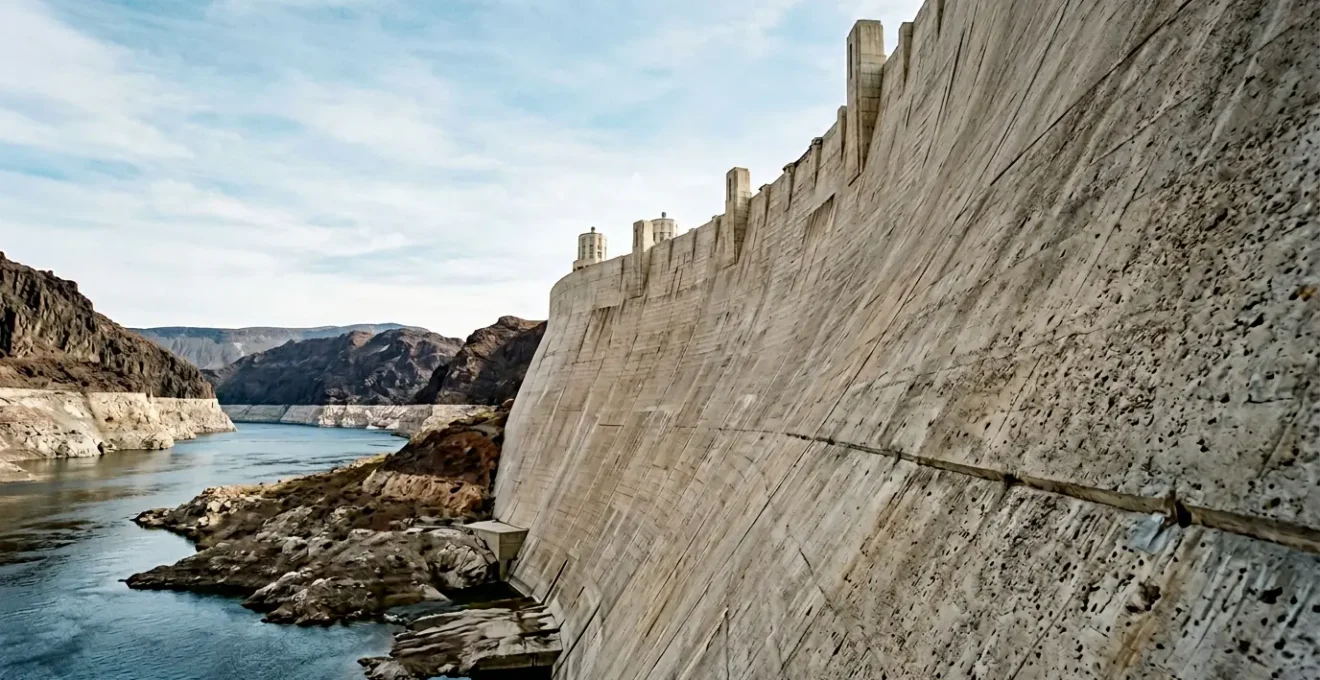
The true marvel of Hoover Dam isn’t its size, but the elegant engineering solutions that manage immense physical forces.
- The dam’s arch-gravity design and Art Deco flourishes represent a deliberate fusion of brute strength and national optimism during the Great Depression.
- Power generation is directly tied to the physics of « head pressure, » making Lake Mead’s water level a visible gauge of the dam’s electrical potential.
Recommendation: Visit not just to see a monument, but to deconstruct a masterpiece of civil engineering, from its internal tunnels to its power-generating heart.
The Hoover Dam is not merely a wall of concrete; it is a monument to ambition, a masterclass in structural engineering, and a testament to humanity’s ability to command the natural world. For the casual tourist, its scale is breathtaking. But for the engineering enthusiast, the true story is written in the language of stress loads, fluid dynamics, and material science. Most guides will tell you it’s big and that it makes electricity. They will point you toward the visitor center and mention the Art Deco styling as a quaint historical footnote. This approach misses the entire point.
The genius of the Hoover Dam lies not in its static mass but in its dynamic equilibrium. It is a precisely calculated instrument designed to balance the crushing force of what was once the world’s largest man-made lake against the geology of Black Canyon. Understanding this structure requires moving beyond the surface-level facts. It requires thinking like an engineer: appreciating the function behind the form, the physics behind the power, and the philosophy behind the aesthetics. This guide is designed to take you inside that mindset. We will deconstruct the visitor experience into its core components to reveal the engineering principles that make this concrete giant one of the modern wonders of the world.
This article provides a structured approach to understanding the dam’s engineering soul. Each section tackles a specific aspect, from the internal workings to the external vistas, allowing you to appreciate the structure on a deeper, more technical level.
Summary: Hoover Dam: A Civil Engineer’s Guide to Its Concrete Heart
- Dam Tour vs. Power Plant Tour: Which Goes Deeper?
- How to Walk the Mike O’Callaghan–Pat Tillman Memorial Bridge for the Best View?
- Art Deco vs. Industrial Utility: Which Style Defines the Dam?
- The Mistake of Bringing Large Bags to the Security Checkpoint
- When to Cross the Dam to Avoid the Checkpoint Backup?
- Why the 1.5 Million Gallon Pool in « O » Doesn’t Leak?
- Why the West Rim is Not the National Park South Rim?
- Lake Mead Power Plant: How Does the Water Level Affect Electricity?
Dam Tour vs. Power Plant Tour: Which Goes Deeper?
The first decision any technically-minded visitor must make at Hoover Dam is choosing the right tour. This choice dictates the depth of your access and understanding. While nearly 1 million people per year take a tour, not all tours are created equal. The standard « Power Plant Tour » offers a solid introduction, but it is the comprehensive « Dam Tour » that provides a genuine glimpse into the structure’s core.
The 30-minute Power Plant Tour is an accessible, surface-level experience. It takes you through original construction tunnels to the Nevada Powerhouse viewing platform, where you can stand alongside the massive generators. The sheer scale and hum of the seventeen main turbines is impressive. However, this tour focuses primarily on the *output* of the dam: the generation of electricity. It answers the « what, » but not the « how. »
For a deeper understanding, the 60-minute Dam Tour is essential. It includes all elements of the Power Plant Tour but adds exclusive access to the dam’s inner workings. You ride an original elevator to the top and, most importantly, walk through the historic inspection tunnels. These passages, originally built for cooling the curing concrete and for ongoing maintenance, offer a tangible connection to the dam’s construction. Looking out through a ventilation shaft at the Colorado River far below, you are inside the structure itself, feeling its mass and appreciating its design not as a visitor, but from the perspective of an engineer. This is where you truly connect with the monument.
How to Walk the Mike O’Callaghan–Pat Tillman Memorial Bridge for the Best View?
While the internal tours reveal the dam’s heart, the most profound sense of its scale is achieved from the outside. The Mike O’Callaghan–Pat Tillman Memorial Bridge, an engineering marvel in its own right, offers the definitive panoramic view. Spanning Black Canyon 900 feet above the Colorado River, its pedestrian walkway is a platform for appreciating the dam’s elegant curve as it braces against the canyon walls. But capturing the perfect perspective requires more than just a walk to the middle.
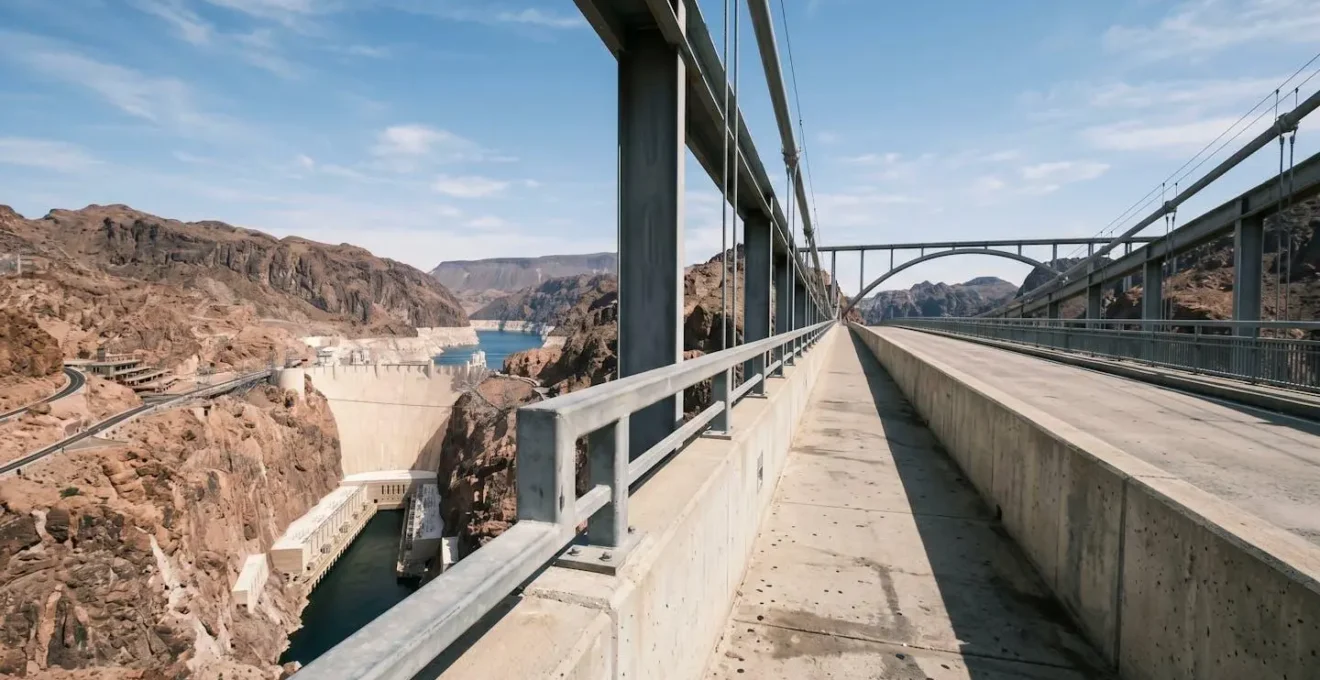
As the image above illustrates, the bridge provides a commanding, almost aerial, viewpoint. To leverage this, adopt a photographer’s strategy. For optimal lighting, start your walk from the Nevada-side overlook in the early morning. The low-angle sun casts a soft golden light on the concrete and canyon, defining its texture. A mid-range zoom lens (24-70mm) is ideal for framing the dam within its geological context. As you walk toward the bridge’s center apex, you’ll find the most dramatic, perpendicular view, a perspective that highlights the perfect symmetry of the arch-gravity design. This is also where you can appreciate the unique acoustic environment, suspended between the vast canyon walls.
Conversely, the late afternoon « golden hour » offers warmer tones and creates deep, dramatic shadows, especially when viewed from the Arizona side’s rim trail. The desert light is fleeting; be prepared to wait for the right moment as clouds and light patterns shift, transforming the scene in minutes. The bridge isn’t just a viewpoint; it’s an instrument for observing the dam’s relationship with its environment.
Art Deco vs. Industrial Utility: Which Style Defines the Dam?
The Hoover Dam is a structure of fascinating contradictions, none more apparent than its design philosophy. It is both a brutal piece of industrial utility and a soaring monument of Art Deco elegance. This duality was intentional. The Bureau of Reclamation engineers prioritized function, but consulting architect Gordon Kaufmann was tasked with giving the colossal project a human-facing, aesthetic dimension. The result is a tension between raw power and refined art.
The most visible expressions of this philosophy are found on the Nevada-side plaza. Here, the terrazzo floor is inlaid with seals of the seven Colorado Basin states, and the « Winged Figures of the Republic » statues, designed by Oskar J. W. Hansen, stand as 30-foot bronze sentinels. This is not mere decoration. As one architectural commentary notes:
The Art Deco elements weren’t just decorative; they were a deliberate message of optimism and human mastery over nature during the Great Depression.
– Cultural heritage analysis, Rachel’s Ruminations
This public-facing elegance stands in stark contrast to the brutal, utility-first design of the generator halls. Down below, form follows function absolutely. The space is dominated by the seventeen massive generators, with exposed pipes and industrial fixtures. There is no ornamentation, only the raw machinery of power generation. This contrast is the dam’s true architectural statement: an exterior that speaks of hope and monumental achievement, and an interior that delivers the raw, unadorned power to make it possible.
The Mistake of Bringing Large Bags to the Security Checkpoint
The visitor experience at Hoover Dam is framed by a security apparatus that can seem intense to the unprepared. The strict prohibitions on large bags, backpacks, and certain electronics are not arbitrary rules designed to inconvenience tourists. They are a direct consequence of the dam’s strategic importance. Following the September 11, 2001 terrorist attacks, the structure was officially designated as National Critical Infrastructure by the Department of Homeland Security.
This designation fundamentally changed how the site is managed. It is viewed not just as a historic landmark or a power plant, but as a potential target whose failure would have catastrophic consequences for the water supply and electrical grid of the American Southwest. Therefore, the security checkpoint is not TSA-style theater; it is a federal law enforcement operation run by the Hoover Dam Police. Every vehicle and visitor is subject to inspection, and the restrictions are enforced without exception.
The most common mistake is arriving with a large backpack or bag that is not permitted on the tours. There are no lockers or storage facilities available past the security checkpoint. This means a trip back to your car, wasting valuable time and potentially missing your tour slot. To ensure a smooth visit, travel light: a small camera bag, a water bottle, and essential personal items are all that is needed or allowed. Understanding that the dam is an active, high-security federal facility is the key to a frustration-free visit.
When to Cross the Dam to Avoid the Checkpoint Backup?
Managing the logistics of a Hoover Dam visit is an engineering problem in itself, primarily focused on avoiding bottlenecks. With a staggering 1.2 million vehicles annually and up to 150 tour buses per day, the single-lane security checkpoint on Nevada State Route 172 can become a significant point of congestion. Strategic timing is everything.
The primary wave of traffic comes from Las Vegas tour buses, which typically arrive between 10:00 AM and noon. Arriving before 9:00 AM allows you to pass through the checkpoint before this rush. This early arrival also coincides with the least crowded tour times, enhancing the experience inside the dam itself. The other optimal window is in the late afternoon, after 3:00 PM, when most tour buses have departed. This timing allows for a more relaxed visit and offers the added benefit of being on-site for the sunset, which provides spectacular photographic opportunities.
Beyond traffic, timing your crossing of the dam itself offers a unique novelty. The structure famously straddles the Pacific and Mountain time zones. Crossing from the Nevada side (Pacific Time) to the Arizona side (Mountain Time) at the top of the hour, you effectively « lose » an hour. The reverse is true when walking back. It’s a small but fascinating quirk that underscores the dam’s role as a physical and symbolic line between states. Planning your crossing around this can add another layer to your visit.
Your Strategic Plan for an Efficient Dam Crossing
- Intel Gathering: Acknowledge the main traffic sources: Las Vegas tour buses (arriving 10 AM-12 PM) and general public vehicles.
- Resource Inventory: Identify your key time windows for minimal congestion: pre-9:00 AM for the morning, and post-3:00 PM for the afternoon.
- Strategic Alignment: Match your arrival time to your primary objective. For less-crowded internal tours, choose the early morning slot. For photography, the late afternoon light is superior.
- Unique Opportunity: Locate the time zone demarcation line on the dam. Plan to cross it at the top of the hour to experience the « time travel » effect.
- Execution Plan: Arrive with minimal baggage to clear security swiftly. Proceed directly to the Visitor Center if taking a tour, or to the bridge/dam crest if exploring independently.
Why the 1.5 Million Gallon Pool in « O » Doesn’t Leak?
In Las Vegas, not far from the dam, the Cirque du Soleil show « O » features a 1.5-million-gallon pool that appears and disappears in seconds, a marvel of modern stage engineering. A common question is how such a massive, dynamic body of water is perfectly contained. The answer lies in advanced materials, precision engineering, and an impeccable understanding of waterproofing—the very same principles that, scaled up exponentially, allow the Hoover Dam to hold back the 9.3 trillion gallons of Lake Mead.
The secret to the dam’s impermeability is the concrete itself. It wasn’t just poured; it was meticulously engineered. The heat generated by curing concrete on this scale was a monumental challenge. If poured in a single, continuous block, it would have taken over 125 years to cool, and the resulting stresses would have cracked it into pieces. To solve this, engineers poured the dam as a series of interlocking trapezoidal columns. Within these blocks, they embedded over 582 miles of 1-inch steel pipes, circulating river water to dissipate the heat. This technique, a form of post-cooling, was revolutionary.
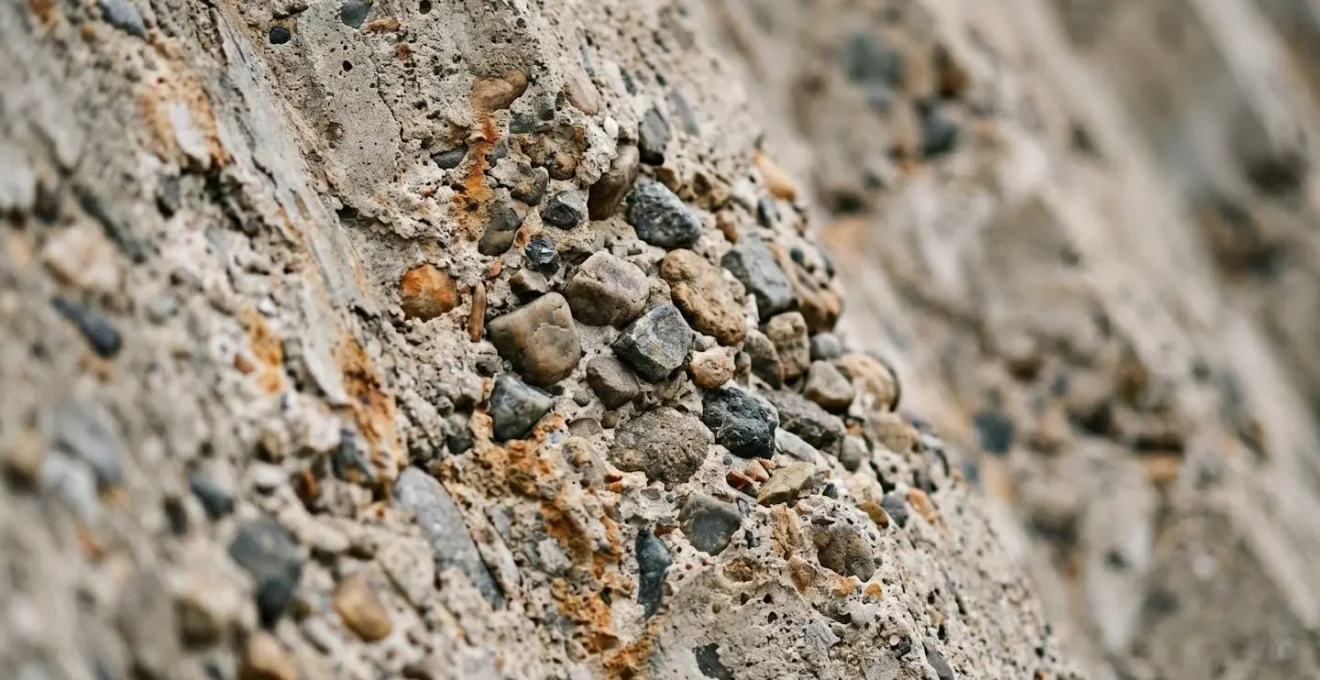
Once a section cooled, the gaps between the columns were filled with grout to form a monolithic structure. The concrete mix was designed for maximum density and low heat generation. Looking at the weathered surface today, you see a material designed not just for compressive strength but for longevity and water resistance. So, while the « O » pool relies on modern liners and sealants, Hoover Dam achieved its seal through sheer mass, clever thermal management, and fundamental material science. It is the original, and still greatest, example of building a waterproof megastructure.
Why the West Rim is Not the National Park South Rim?
A common point of confusion for visitors to the region is the distinction between the Grand Canyon’s West Rim and its more famous South Rim. They are not interchangeable. The South Rim is part of the National Park, managed by the federal government for conservation and natural vistas. The West Rim, home to the Skywalk, is on Hualapai Nation sovereign land and is managed as a tribal enterprise focused on a different kind of visitor experience. This difference in governance and philosophy provides a perfect analogue for understanding the Hoover Dam.
The dam, like the West Rim, offers a highly structured, controlled, and « engineered » visitor experience. It is owned and operated by the Bureau of Reclamation, a federal agency whose primary mission is water management and power generation, not tourism. As a result, your visit is dictated by the operational and security needs of the facility. Access is controlled through mandatory checkpoints, movement is restricted to designated tour paths, and the entire experience is curated to ensure safety and security.
This contrasts with a more open, exploratory experience you might find at a National Park like the Grand Canyon’s South Rim. The comparison also contextualizes the sheer scale of the American West. The vast distance between the two rims illustrates the region’s emptiness, a void that the Hoover Dam was built to tame and make productive. In this context, the dam itself acts as a man-made canyon wall, a structure whose 726-foot height is as difficult to truly comprehend as the depth of the Grand Canyon until you are standing on the Memorial Bridge, looking down.
Key Takeaways
- The Dam Tour is superior for engineering enthusiasts as it provides access to the internal inspection tunnels, offering a true sense of the structure’s mass.
- The Mike O’Callaghan–Pat Tillman Memorial Bridge provides the most comprehensive view, and strategic timing (early morning or late afternoon) is crucial for optimal lighting.
- Hoover Dam’s design is a deliberate ideological statement, contrasting the optimistic public-facing Art Deco elements with the raw, functional utility of its power-generating core.
Lake Mead Power Plant: How Does the Water Level Affect Electricity?
The ultimate purpose of the Hoover Dam is to convert the potential energy of stored water into electrical energy. While its powerhouse has a peak capacity of 2,080 megawatts, this output is not constant. It is directly and dramatically affected by the water level of Lake Mead. This relationship is governed by a fundamental principle of physics: head pressure. Head pressure is the force exerted by a column of water due to its height. The taller the column, the greater the pressure at the bottom.
The iconic white « bathtub ring » visible on the canyon walls of Lake Mead is more than a sign of drought; it’s a real-time visual gauge of the dam’s power potential. When the lake is full, the water level is high, creating maximum head pressure. This immense force pushes water through the four intake towers and down massive penstocks, where it reaches speeds of nearly 85 mph before striking the turbines. Higher pressure spins the turbines faster, generating more electricity. The system is designed for a maximum hydraulic head of 590 feet.
As the water level of Lake Mead drops, the height of the water column decreases. This reduces the head pressure, meaning water strikes the turbines with less force. The result is a direct and measurable decrease in generating capacity. Every foot of water level lost translates to a reduction in megawatt output, impacting the power supply for an estimated 1.3 million residents across Nevada, Arizona, and California. The dam isn’t just a wall; it’s the critical component of a massive, gravity-fed battery whose charge level is written on the canyon walls for all to see.
By deconstructing the dam into its constituent parts—its structure, its art, its security, and its function—one can move beyond simple tourism and engage in a true engineering appraisal. Plan your visit not as a checklist of sights, but as a practical investigation into one of the 20th century’s greatest achievements.