
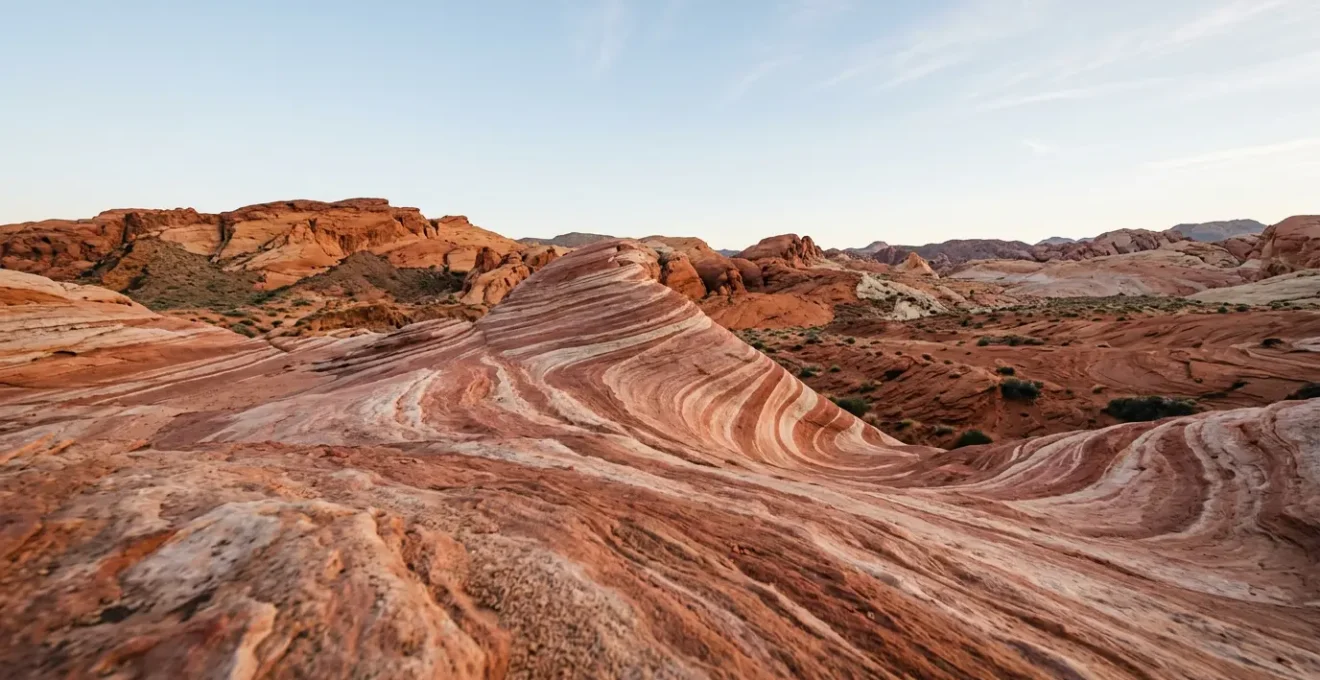
Capturing the Valley of Fire’s true essence is less about camera settings and more about understanding the geological story written in its Aztec Sandstone.
- The iconic swirls of the Fire Wave are a direct result of Jurassic-era wind patterns preserved as sandstone cross-bedding.
- The park’s vibrant palette stems from mineralogy: iron oxides create the deep reds, while manganese staining produces purples and blacks.
Recommendation: Approach your photography not as a tourist documenting locations, but as a field scientist observing how light interacts with ancient geology to predict the most compelling images.
For nature photographers, the Valley of Fire presents a tantalizing challenge. The landscape burns with a palette of reds, oranges, and pinks so intense they seem otherworldly. The common advice is predictable: arrive at golden hour, use a wide-angle lens, and visit the popular spots. While this may yield a pleasing snapshot, it misses the profound narrative embedded within the rock itself. To truly capture the spirit of this place, one must think less like a photographer and more like a geologist. The park’s spectacle is not a random splash of color but a 150-million-year-old story of shifting dunes, mineral-rich water, and relentless erosion.
The key lies in understanding the Aztec Sandstone, the Jurassic-era formation that constitutes the park’s main attraction. Its breathtaking swirls and layers are not mere patterns; they are fossilized evidence of ancient wind-blown sand dunes. The vibrant coloration is a lesson in geochemistry—the result of iron and manganese oxides staining the rock over millennia. By learning to read this geological language, a photographer can move beyond simply documenting a scene. You can begin to anticipate how the low-angle light of dawn will rake across ancient cross-bedding, or how the midday sun, while harsh, reveals the subtle mineralogical palette on a shaded rock face.
This guide departs from conventional photography advice. We will not just list locations; we will deconstruct them. We will explore the scientific phenomena behind the park’s beauty, from the deceptive physics of desert heat to the subtle clues that reveal ancient petroglyphs. By the end, you will be equipped to see the Valley of Fire on a deeper level, enabling you to create images that are not only visually stunning but also rich with the immense story of geological time.
This exploration will provide a framework for seeing and capturing the park’s essence. Below, we delve into the specific geological and environmental factors that define the photographic opportunities at Valley of Fire, from its most iconic formations to the critical safety knowledge required to explore them.
Summary: A Geologist’s Photographic Guide to the Valley of Fire
- Why the « Fire Wave » Trail Rivals The Wave in Arizona?
- How to Spot Ancient Rock Art at Atlatl Rock?
- Elephant Rock vs. Seven Sisters: Which is Better for Sunset Photos?
- The Risk of Radiated Heat from the Red Rocks
- When to Visit to See the Desert Wildflowers Bloom?
- Why You Will Get Turned Away Without a Timed Entry Reservation?
- Why You Don’t Feel Yourself Sweating Until It’s Too Late?
- Red Rock Canyon: How to Hike the Desert Safely in the Morning?
Why the « Fire Wave » Trail Rivals The Wave in Arizona?
The immediate comparison for many photographers hearing of the Fire Wave is Arizona’s iconic, permit-only « The Wave. » While both formations are masterpieces of wind and water erosion on sandstone, their accessibility and character offer different photographic propositions. The Wave in Arizona is famously exclusive. In contrast, the Fire Wave offers a geologically similar experience with far greater accessibility; official park rules confirm that no permit is required for Fire Wave access, unlike The Wave’s highly restrictive daily lottery system. This logistical freedom allows for spontaneity and repeated visits to capture the perfect light.
From a geological perspective, the Fire Wave is a textbook example of eolian (wind-driven) cross-bedding in the Aztec Sandstone. The undulating stripes of red and white are not surface paintings but exposed cross-sections of ancient sand dunes. As Jurassic winds shifted, they deposited sand at different angles, creating the sweeping, intersecting curves. The photographer’s job is to capture this frozen motion. To do this effectively, one must consider the light’s direction relative to these layers.

As the image above illustrates, low sidelight during golden hour is exceptionally effective. It creates micro-shadows that define the texture of each sand grain and accentuates the elegant flow of the striations. Unlike a flat, front-lit scene, raking light gives the rock a three-dimensional, tactile quality. For photographers, this means the Fire Wave isn’t just one shot; it’s an entire studio of compositions that change dramatically with every hour of the day, offering a level of creative access its Arizona counterpart cannot match.
How to Spot Ancient Rock Art at Atlatl Rock?
While the Valley of Fire’s geological formations speak to deep time, its petroglyphs offer a more intimate connection to the past. Atlatl Rock is one of the park’s most significant cultural sites, serving as an open-air gallery of ancient rock art. For a photographer, capturing these petroglyphs is not just an aesthetic exercise but an act of documenting human history. These are not random etchings; they are a window into the lives of the region’s early inhabitants. Archaeological studies suggest that some of the petroglyphs are over 4,000 years old, depicting bighorn sheep, human figures, and abstract symbols.
Photographing them requires a different approach than capturing grand landscapes. The key is to use light to reveal, not overwhelm. The petroglyphs were created by pecking away the dark « desert varnish » (a manganese-rich coating) to expose the lighter sandstone beneath. Direct, frontal light can flatten these images, making them difficult to discern. The best technique is to use low-angle sidelight, which casts subtle shadows within the pecked-out areas, giving them definition and depth. An early morning or late afternoon visit is therefore ideal. A polarizing filter can also be invaluable, as it helps reduce glare on the rock face and enhances the contrast between the dark varnish and the lighter etchings.
Most importantly, photographing this site comes with a profound responsibility of preservation. The metal staircase at Atlatl Rock was installed to provide excellent viewing access without endangering the panels. As Nevada State Parks emphasizes in its conservation guidelines found on park-related sites:
In order to protect these cultural treasures, we ask that you do not walk on, touch, or deface the rock. Help us protect our petroglyphs for others to enjoy for generations to come.
– Nevada State Parks, Valley of Fire State Park conservation guidelines
Your role as a photographer is that of a respectful observer. Use a telephoto lens to get close-ups without leaving the designated path, and never touch the rock art. The oils from human skin can cause irreparable damage to the delicate desert varnish and the ancient stories it holds.
Elephant Rock vs. Seven Sisters: Which is Better for Sunset Photos?
Choosing a location for sunset photography in the Valley of Fire often comes down to a choice between two iconic sites: Elephant Rock and the Seven Sisters. The decision is not about which is « better, » but which suits your photographic intention. Are you seeking a dramatic, character-focused subject, or a grand, layered landscape? Elephant Rock, a natural arch resembling its namesake, is an exceptional subject for a character study. The Seven Sisters, a series of eroded sandstone fins, provide a canvas for capturing a wide, atmospheric vista. Understanding their distinct photographic personalities is key to making the right choice.
Elephant Rock, accessible via a short 0.3-mile loop trail, is a singular, iconic formation. At sunset, the goal is often to capture the last rays of light illuminating the « trunk » or glowing through the arch. It is a very popular spot, so arriving early is essential to secure a good composition. The Seven Sisters, conversely, are easily accessible from the roadside and offer a different kind of drama. Here, the power lies in layering and silhouette. As the sun sets behind them, the formations become dark, graphic shapes against a sky that can explode with color. It’s a classic landscape shot that emphasizes scale and atmosphere.
To help guide this decision, this comparative table breaks down the key photographic considerations for each location.
| Location | Walking Distance | Photographic Character | Crowd Level at Sunset | Best Light Direction |
|---|---|---|---|---|
| Elephant Rock | 0.3 miles from parking | Iconic arch formation, character study subject | 2nd most popular in park | Side glow from final rays, soft morning light ideal |
| Seven Sisters | Roadside access | Grand dramatic landscape, layered silhouettes | Moderate | Backlit for silhouettes, colorful sky backdrop |
Ultimately, your choice depends on the story you want to tell. Elephant Rock is for the intimate portrait of a geological wonder. The Seven Sisters are for the sweeping epic of the desert at dusk. To execute either shot effectively, a systematic approach to golden hour is necessary.
Your Action Plan: Golden Hour Photography Strategy
- Scout Early: Arrive at least 45 minutes before sunset to explore compositions and find your spot before the crowds gather.
- Embrace the Shadows: Shoot during the golden hours (sunrise and sunset) when long, dramatic shadows carve out the textures and intensify the red hues of the Aztec Sandstone.
- Select Your Lens: Use a wide-angle lens (e.g., 14-24mm) to capture the sweeping landscapes at Seven Sisters, or a telephoto lens (e.g., 70-200mm) to compress and isolate details on Elephant Rock.
- Stabilize and Polarize: Always use a sturdy tripod for sharp, low-light shots with a low ISO. A polarizing filter is essential to cut glare from the rock surfaces and deepen the sky’s color.
- Consider Alternatives: Scout the Seven Sisters area for its astrophotography potential after dusk, and remember that Elephant Rock is also exceptional in the soft, gentle light of early morning.
The Risk of Radiated Heat from the Red Rocks
While the Valley of Fire’s geology provides immense beauty, it also creates a significant and often underestimated danger: radiated heat. Photographers, focused on their craft, can be particularly vulnerable. The danger in the desert isn’t just the ambient air temperature; it’s the heat absorbed and re-emitted by the rock itself. The dark, iron-rich Aztec Sandstone acts like a massive thermal battery, soaking up solar radiation all day and releasing it long after the sun has set. This means that even in the evening, the ground and rock faces can be significantly hotter than the air, creating a dangerous microenvironment.
This phenomenon is so severe that Nevada State Parks implements safety closures, noting that many trails are closed from May 15 to September 30 due to a high frequency of medical emergencies and fatalities. For a photographer, this radiated heat poses a dual threat. Firstly, to your health, as kneeling or sitting on hot rock can accelerate dehydration and heatstroke. Secondly, to your images. As photography experts note, heat radiating from the ground creates visible distortion.

This « heat shimmer » or mirage is caused by light refracting through air of different temperatures and densities. It can ruin the sharpness of a long-lens shot, rendering distant subjects blurry and indistinct. As one technical guide explains, « As you look further away, you begin to see more heat distortion because you’re looking through more atmosphere. » The only effective countermeasure is to avoid shooting during the hottest parts of the day. As illustrated above, the solution is to work during the cool hours of the early morning. Starting before dawn not only provides superior light but also a safer and more productive working environment, free from the physical and photographic distortions of extreme heat.
When to Visit to See the Desert Wildflowers Bloom?
While the Valley of Fire is renowned for its permanent geological wonders, it hosts an ephemeral spectacle that offers a completely different photographic subject: the spring wildflower bloom. For a brief window, the stark red rock landscape is softened by delicate splashes of color, creating a powerful visual contrast between the enduring stone and the fleeting life it supports. Capturing this event is a matter of precise timing and a shift in photographic technique from grand landscapes to intimate macro details.
The bloom is entirely dependent on winter precipitation. After a wet winter, the desert floor can come alive with color. According to seasonal visitor reports, March and April are the prime months to see wildflowers, transforming the landscape into « one of the better versions » of itself. The key for a photographer is to be flexible and monitor conditions. The park’s visitor center is the best resource for real-time bloom reports. When the bloom is on, the goal is to find compelling compositions that juxtapose the delicate flowers with the immense scale of the sandstone backdrop.
This requires a macro-focused approach. Common species to look for include the bright yellow Desert Marigold, the deep purple Indigo Bush, and the cheerful Brittlebush. To photograph them effectively, you need to control your depth of field and light. Here are some key techniques for wildflower macro photography in the desert:
- Isolate Your Subject: Use a wide aperture (f/2.8 to f/4) to create a shallow depth of field. This will blur the distant red rock formations, making the flower stand out as the primary subject against a soft, colorful background.
- Control the Light: Desert sun can be harsh. Shoot in the soft light of early morning or use a small diffuser to soften direct sunlight. A small reflector or even a piece of white card can be used to bounce gentle light back into the shadowed parts of a flower.
- Emphasize Scale: Get low to the ground. By shooting from the flower’s level, you can create a powerful composition that compresses the foreground flower against the vast sandstone landscape in the background, highlighting the contrast in scale.
Photographing wildflowers in the Valley of Fire is a rewarding scavenger hunt. It forces you to slow down, observe closely, and appreciate the resilience of life in one of the world’s most challenging environments.
Why You Will Get Turned Away Without a Timed Entry Reservation?
This question is a common point of confusion for visitors, often stemming from experiences at other popular parks like the nearby Red Rock Canyon, which *does* utilize a timed entry system. It is critical to clarify the current policy: as of today, the Valley of Fire does not require timed entry reservations for day use. The official park website clearly states, « Reservations are not required for day use of the park. » However, the premise of the question touches upon a crucial issue facing the park: explosive growth and the potential need for future crowd management.
The park’s popularity has skyrocketed. Data from Nevada State Parks shows that Valley of Fire now welcomes more than 750,000 visitors per year, a staggering increase from the mere 9,000 guests it saw in its inaugural year in 1934. This immense pressure on a delicate desert ecosystem is the primary reason parks implement reservation systems. They are not designed to be punitive but are a necessary tool for conservation, ensuring that trails are not eroded by overuse, wildlife is not disturbed, and the visitor experience is not degraded by overwhelming crowds.
So, while you will not be turned away today for lacking a reservation, the park does occasionally reach capacity on extremely busy holidays or weekends, leading to temporary entry holds until the parking lots clear. This situation underscores the very real pressures of over-tourism. For a photographer, this means planning is still paramount. To avoid potential entry delays and, more importantly, to experience the park in relative solitude, the best strategy is to visit on a weekday and arrive early in the morning, well before the peak crowds descend around mid-day. Understanding the « why » behind reservation systems, even where they don’t yet exist, makes you a more conscientious and strategic visitor.
Why You Don’t Feel Yourself Sweating Until It’s Too Late?
One of the most insidious dangers of a desert environment like the Valley of Fire is the phenomenon of « stealth dehydration. » Many people, accustomed to more humid climates, use the feeling of sweat as a cue to drink water. In the arid desert, this internal alarm system fails. The reason is simple physics: the air is so dry that your sweat evaporates almost instantly from your skin. This process, known as evaporative cooling, is highly efficient at regulating your body temperature, but it masks the sheer volume of fluid you are losing. You are sweating profusely, but you never feel wet, leading to a dangerous illusion of comfort.
The environment of the Valley of Fire is exceptionally arid, with an average annual rainfall of just four inches. This lack of atmospheric moisture creates a powerful « wicking » effect on your body. You can lose a liter of water or more per hour while hiking and not even realize it until the first symptoms of dehydration set in: a throbbing headache, dizziness, irritability, or muscle cramps. By the time you feel intense thirst, you are already significantly dehydrated. For a photographer carrying gear and focusing intently on composition, it is dangerously easy to ignore these early warning signs.
The only defense is a proactive hydration strategy. You must drink water mechanically, not in response to thirst. Adopting a strict protocol is not just a recommendation; it is a critical safety measure. Here is a baseline protocol for any photographic excursion into the park:
- Drink on a Schedule: Consume at least a half-liter (16 oz) of water every hour of outdoor activity, regardless of whether you feel thirsty.
- Monitor Your Output: A simple but effective check is to monitor your urine color. Pale yellow indicates good hydration; dark yellow is a clear warning sign of dehydration that requires immediate fluid intake.
- Replace Electrolytes: On any hike or photo session lasting over two hours, water alone is not enough. The sweat evaporating from your skin also removes essential salts (electrolytes). Supplement your water with electrolyte tablets or powders to prevent cramping and maintain cognitive function.
- Carry More Than You Need: The rule of thumb is to carry a minimum of one liter of water per person for every hour you plan to be out. In summer, this amount should be doubled.
Key Takeaways
- Geology is Your Guide: The best photos come from understanding how light interacts with the Aztec Sandstone’s unique formations and mineral content.
- Heat is a Dual Threat: Radiated heat from the rocks can damage your photos with distortion and poses a serious health risk. Morning shoots are paramount.
- Timing is Everything: Whether capturing the fleeting wildflower bloom in spring or choosing between sunset spots, your photographic success depends on seasonal and daily timing.
Red Rock Canyon: How to Hike the Desert Safely in the Morning?
While this guide focuses on the Valley of Fire, many visitors to the Las Vegas area also explore Red Rock Canyon National Conservation Area. A comparative understanding is useful, as both offer stunning red rock vistas but present different environmental challenges, particularly for morning hikes. The question of how to hike safely in the morning at Red Rock can be best answered by contrasting its terrain with that of the Valley of Fire. In short, Red Rock generally offers more options for shade and elevation, which can extend your safe hiking window.
The primary geological difference is one of elevation and relief. Valley of Fire sits at a lower elevation (around 2,000-2,600 feet) and its terrain is often more open and exposed. Red Rock Canyon features a much greater elevation range and is characterized by deep, shaded canyons and towering cliffs. This means that while both locations get dangerously hot, at Red Rock it is often possible to find shaded routes (like Ice Box Canyon) that remain cooler for longer in the morning. At Valley of Fire, most trails are fully exposed to the sun, which is why many are closed entirely during the summer months.
This table summarizes the key differences for a morning photographer and hiker:
| Factor | Valley of Fire | Red Rock Canyon |
|---|---|---|
| Elevation Range | 2,000-2,600 feet (lower, hotter) | Higher elevations with more relief |
| Terrain Exposure | Generally lower, hotter, more exposed | More shaded canyons available |
| Summer Trail Status | Many trails closed May 15-Sept 30 | More year-round access with precautions |
| Morning Advantage | Golden window for photos, wildlife, energy before 10 AM heat | Golden window plus more shade options extend safe hiking time |
Regardless of the location, the fundamental principles of desert morning safety remain the same. The « golden window » for both photography and physical activity is typically from dawn until about 10 AM. You must start early and have a non-negotiable turnaround time to avoid being caught out by the rapidly intensifying midday heat. A universal gear checklist is essential for any pre-dawn start in the desert.
- Headlamp: Essential for navigating the trail before sunrise. A model with a red-light mode is ideal for preserving your night vision.
- Layers: Desert mornings can be surprisingly cold, starting in the 50s (°F) even on days that will reach 110°F. A lightweight fleece or windbreaker is crucial for the first hour.
- Proper Footwear: The sandstone (« slickrock ») can be slippery, especially with loose sand on top. Shoes with sticky rubber soles provide the best grip.
- Hydration and Nutrition: Carry a minimum of 2 liters of water per person, even for a short morning hike, along with electrolyte supplements and a snack.
By approaching the desert with this blend of artistic vision and scientific respect, you transform a simple photo trip into a deep exploration of time, light, and life. The images you create will carry not just the beauty of the landscape, but the weight of its incredible story.