
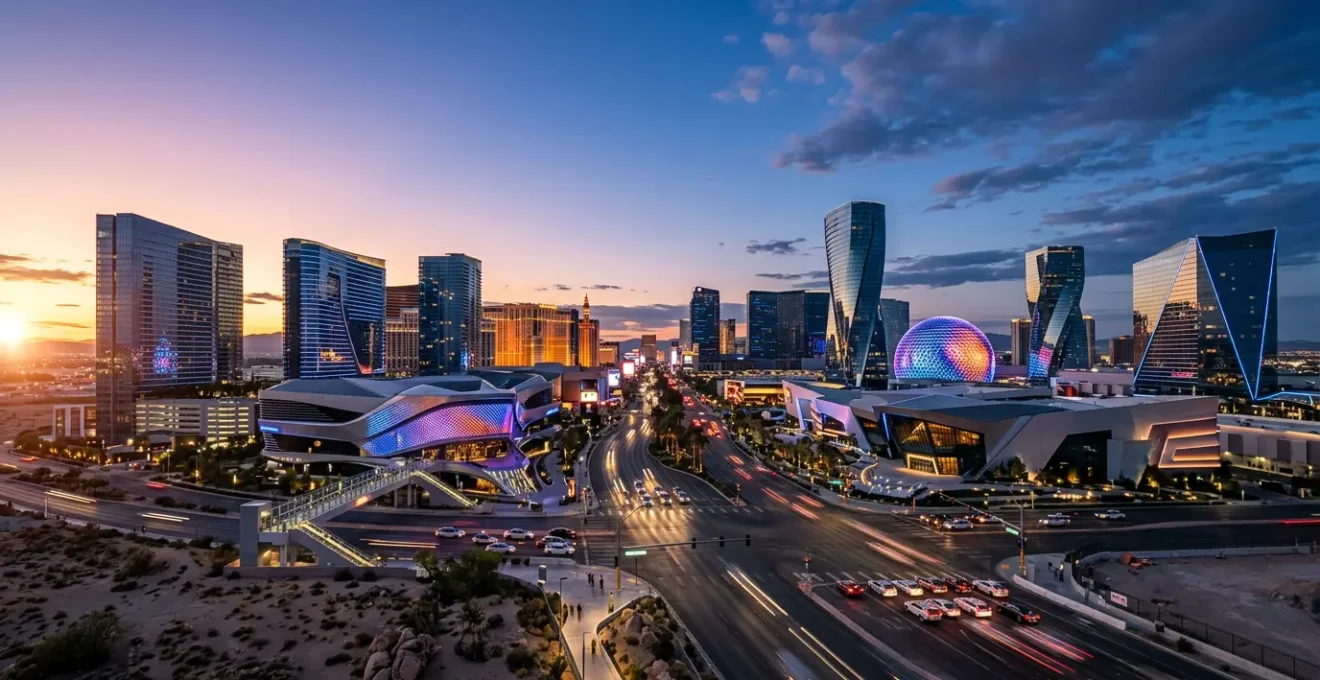
Las Vegas is no longer just a city of entertainment; it’s a living beta test for the technologies that will shape our future.
- Cutting-edge systems like the Vegas Loop are already revolutionizing urban transport, not just moving people.
- Interactive robotics and immersive VR offer more than novelty; they are prototypes for future human-machine interaction.
Recommendation: Approach Las Vegas not as a tourist, but as a tech explorer. Use this guide to understand the systems behind the spectacle and get a true glimpse of tomorrow.
Beyond the neon glow and the timeless allure of the casino floor, a new version of Las Vegas is taking shape. This isn’t the Vegas of the past; it’s a dynamic, thrilling preview of the future, a place where science fiction is rapidly becoming science fact. For the tech enthusiast, the city has transformed into a living laboratory, a massive beta test where you can interact with the very systems—from autonomous transport to robotic service and immersive virtual worlds—that will define the next decade. While most visitors see only the spectacle, a deeper experience awaits those who know where to look.
Many guides will point you toward the dazzling lights of the Sphere or the quirky art of Area15. But they often miss the most exciting part: the « why » and « how » behind these innovations. They’ll mention robot bartenders but won’t give you the protocol to order from one. They’ll talk about AI but won’t help you spot the difference between a true learning system and a simple pre-recorded loop. The real key to unlocking the sci-fi side of Vegas isn’t just seeing these attractions; it’s understanding them. This guide is your operating manual to do just that.
We’ll move beyond the surface-level lists to give you the framework for experiencing tomorrow’s technology today. From navigating the city’s emerging autonomous transit network to discerning authentic AI, you will learn to engage with these futuristic marvels not as a passive observer, but as an informed tech ethnographer. Welcome to the future of Las Vegas.
This article breaks down the essential futuristic experiences in Las Vegas, providing the context and practical advice needed to fully appreciate the innovation at play. Explore the sections below to plan your journey into tomorrow.
Summary: Your Guide to the Future of Las Vegas
- Why Elon Musk’s Tesla Tunnel is the Future of Convention Transport
- How to Order a Drink from the Bionic Bar Robots
- Tipsy Robot vs. VR Lounges: Which Tech Experience is More Fun?
- The Disappointment of « AI » Attractions That Are Just Pre-Recorded Loops
- What Will Facial Recognition Mean for Your Privacy in Vegas Casinos?
- What to Expect from VR Gambling Lounges in the Next 5 Years?
- Monorail vs. The Deuce Bus: Which is Faster for Strip Travel?
- Immersive Experiences: How to Participate in Area15 Without Confusion?
Why Elon Musk’s Tesla Tunnel is the Future of Convention Transport
The Las Vegas Convention Center (LVCC) Loop, often called the Tesla Tunnel, is more than just a novelty; it’s a profound glimpse into the future of urban mobility. Developed by The Boring Company, this system tackles one of the biggest challenges of massive venues: inefficient foot traffic. What was once a grueling 45-minute walk across the sprawling convention campus has been transformed into a seamless, near-silent 2-minute ride. This isn’t just an improvement; it’s a paradigm shift in how we think about moving people within a defined commercial space. The system operates 40 feet below ground in a pair of tunnels, using a fleet of human-driven Teslas to shuttle passengers between stations.
The genius of the LVCC Loop lies in its efficiency and minimal disruption. The entire initial phase was constructed in about a year for $47 million, all while conventions continued overhead without interruption. It has already proven its scalability and reliability; a 2024 report confirmed the Vegas Loop has successfully transported over 4 million passengers, demonstrating a peak capacity of over 4,500 people per hour. This is a powerful case study for point-to-point, on-demand transport that eliminates traffic and weather as variables.
For any tech enthusiast, riding the Loop is essential. It feels less like a traditional subway and more like being summoned into a private, futuristic transport pod. It’s a tangible experience of a first-generation autonomous transit network being born. While the cars are currently human-driven for regulatory reasons, the vision for a fully autonomous, high-speed network is crystal clear. This isn’t just a ride; it’s participation in a live beta test for the future of our cities.
How to Order a Drink from the Bionic Bar Robots
Stepping up to a Bionic Bar is like walking onto the set of a sci-fi film. Two massive robotic arms, typically used in high-precision manufacturing, are repurposed here to become master mixologists. The experience is less about the drink itself and more about witnessing the elegant, choreographed dance of automation. This isn’t just a gimmick; it’s a fascinating look at the future of service robotics, where precision, consistency, and spectacle merge. Watching the arms select bottles, deploy mixers, shake, stir, and pour is mesmerizing, offering a unique form of entertainment.
But how do you actually interact with it? The process is entirely digital, designed for efficiency. Here is the exact protocol for getting your futuristic cocktail:
- Access the Interface: Find one of the tablets located in the bar’s seating area. Some venues may also have a dedicated app you can download on your smartphone.
- Design Your Drink: You can choose a preset signature cocktail from the menu or unleash your creativity. The ‘Create Your Own’ option typically gives you access to an incredible array of ingredients, sometimes including 30 spirits and 21 mixers.
- Submit and Queue: Once you’ve finalized your creation, submit the order. Your name and drink will appear in a digital queue on large screens above the robotic arms, letting you track your order’s progress.
- Witness the Creation: This is the main event. Your order will be executed by the robotic arms with incredible precision. They muddle, shake, stir, and strain in a perfectly timed sequence that usually takes between 60 to 90 seconds.
- Claim Your Cocktail: When the screens indicate your drink is ready, you’ll scan your room key, SeaPass card, or another form of payment/ID at the counter. This action releases your drink, sliding it forward for you to pick up.
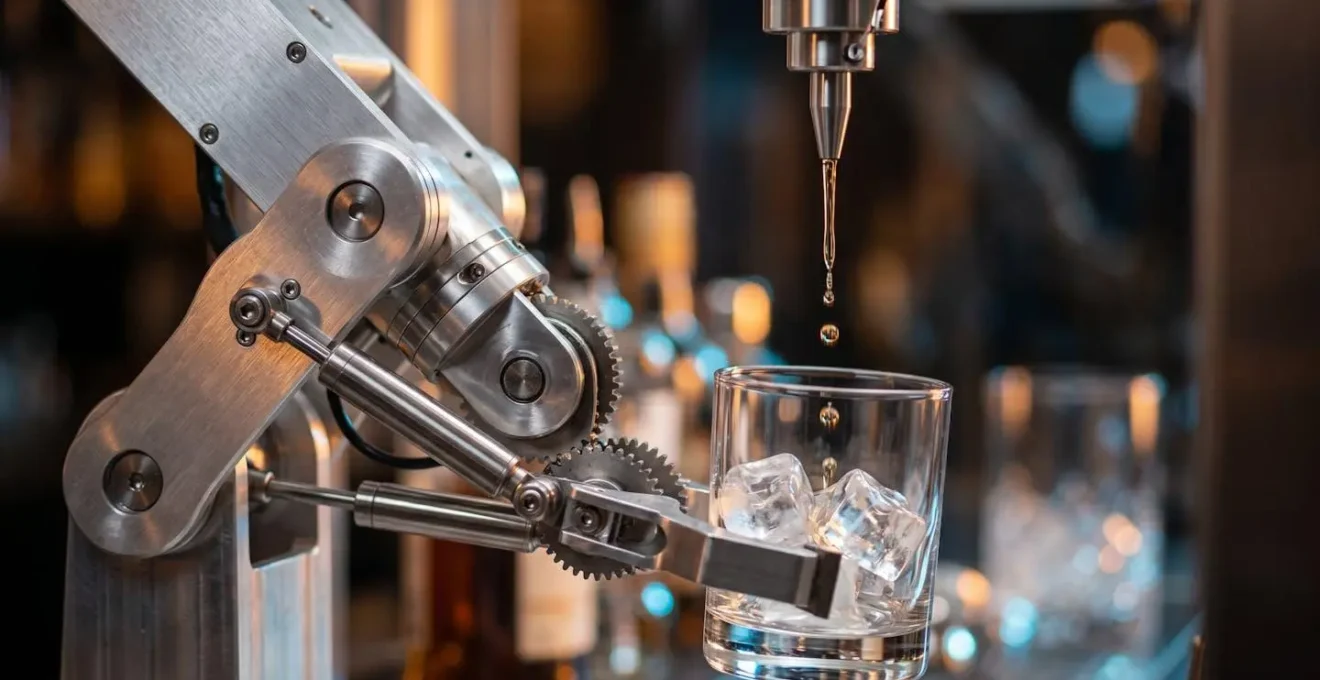
This automated process ensures that every drink is made with the exact same measurements every time, eliminating human error and delivering a perfectly consistent product. It’s a powerful demonstration of how automation can be applied to customer-facing roles, blending entertainment with utility.
Tipsy Robot vs. VR Lounges: Which Tech Experience is More Fun?
Las Vegas offers two distinct flavors of futuristic fun: the observable spectacle of robotics at places like Tipsy Robot, and the deep immersion of virtual reality at lounges found in venues like Area15. Both promise a sci-fi experience, but they cater to very different desires and offer fundamentally different forms of entertainment. Choosing between them depends entirely on what kind of tech enthusiast you are. Are you looking for a quick, shareable « wow » moment, or a longer, more personal adventure?
The robotic bar experience is social and passive. You are a spectator watching a highly advanced machine perform a task. It’s a fantastic conversation starter and a visually impressive display of choreographed automation. In contrast, VR lounges are active and personal. You are the protagonist in your own digital story, exploring vast worlds through a headset and haptic gear. It’s less about watching and more about *doing*.
To help you decide where to invest your time and money, consider this direct comparison of the two experiences.
| Experience Factor | Tipsy Robot | VR Lounges (Area15) |
|---|---|---|
| Duration | 5-10 minutes per drink | 50-60 minutes immersive session |
| Technology Type | Robotic arms with choreographed movements | Free-roaming VR with headsets |
| Social Level | High – spectator-friendly, open bar concept | Medium – individual experience with group potential |
| Cost Range | $15+ per cocktail | $54+ per VR session |
| Sci-Fi Vibe | Star Wars Cantina / Blade Runner aesthetic | Ready Player One / Matrix full immersion |
| Capacity | 120 drinks per hour | World’s largest free-roaming VR space |
| Best For | Casual tourists, quick novelty experience | Hardcore gamers, extended immersive adventure |
Ultimately, the choice comes down to your goal. If you want a quick, visually stunning novelty that’s great for social media, the Tipsy Robot is a perfect stop. If you want to lose yourself in another reality and experience the cutting edge of interactive digital immersion, a VR lounge is the far more profound and memorable adventure.
The Disappointment of « AI » Attractions That Are Just Pre-Recorded Loops
In the rush to appear futuristic, the term « AI » is often used as a marketing buzzword for attractions that are, in reality, quite simple. A true AI system learns, adapts, and generates unique responses. A pre-recorded loop, on the other hand, is just a sophisticated puppet show—impressive, but not intelligent. This is the crucial distinction a tech enthusiast must learn to make in Las Vegas. Many « robotic » or « interactive » experiences are built on simple sensor triggers and repetitive animations, not genuine artificial intelligence.
For example, a robotic bartender is an incredible feat of automation and programming. The marketing might boast about its capabilities, as noted in the Bionic Bar’s technical documentation by the Royal Caribbean Press Center:
These robots can muddle, stir, shake, and strain your drink to perfection. The cocktail combinations are endless with 30 different spirits and 20 different mixers.
– Royal Caribbean Press Center, Bionic Bar technology documentation
While the combinatorial possibilities are vast, the robot is executing a pre-programmed script for each combination. It doesn’t decide to add a creative flourish or comment on your choice of gin. This is automation, not cognition. To avoid the disappointment of mistaking one for the other, you need an authenticity test. Here’s a simple framework for evaluating any « AI » attraction:
- Test for Unique Response: Does the system react to your specific, nuanced actions in a unique way? A true AI might alter its behavior based on your tone of voice or unexpected movements, whereas a loop will always trigger the same sequence.
- Test for Variable Experience: If you did the exact same thing twice, would the outcome be identical? A genuine interactive system should produce non-repeatable moments. A pre-recorded loop will play out the same way every single time.
- Test for Generative Capability: Look for evidence of real-time creation. An AI character that generates novel dialogue is intelligent. An animatronic that recites from a limited set of pre-written lines is not. Systems that offer ‘AI-powered’ customized suggestions based on your data are a better sign of authenticity.
Applying this mental checklist allows you to appreciate automation for the incredible engineering it is, without being misled by the hype. It turns you from a consumer into a discerning critic of technology.
What Will Facial Recognition Mean for Your Privacy in Vegas Casinos?
The proliferation of cameras in Las Vegas is nothing new; « the eye in the sky » has been a part of casino culture for decades. However, the fusion of high-definition cameras with facial recognition technology represents a monumental leap in surveillance capability, raising critical questions about privacy. As a tech explorer, it’s essential to understand not just the technology itself, but the regulatory framework that governs its use. In Las Vegas, this technology is not the free-for-all that many fear.
The key thing to know is that Nevada has strict rules in place. The technology’s primary and legally sanctioned purpose is security—specifically, identifying known cheats and individuals on exclusion lists. As Sandra Douglass Morgan, the former Chairwoman of the Nevada Gaming Control Board, clarified, people understand they are under surveillance, but its application is narrowly focused. The regulations are clear: according to Nevada Gaming Control Board regulations, the technology is employed to detect and identify those who have committed gaming crimes, not to track the behavior of every guest for marketing purposes.
This creates a fascinating tension. On one hand, you have some of the most advanced surveillance hardware in the world. On the other, you have a legal framework that strictly limits its application to security, not commercial exploitation. This is a real-world test case for balancing security needs with privacy rights. While casinos aren’t currently using this tech to analyze your mood at the blackjack table and send you a customized drink offer, the potential is there. Understanding the current legal line is crucial to appreciating the ongoing debate about the future of public-space analytics.
What to Expect from VR Gambling Lounges in the Next 5 Years?
While today’s VR is about escaping to fantastical worlds, the next five years will see a massive push toward integrating it with the real world—and nowhere is this more anticipated than on the casino floor. The future isn’t just about putting on a headset to play virtual slots; it’s about creating a hybrid « phygital » experience that merges the tactile satisfaction of physical gaming with the infinite possibilities of digital enhancement. This evolution will be driven by advancements in both Virtual Reality (VR) and, perhaps more importantly, Augmented Reality (AR).
Imagine sitting at a real poker table, wearing a pair of sleek AR glasses. As physical cards are dealt, the glasses could overlay real-time statistics, pot odds, and even subtle analysis of your opponents’ betting patterns. This is the promise of AR: to enhance reality, not replace it. It transforms a traditional game into an information-rich, dynamic experience that feels straight out of a cyberpunk novel. These technologies will make gambling more engaging, strategic, and visually spectacular.
Further out, dedicated VR gambling lounges will move beyond solo experiences. They will become social hubs, or « meta-casinos, » where players’ avatars can interact, compete in global tournaments, and experience games that would be physically impossible to build. Think zero-gravity poker or a roulette wheel the size of a planet. Experiences like the upcoming Interstellar Arc spaceport in Las Vegas, which focuses on immersive, narrative-driven adventures, are paving the way by solving technical hurdles like motion sickness and perfecting natural locomotion systems. The future of VR gambling is social, immersive, and seamlessly blended with the physical casino world.
Monorail vs. The Deuce Bus: Which is Faster for Strip Travel?
Navigating the Las Vegas Strip is an experience in itself, a battle against traffic and distance. For the tech enthusiast looking to visit futuristic attractions, choosing the right mode of transport is a strategic decision. Your options represent a timeline of urban transit: the dystopian present (The Deuce Bus), yesterday’s vision of the future (The Monorail), and a beta test of tomorrow (The Vegas Loop). While the Loop is currently limited to the convention center area, its planned expansion promises a seismic shift in city-wide travel. For now, the primary choice for traversing the length of the Strip is between the Monorail and the Deuce.
The Monorail is an elevated train that glides behind the casinos on the east side of the Strip. It’s faster than ground traffic, completing its full run in about 15 minutes, but its stations can be a long walk from the Strip sidewalk. The Deuce is a double-decker bus that runs 24/7 right on Las Vegas Boulevard, offering curbside convenience but falling victim to the Strip’s notorious gridlock. A trip that takes 15 minutes on the Monorail can easily stretch to 45 minutes or more on the bus.
The real game-changer is the expansion of the Vegas Loop. The ultimate vision is an incredible 68-mile network with 104 stations designed to move 90,000 passengers per hour. When this system is complete, it will render all other options obsolete for speed and efficiency. Until then, this table provides a clear breakdown for your current travel planning.
| Method | Speed/Time | Cost | Sci-Fi Experience | Best For |
|---|---|---|---|---|
| Vegas Loop | 2-5 minutes between stations at 35 mph | $5 day pass from Resorts World | Beta-test future: Personal pod transit | LVCC events, convention center access |
| Monorail | 15 minutes full Strip run | $5 single ride, $15 day pass | Yesterday’s future: Jetsons-style elevated rail | Reaching Area15 via Sahara station |
| The Deuce Bus | 30-45 minutes full Strip (traffic dependent) | $6 two-hour pass, $8 day pass | Dystopian present: Ground-level urban reality | Budget travel, curbside convenience |
For a tech explorer, the choice is clear. The Monorail offers the best combination of speed and sci-fi aesthetic for reaching key destinations like the Sahara station, which is the closest stop to Area15. It represents a more elegant, if dated, vision of the future compared to the gritty reality of the bus.
Key Takeaways
- Las Vegas is a ‘living beta test’ where you can experience tomorrow’s transport, robotics, and VR today.
- True technological insight comes from understanding the systems behind the spectacle, not just observing them.
- Distinguishing genuine AI from simple automation is a key skill for any modern tech enthusiast.
Immersive Experiences: How to Participate in Area15 Without Confusion
Area15 is not an attraction; it’s a platform. This distinction is the single most important thing to understand before you go. Thinking of it as a single theme park will lead to confusion and frustration. Instead, see it as a sprawling, chaotic, and brilliant shopping mall of experiences. General entry is often free, but every major installation, VR adventure, or art exhibit inside—from Meow Wolf’s Omega Mart to immersive VR—requires a separate, individually priced ticket. Without a strategy, it’s easy to feel overwhelmed and miss the best parts.
The key to a successful visit is to approach it like a tech explorer mapping a new world, not a tourist wandering aimlessly. This means defining your mission beforehand. Are you there for the mind-bending narrative art of Omega Mart? The adrenaline rush of a free-roaming VR shooter? The psychedelic visuals of an electronic nature exhibit? Your goal determines your path and your budget. With major new attractions constantly being added in its Zone 2 expansion, allocating at least 3-4 hours is essential for a satisfying visit.
To help you navigate this wonderful chaos, you need a plan. The following checklist will turn you from a confused visitor into a strategic participant, ensuring you get the most out of this incredible sandbox of creativity and technology.
Action Plan: Strategic Navigation of Area15
- Identify Your Goal: Before buying any tickets, decide if your priority is art (Omega Mart), thrills (VR), social media moments (light installations), or dining. This dictates your budget and schedule.
- Understand the Pricing: Confirm if general entry is free on your chosen day, then pre-purchase tickets for your one or two must-do attractions online. Popular experiences like Interstellar Arc can sell out.
- Choose a Thematic Path: Don’t just wander. Follow a self-guided path. A « Cyberpunk » route could include VR lounges and neon bars. A « Cosmic Explorer » route might focus on the Interstellar Arc and astronomical light shows.
- Time Your Visit: Arrive during off-peak hours, like a weekday afternoon, to minimize crowds and line-ups. A minimum of 3-4 hours is non-negotiable for a first-time, in-depth visit.
- Decode the Narrative: If you visit Omega Mart, treat it like a game. The experience has a hidden story. Look for glowing portals, scan QR codes on bizarre products, and venture into « employee-only » areas to uncover the multiverse plot.
By adopting this structured approach, Area15 transforms from a confusing collection of attractions into a deeply rewarding journey through the bleeding edge of entertainment.
Frequently Asked Questions About Las Vegas’s Tech Future
How will AR overlays change physical poker tables?
Augmented Reality will enable players to see real-time statistics, opponent tells analysis, and virtual card animations overlaid on physical casino tables, creating a hybrid phygital experience that merges tactile gameplay with digital enhancements.
What regulatory challenges must VR gambling overcome?
Regulators must establish frameworks for ensuring fair play in virtual environments, preventing cheating through hardware manipulation, verifying player identity across metaverse platforms, and addressing jurisdictional issues when players connect from multiple locations.
Will motion sickness prevent mass VR gambling adoption?
Modern VR systems like those at Interstellar Arc have largely solved motion sickness through improved refresh rates, natural locomotion systems, and stationary gameplay designs. Future VR gambling will prioritize seated experiences with minimal camera movement to maximize accessibility.