
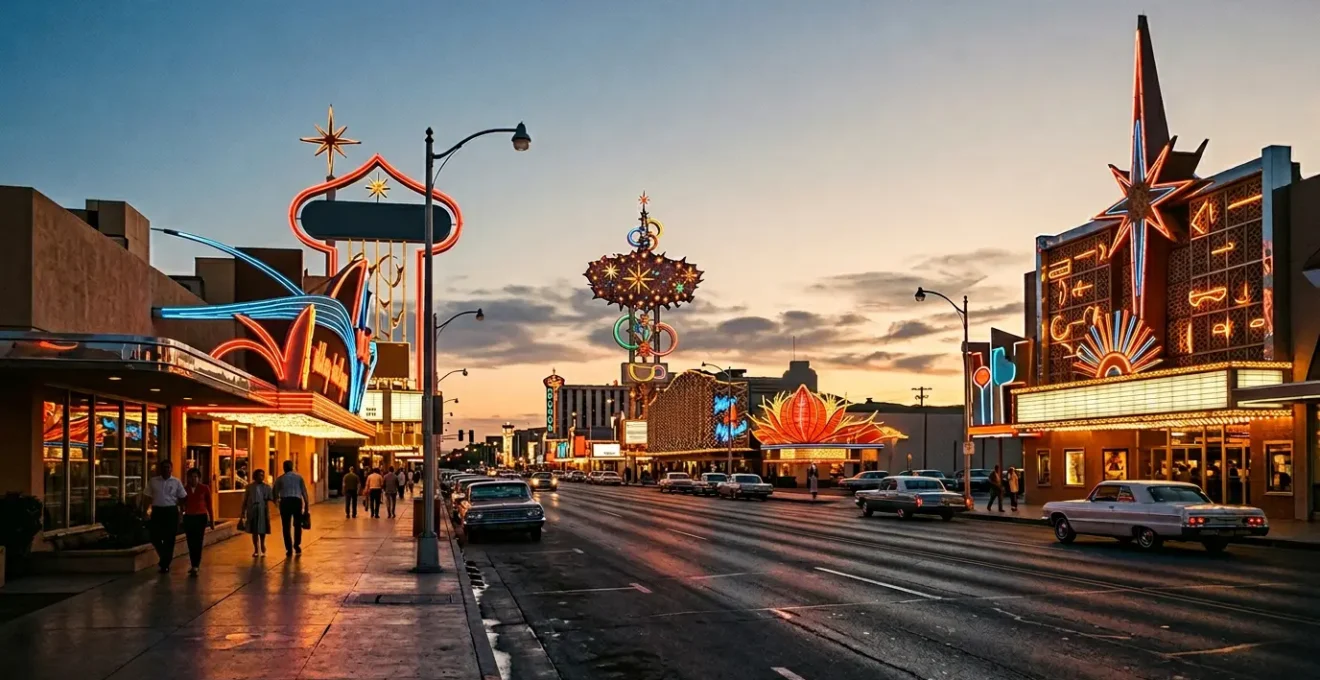
To truly experience the Rat Pack’s Vegas, you must stop chasing locations and start embodying their philosophy of effortless cool and spontaneous performance.
- Authenticity lies not in imitation, but in understanding the cultural shift the Rat Pack initiated, from their on-stage improvisation to breaking segregation barriers.
- Key experiences involve dining in historic booths, adopting a tailored (not theatrical) style, and visiting the « boneyard » of the city’s past.
Recommendation: Focus on the « why » behind the glamour—the invention of the residency, the spirit of Googie architecture, and the insider feeling they created—to truly connect with their legacy.
Searching for the spirit of Frank Sinatra, Dean Martin, and Sammy Davis Jr. in modern Las Vegas can feel like chasing ghosts. Many guides will point you toward tribute shows and dimly lit bars, offering a pre-packaged version of 1960s cool. The common advice is to visit a few historic spots, maybe don a fedora, and call it a nostalgic trip. This approach often misses the point, reducing a revolutionary cultural moment to a mere costume party. It treats the Rat Pack’s legacy as a collection of artifacts to be viewed, rather than an ethos to be experienced.
But what if the key to finding them wasn’t in the places they stood, but in understanding the way they stood there? The real magic of the Rat Pack wasn’t just in their songs or their suits; it was in their effortless command of a room, their rebellious camaraderie, and the way they transformed Las Vegas from a dusty gambling outpost into the world’s entertainment capital. Their glamour was a byproduct of their authenticity, a spirit of spontaneous performance that made every audience member feel like an insider to the greatest party on Earth.
This guide moves beyond the surface-level tour. We will not just list locations; we will deconstruct the philosophy that made them iconic. We will explore how to dine, dress, and engage with the city not as a tourist imitating the past, but as a curator appreciating its timeless essence. From the sacred ground of their favorite steakhouse to the architectural soul of the era, you will learn to see their ghosts not in blurry photographs, but in the cultural DNA of Las Vegas itself. It’s time to stop looking for the Rat Pack and start understanding them.
To fully grasp this journey into the heart of vintage Vegas, this article is structured to guide you through the essential pillars of the Rat Pack experience, from tangible landmarks to the intangible attitude that defined them.
Summary: Finding the Spirit of Sinatra in Today’s Las Vegas
- Why the Golden Steer Steakhouse is the Holy Grail of Old Vegas?
- How to Follow the « Black Tie » Code without Looking Like a Costume?
- The Rat Pack is Back vs. Sinatra Impersonators: Which Feels Authentic?
- The « Summit » at the Sands: Why That Moment Changed Vegas Forever?
- When to Visit the Neon Boneyard to See the Original Sands Sign?
- Why Siegfried & Roy’s Legacy Still Defines Vegas Entertainment?
- Googie Architecture vs. Modern Glass: Which Defines the Real Vegas?
- Nevada’s Identity: Why is Las Vegas More Than Just a Gambling Outpost?
Why the Golden Steer Steakhouse is the Holy Grail of Old Vegas?
The Golden Steer is not merely a restaurant; it’s a time capsule. Opened in 1958, it stands as one of the very few Rat Pack-era establishments still operating in its original location, making it the most sacred pilgrimage site for any aficionado. This wasn’t just a place they ate; it was a sanctuary. The restaurant served as neutral territory for mob families and a discrete haven for stars. Its dark wood, red leather booths, and veteran staff have absorbed over sixty years of whispered deals and celebrity banter. To sit here is to breathe the same air, to occupy the same space where the legends held court.
The key to its enduring allure is its authenticity. The restaurant has fiercely resisted the urge to modernize, preserving the very booths where the icons sat. Sinatra held court in Booth 22, with Dean Martin in 21 and Sammy Davis Jr. in 20, all clustered together. This physical proximity tells a story of their real-life camaraderie, a stark contrast to a staged performance. The menu itself is a historical document, offering dishes like Clams Casino, a Sinatra favorite. Dining here is less about the food—though it remains exceptional—and more about participating in a living history, a tangible connection to the city’s most glamorous and dangerous era.
Case Study: Golden Steer as a Living Museum of Mob-Era Vegas
Operating continuously since 1958, the Golden Steer served as neutral territory for mob families in the 1960s, with its Mob Room functioning as a discrete meeting space. The infamous Chicago Outfit enforcer, Tony Spilotro, used a back entrance from his nearby shop to dine with his lawyer, Oscar Goodman—scenes later immortalized in the film Casino. Today, the restaurant preserves this history by maintaining the exact booths where Sinatra (22), Dean Martin (21), and Sammy Davis Jr. (20) sat, offering a direct, physical link to the social dynamics of the Rat Pack era.
Your Action Plan: Dining in Sinatra’s Footsteps
- Book Months in Advance: Reservations open three months ahead and fill instantly. When booking online or by phone, specifically request Booth 22 (Sinatra), 21 (Martin), or 20 (Davis Jr.), though it is not guaranteed.
- Arrive Early for Cocktails: The bar opens at 4:30 PM. Arrive 15-30 minutes before your reservation to order a classic martini and soak in the atmosphere before the crowds arrive.
- Order the Sinatra Experience: To dine like the Chairman, start with Clams Casino, order the New York Strip medium-rare, and request his drink of choice: Jack Daniel’s with exactly three ice cubes.
- Dress with Respect: The restaurant enforces a smart, elegant dress code. Aim for business casual or better to honor the history of the room. No flip-flops, baseball caps, or beachwear.
- Engage with the History: Ask your waiter about the restaurant’s history. Many have been there for decades and hold firsthand stories that aren’t in any guidebook.
How to Follow the « Black Tie » Code without Looking Like a Costume?
Emulating the Rat Pack’s style is a delicate art. The line between timeless elegance and theatrical costume is perilously thin. Their « black tie » look wasn’t about rigid formality; it was about an effortless cool that came from perfectly tailored garments worn with nonchalant confidence. The key is to channel the *spirit* of their style, not to replicate an outfit piece for piece. Forget the cheap fedoras and oversized zoot suits sold in tourist shops. The goal is sophistication, not caricature.
The foundation of their look was the fit. Their tailor, Sy Devore, was a master of creating suits that were slim and sharp without being restrictive. Today, this translates to investing in a well-tailored suit in a classic fabric like sharkskin or dark worsted wool. These materials have a subtle sheen that captures light beautifully, a detail that was essential for black-and-white photography and television. The second pillar was restraint. Their accessories were minimal and chosen with care: a skinny silk tie (no wider than 2.5 inches), a crisp pocket square with a clean fold, and a quality pair of cufflinks. It was about one or two perfect details, not a cacophony of flashy items. The essence of their style was control—looking impeccable without ever looking like you tried too hard.

This focus on fabric and cut is what separates authentic style from costume. The modern interpretation is to adopt the principles, not the props. Instead of a fedora, focus on a sharp haircut. Instead of a loud tie, choose a dark, narrow one. The ultimate test is what can be called the ‘Bar Test’: if your outfit would look out of place in a sophisticated, modern cocktail bar, you’ve strayed into costume territory. True Rat Pack style is, and always was, timeless.
- Prioritize fit over formality: A modern slim-cut (not skinny) suit is the cornerstone. The Rat Pack’s look was defined by tailoring that fit close to the body without bunching.
- Choose quality fabrics: Select sharkskin or worsted wool in dark tones like charcoal, navy, or deep gray. These fabrics possess a subtle two-toned effect that adds depth and photographs exceptionally well.
- Master the skinny tie: Opt for a silk necktie between 2 and 2.5 inches in width. Stick to solid dark colors or understated patterns like micro-dots or thin stripes.
- Add one signature accessory: A classic watch, mother-of-pearl cufflinks, or a silk pocket square (neatly folded, not puffed) adds a touch of personality without being ostentatious.
The Rat Pack is Back vs. Sinatra Impersonators: Which Feels Authentic?
Experiencing the music of the Rat Pack live in Las Vegas presents a spectrum of authenticity, from polished theatrical productions to casual lounge acts. Understanding the difference is key to aligning your expectations with the experience. The choice is not simply between good and bad impersonators; it’s between different philosophies of tribute. Do you seek a recreation of a specific moment, or an evocation of a general feeling? The two leading options, a full-scale show like « The Rat Pack Is Back » and a solo impersonator, offer vastly different answers.
« The Rat Pack Is Back, » staged in a proper showroom with a live orchestra, aims for theatrical authenticity. It’s a scripted production that recreates the banter, the camaraderie, and the musical arrangements of the famous « Summit at the Sands » shows. The performers are actors as much as singers, capturing the distinct personas of Frank, Dean, and Sammy. The value here is in the polish and the complete sensory experience—the sound of a live big band, the clinking of cocktail glasses, and the feeling of being transported to the Copa Room. As one attendee noted, the cast « captures the essence of the originals—it’s slick, polished, and they stay true to the characters. » This is for those who want a reliable, high-quality re-enactment of history.
You have to go if you’re a Rat Pack fan. The cast captures the essence of the originals—it’s slick, polished, and they stay true to the characters.
– Verified attendee review, The Rat Pack Is Back audience testimonial
Solo impersonators, often found in smaller casino lounges or on Fremont Street, offer a more casual and spontaneous experience. The focus is less on historical accuracy and more on vocal and visual resemblance. While the production values may be lower (often using backing tracks instead of a live band), the intimacy can be powerful. This format is closer to a modern lounge act paying homage to a classic repertoire. The authenticity here is more personal—a gifted singer channeling the spirit of Sinatra for a small, appreciative crowd. Neither is inherently superior; the « right » choice depends on whether you prefer a polished, historical play or an intimate, music-focused homage.
The following table breaks down the spectrum of tribute experiences available, helping you choose the one that best fits your definition of an authentic night out.
| Show Type | Example | Authenticity Factor | Atmosphere | Best For | Typical Price Range |
|---|---|---|---|---|---|
| Theatrical Production | The Rat Pack Is Back (Tuscany Casino) | Vocal accuracy + scripted banter | 400-seat showroom, live 7-piece orchestra, dinner packages available | Group celebrations, nostalgic entertainment seekers | $60-$150 with dinner |
| Intimate Lounge Homage | Petrossian Bar at Bellagio (unscripted piano lounge) | Spontaneous energy + classic repertoire | Small lounge setting, jazz trio, cocktails at small tables | Couples, sophisticated nightcap, quiet immersion | Drink minimums only |
| Solo Impersonator | Various Frank/Dean acts on Fremont Street venues | Visual resemblance emphasis | Smaller casino lounges, karaoke-style backing tracks | Casual observers, photo opportunities | $30-$60 or complimentary with gaming |
| Dinner Show Hybrid | Bootleg Canyon/Off-Strip dinner theaters | Comedy + music medley | Dinner theater format, audience participation encouraged | Families, casual entertainment | $75-$100 with meal |
The « Summit » at the Sands: Why That Moment Changed Vegas Forever?
In January 1960, something unprecedented happened at the Sands Hotel. While filming Ocean’s 11 by day, Frank Sinatra, Dean Martin, Sammy Davis Jr., Peter Lawford, and Joey Bishop took over the Copa Room stage at night. Dubbed « The Summit, » these performances weren’t a concert; they were a party the audience was invited to crash. The group rolled drink carts onstage, improvised their banter, and sang over each other’s numbers. This act of spontaneous performance completely redefined the relationship between star and spectator. For the first time, the biggest stars in the world were not just performing *for* an audience, but partying *with* them. The demand was astronomical; a historical account mentions there were 18,000 reservation requests for just 200 rooms at the Sands.
This month-long engagement was the genesis of the modern Las Vegas residency. Before The Summit, stars would come to Vegas for a week or two. The Rat Pack created a new model: a sustained run by major headliners that became a destination event in itself, drawing visitors from around the globe. This is the direct cultural ancestor of the multi-year productions by artists like Celine Dion, Elton John, and Adele. They proved that the « show » could be the primary reason for a trip to Vegas, shifting the city’s economic and cultural focus from pure gambling to high-end entertainment.
How the Summit Invented the Modern Vegas Residency
The unscripted, party-like atmosphere of the 1960 Summit shows was revolutionary. By creating an event where the primary draw was seeing these stars interact spontaneously, the Rat Pack established the concept of a « must-see » destination show. This format, a sustained run that defines a hotel’s brand and draws global tourism, invented what we now recognize as the Las Vegas residency. It created the blueprint for every major headliner that followed, transforming the city’s entertainment model from short-term bookings to long-term, iconic productions.
Perhaps most importantly, the Summit’s legacy extends beyond entertainment. At a time when Las Vegas casinos were still largely segregated, Sinatra wielded his immense influence for social change. He refused to perform unless Sammy Davis Jr. was given the same treatment and accommodations as the white members of the group, including staying at the hotel. As one historical account notes, the Rat Pack, led by Sinatra, insisted Sammy Davis Jr. be treated as an equal, which was a powerful force in breaking segregation barriers in Vegas hotels. This « cultural footprint » proves their impact was not just about glamour, but about fundamentally reshaping the city’s social fabric.
When to Visit the Neon Boneyard to See the Original Sands Sign?
The Neon Boneyard is where Las Vegas signs go to die, but it’s also where their stories are preserved. For a Rat Pack enthusiast, this outdoor museum is a poignant final stop. Here, you can stand before the fragments of the original Sands Hotel sign, the very beacon that welcomed a generation of high-rollers and dreamers. However, the *timing* of your visit dramatically changes the experience and the narrative you take away. Choosing between a day tour and a night tour is a choice between two different kinds of authenticity: historical clarity versus atmospheric resurrection.
A day tour offers archaeological authenticity. In the bright, unforgiving desert sun, the signs are revealed not as glowing icons, but as giant, rusting sculptures. You can see the chipped paint, the tangled wiring, and the weathered metal up close. This is the best time to appreciate the craftsmanship and sheer scale of these creations. For the Sands sign, daylight reveals the elegant typography and mid-century design that are lost in the nocturnal glow. It’s an experience of beautiful decay, a chance to photograph the textures of rust and faded color that tell the true story of time’s passage.

A night tour offers emotional authenticity. While many signs are too fragile for full re-illumination, the museum uses a spectacular projection-mapping show called « Brilliant! » to bring them back to life. Seeing the Sands sign reanimated with light, synchronized to a soundtrack of classic Vegas tunes including Sinatra, is a ghostly and profoundly moving experience. It’s a fleeting resurrection that evokes the spirit of the Strip in its heyday. For a truly immersive moment, download Sinatra’s « Live at the Sands » album beforehand and listen with headphones as you stand before the sign’s remains. This personal soundtrack transforms a museum visit into a private, temporal dialogue with the past.
Your Field Guide to a Strategic Boneyard Visit
- Book a Day Tour for History: For the best light to photograph details and appreciate the craftsmanship, choose a morning or early afternoon guided tour.
- Choose a Night Tour for Atmosphere: Reserve an evening tour that includes the « Brilliant! » show to see the signs magically reanimated.
- Create a Personal Soundtrack: Download Sinatra’s « Live at the Sands » (1966) to your phone. Listening while viewing the Sands sign artifacts creates a powerful, immersive connection.
- Focus on Decay as Narrative: Look beyond the neon to the rust and broken bulbs. These imperfections tell the story of Vegas’s constant reinvention and the passage of time.
- Book Well in Advance: This is a major attraction. Reserve tickets online at the official Neon Museum website 2-4 weeks ahead, especially for the popular evening tours.
Why Siegfried & Roy’s Legacy Still Defines Vegas Entertainment?
To understand the unique space the Rat Pack occupied, one must look at who came after them. Siegfried & Roy, who dominated the Strip from 1990 to 2003, represent the next and perhaps final step in the evolution of the Vegas headliner. While their act of grand illusion and exotic animals seems a world away from Sinatra’s cool crooning, they inherited the Rat Pack’s mantle as the undisputed kings of the city. A historical analysis points out that Siegfried & Roy were the last performers to command the same level of city-wide influence and autonomy once wielded by Sinatra, effectively « owning the town » in a way no modern resident can.
The critical shift they represent is the move from personality-driven entertainment to spectacle-driven entertainment. The Rat Pack’s draw was intimate and personal. Audiences flocked to the 400-seat Copa Room to be in the presence of Frank, Dean, and Sammy’s charisma. The show was their personality. Siegfried & Roy, in contrast, built a multi-million dollar theatrical production for an audience of over 1,500 per show at The Mirage. Their show was a meticulously choreographed machine of wonder and illusion. Both promised the impossible, but they did so in different ways: Sinatra through his effortless cultural power, and Siegfried & Roy through literal magic.
From Personality to Spectacle: The Evolution of the Vegas Show
The Rat Pack’s intimate, spontaneous performances in the 400-seat Copa Room centered on charisma and vocal talent. Siegfried & Roy’s production at The Mirage (1990-2003) shifted the paradigm to a massive, 1,500-seat theatrical spectacle with exotic animals and elaborate illusions. This move from adult-oriented cocktail culture to family-friendly blockbuster entertainment created the template for the large-scale Cirque du Soleil residencies that now define the modern Las Vegas Strip, marking a fundamental change in the city’s core demographic and entertainment philosophy.
Siegfried & Roy’s legacy is the creation of the family-friendly, mega-production model that now dominates Las Vegas. They took the « destination show » concept invented by the Rat Pack and scaled it up for a mass audience, paving the way for Cirque du Soleil and other contemporary residencies. By understanding this transition, we can more clearly see what was unique about the Rat Pack era: it was the last time that the sheer force of a performer’s personality, rather than the scale of their production, was the main event.
Googie Architecture vs. Modern Glass: Which Defines the Real Vegas?
The soul of a city is often written in its architecture, and in Las Vegas, two competing narratives are etched into the skyline. On one hand, the sleek, anonymous glass towers of the modern Strip, like The Venetian which stands on the grave of the Sands. On the other, the few surviving remnants of Googie architecture, the style that defined the Rat Pack’s Vegas. Googie was the visual language of the Atomic Age: playful, optimistic, and designed to be seen from a speeding car. With its swooping rooflines, starburst patterns, and futuristic shapes, it was architecture as advertisement, broadcasting a message of fun and fantasy to the open road.
This style was the perfect backdrop for the Rat Pack’s brand of whimsical indulgence. It was democratic, street-level, and unpretentious, designed to lure you in with its eye-catching forms. The most perfectly preserved example is the shell-shaped lobby of the former La Concha Motel (1961), which was heroically saved from demolition and now serves as the visitor center for the Neon Museum. Its preservation, which involved slicing the structure into eight pieces and moving it 3.5 miles, underscores its cultural significance. It represents a time when Vegas’s identity was unique and unabashedly American.
Case Study: The La Concha Motel Lobby, a Preserved Googie Masterpiece
The La Concha Motel lobby (1961) is the quintessential example of Googie’s playful, optimistic vision. Its curved, shell-like concrete and glass forms captured the futuristic spirit of the Rat Pack era. Facing demolition in 2005, the lobby was donated, cut into eight pieces, and relocated to become the Neon Museum’s visitor center at a cost of nearly $3 million. This painstaking effort highlights the contrast between Googie’s democratic, eye-catching style and the inward-facing, corporate luxury of modern glass towers like The Venetian, which was built on the site of the demolished Sands Hotel.
In contrast, the modern glass towers that dominate today’s Strip represent a globalized, corporate aesthetic. They are imposing and inward-facing, designed to keep guests inside their self-contained ecosystems of shopping, dining, and gambling. While luxurious, they could be in Dubai, Shanghai, or Las Vegas. Googie architecture, however, could only be here. It is the city’s authentic architectural DNA. To find the ghost of the real Vegas, one must look past the reflective glass of the present and seek out the few remaining curves and angles of its optimistic past.
Your Checklist: An Urban Explorer’s Guide to Finding Hidden Googie
- Explore East Fremont Street: Go past the Fremont Street Experience canopy to find off-Strip motels and diners where 1950s-60s signage and angular rooflines survive.
- Visit the La Concha Lobby: The Neon Museum’s visitor center at 770 N Las Vegas Blvd is the most pristine example of Googie design left in the city.
- Hunt in the Arts District: Walk through the 18b Arts District (around Main Street and Charleston) to spot vintage neon fragments and atomic-age typography on old storefronts.
- Observe the Golden Steer Exterior: Note the classic 1958 signage and architectural details at 308 W Sahara Ave, a rare, still-operating original.
- Document with Respect: Photograph these remnants as cultural archaeology. Many are privately owned and fragile, so admire them without trespassing.
Key Takeaways
- Authentic Rat Pack style is about impeccable tailoring and restraint, not costume-like imitation.
- The 1960 « Summit at the Sands » was a pivotal moment that invented the modern Las Vegas residency and helped break segregation barriers.
- The choice between a theatrical tribute show and a solo impersonator depends on whether you seek historical re-enactment or intimate homage.
Nevada’s Identity: Why is Las Vegas More Than Just a Gambling Outpost?
Before the Rat Pack, Las Vegas was primarily known for one thing: legal gambling. It was a functional identity, a desert outpost differentiated from the rest of America by its casinos. The arrival of the Rat Pack, and specifically their 1960 Summit, fundamentally and permanently redefined Nevada’s cultural capital. They made « coming to Vegas » an event entirely independent of the gaming tables. The worldwide media coverage of their performances broadcast a new idea: Las Vegas as the global epicenter of glamour, entertainment, and cool.
Their impact transcended the stage. They transformed the city’s reputation from a place you go to do one thing (gamble) to a place you go to *be* someone, to participate in a fantasy. The Summit shows alone drew an incredible number of people; 34,000 people packed the Sands over four weeks, according to historical attendance records, all eager for a taste of that exclusive magic. This cultural shift laid the groundwork for everything that followed, from the spectacles of Siegfried & Roy to the world-class dining and Cirque du Soleil productions of today. They gave the city a new, more powerful story to tell.
Ultimately, the Rat Pack’s most enduring legacy was giving Las Vegas its soul. By combining unparalleled talent, a rebellious spirit, and a platform for social change, they elevated the city’s identity from a « gambling outpost » to the self-proclaimed « Entertainment Capital of the World. » This was not a marketing slogan; it was a reputation earned night after night in the Copa Room. Finding their ghosts today means recognizing that their influence is not confined to a few old buildings, but is woven into the very identity of the city they helped build—a city of reinvention, spectacle, and enduring cool.
Now, armed with this understanding, the next logical step is to begin planning your own curated journey into the heart of vintage Las Vegas, focusing not just on where to go, but on how to see.