
In summary:
- Las Vegas is shifting from a tourist-only model to a competitive gaming hub, offering daily tournaments for hardcore players.
- Success in Vegas esports requires a strategic approach, treating it like an in-game campaign focusing on gear, bankroll, and logistics.
- Key venues like HyperX Arena cater to active competitors (« Gladiators »), while large-scale events at places like the Sphere are for spectators.
- Planning your trip around major events like EVO or utilizing daily LANs requires different booking and preparation strategies.
For decades, Las Vegas has been synonymous with casinos and nightclubs. For a hardcore gamer, the city was a flashy distraction, not a destination. You’d come for a convention or a bachelor party, but never to truly test your skills. That entire landscape is undergoing a seismic shift. The blinking lights of slot machines are now competing with the RGB glow of high-end gaming rigs, and the bass drops of DJ sets are being replaced by the roar of a crowd watching a clutch play.
Most guides will give you a simple list of « esports bars, » treating the scene as another tourist novelty. They miss the point entirely. For a competitive player, a trip to Vegas isn’t about passively watching; it’s about actively competing. The real challenge isn’t finding a place with PCs—it’s navigating the player economy, mitigating the risks of house peripherals, and managing the meta-game of logistics to maximize your performance when it counts. The key isn’t just knowing where to go, but understanding how to operate like a pro player on the road.
This guide breaks down the Las Vegas competitive gaming scene from a player’s perspective. We’ll explore the infrastructure that makes Vegas a new gaming frontier, detail how to jump into the action at iconic venues, and provide the strategic framework for choosing your battles. We’ll cover everything from managing your bankroll between tournaments to optimizing your travel and even how to decompress without sensory overload, ensuring you leave Vegas with a better win rate, not just a lighter wallet.
This article provides a complete roadmap for the competitive gamer in Las Vegas. The following summary outlines the key strategies and locations you’ll need to master to conquer the city’s burgeoning esports scene.
Summary: A Player’s Guide to Conquering Vegas Esports
- Why Vegas is Pivoting from Nightclubs to Esports Lounges?
- How to Enter a « Daily LAN » Tournament at HyperX Arena?
- Luxor Esports Arena or sphere-based events: Which Fits Your Game Style?
- The Risk of Using House Peripherals in Competitive Matches
- When to Book Your Trip to Catch the EVO Championship Finals?
- Cash Games or Daily Tournaments: Which Builds a Bankroll Faster?
- Why Elon Musk’s Tesla Tunnel is the Future of Convention Transport?
- Immersive Experiences: How to Participate in Area15 Without Confusion?
Why Vegas is Pivoting from Nightclubs to Esports Lounges?
The transformation of Las Vegas into an esports destination isn’t an accident; it’s a calculated business pivot. For years, the city’s entertainment model relied heavily on nightclubs and casinos, but demographics are changing. A new generation of visitors spends more on experiences than on slot machines, and their idea of a high-stakes evening involves a prize pool, not a poker table. This shift created a massive market opportunity that savvy operators are now capitalizing on, recognizing that the engagement and community of gaming offer a more sustainable model than the transient world of velvet-rope nightlife.
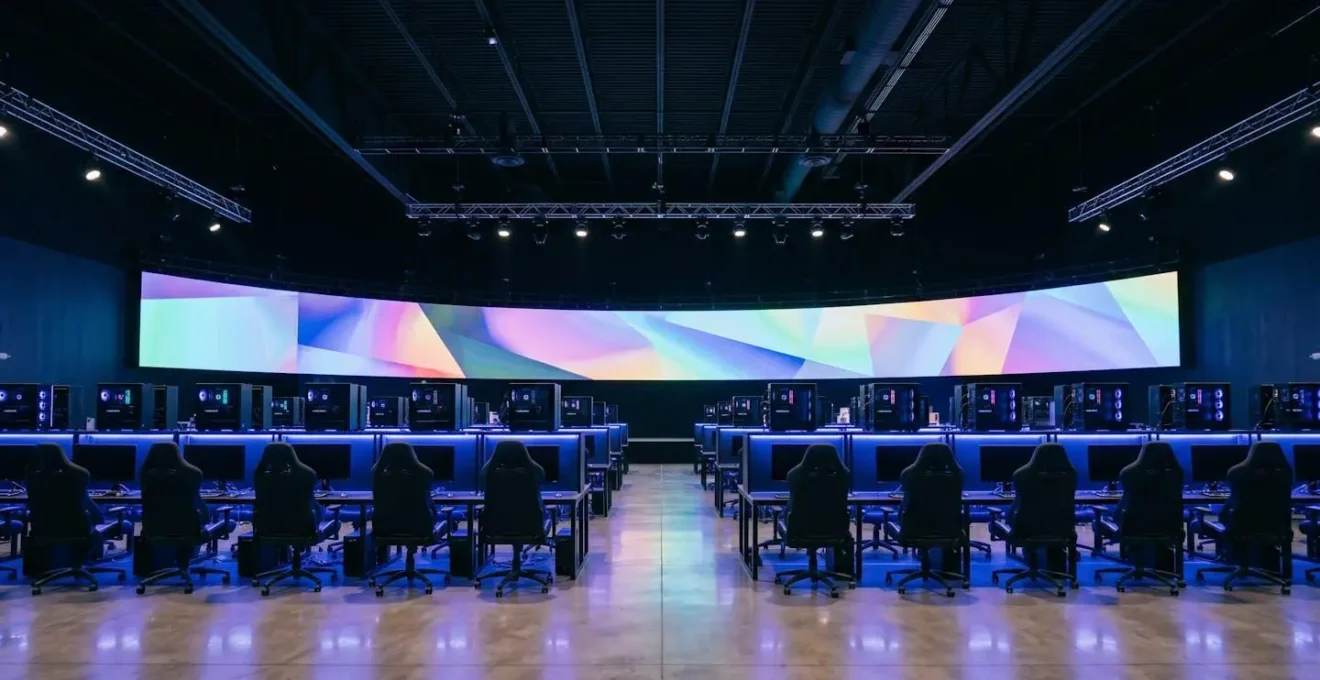
The most concrete evidence of this pivot is the HyperX Esports Arena at the Luxor. In 2018, a former nightclub was gutted and reborn as a staggering 30,000 square-foot competitive gaming venue. This wasn’t just adding a few PCs to a hotel lobby; it was a multi-million dollar investment featuring a competition stage, a 50-foot LED video wall, broadcast facilities, and dozens of gaming stations. It was a statement: esports is not an amenity, it’s a main attraction.
This strategic move is a direct response to a global phenomenon. The esports market is a financial juggernaut, attracting immense investment and a dedicated, global audience. By building world-class infrastructure, Las Vegas is positioning itself to capture a piece of this lucrative pie. The city’s existing expertise in hosting large-scale events, from conventions to championship boxing, provides the perfect foundation. They are simply swapping boxing rings for virtual battlegrounds and applying the same high-production-value formula to a new, digitally native audience.
This pivot creates a unique ecosystem for visiting gamers. It means access to professional-grade facilities, a constant stream of events, and an environment built by people who understand competitive play. Vegas is no longer just a place to visit; it’s a place to train, compete, and connect with the community.
How to Enter a « Daily LAN » Tournament at HyperX Arena?
Jumping into the competitive scene at HyperX Arena is surprisingly straightforward, designed to be as accessible as a walk-up poker game. These « Daily LAN » tournaments are the lifeblood of the arena’s competitive ecosystem, offering players of all skill levels a chance to test their mettle in a professional setting without the pressure of a major championship. Forget online qualifiers; this is about showing up and proving your skill on the day. The process is streamlined to get you from the casino floor to the command chair with minimal friction.

The key is to plan slightly ahead. While walk-ins are often possible, popular titles can fill up fast. The entire process, from finding a tournament to checking in, is designed for efficiency. Here are the essential steps to get you started:
- Check the Schedule: First, visit the official HyperX Arena website. They maintain a constantly updated calendar of daily and weekly tournaments, specifying the game, format (e.g., Solos, Duos, 2v2), and start time.
- Choose Your Event: Select a tournament that fits your game and skill level. Entry fees are typically modest, often ranging from $15 to $60 per player, which contributes to the prize pool for that event.
- Register Online: Secure your spot by registering online in advance. Most tournaments have a player cap. Registration usually closes about 15-30 minutes before the event begins, so don’t wait until the last minute.
- Arrive Early: Plan to arrive at least 30-45 minutes before your tournament. This gives you time to check in at the front desk, find your station, and most importantly, warm up. Use this time to get a feel for the setup, especially if you’re using house peripherals.
- Check-In and Prepare: Head to the registration desk with your confirmation. For certain tournaments, especially those with cash prizes or age-restricted games, you may be required to show a valid ID. Once checked in, you’re ready for your match.
This system turns the daunting idea of competing in a massive arena into a simple, repeatable process. It allows you to build a Vegas trip around consistent competition, playing in a different tournament every night if you choose.
Luxor Esports Arena or sphere-based events: Which Fits Your Game Style?
As Las Vegas’s esports scene matures, it’s splitting into two distinct paths, creating a critical choice for any visiting gamer: are you a « Gladiator » or a « Spectator »? This isn’t just about which game you play; it’s about how you want to experience the competition. Your decision between a dedicated venue like the HyperX Esports Arena and a massive production at a location like the Sphere will define your entire trip. One is about being in the thick of the action, hands on the keyboard; the other is about witnessing a Super Bowl-scale entertainment spectacle from a distance.
The HyperX Arena at the Luxor is the definitive « Gladiator » pit. It’s designed for participation. With dozens of high-end PCs and consoles available for hourly play and daily tournaments, its entire purpose is to get you in the game. The energy is raw, personal, and focused on the players. You’re surrounded by fellow competitors, the air thick with the sound of mechanical keyboards and intense callouts. It’s the place you go to build your skills, earn prize money, and feel the adrenaline of live, in-person competition. It is the modern LAN party elevated to a professional standard.
Events at the Sphere, on the other hand, are built for the « Spectator. » These are massive, ticketed productions where you come to watch the world’s best teams compete on a jaw-dropping scale. There are no player stations for you; the focus is entirely on the viewing experience, with massive screens, intricate stage designs, and concert-level audio. It’s an incredible way to experience the pinnacle of a game you love, but it’s a passive experience. You are there to be entertained, not to compete.
To make the right choice, you need to understand the fundamental differences in cost, atmosphere, and purpose. The following comparison, based on the operating models of these distinct venues, breaks down the decision-making process.
| Feature | HyperX Arena (Luxor) | Sphere Esports Events |
|---|---|---|
| Experience Type | Participant – Play & Compete | Spectator – Watch Championships |
| Entry Cost | $15-$60 tournament entry or hourly play rates | $50+ for premium ticketed events |
| Spontaneity | Walk-in daily tournaments available | Pre-planned, advance ticket purchase required |
| Venue Size | 30,000 sq ft intimate arena | Massive stadium-scale production venue |
| Atmosphere | Raw competitive energy, player-focused | Entertainment spectacle, ‘Super Bowl’ scale |
| Gaming Stations | 50+ daily gaming PCs available | No player stations – viewing only |
| Best For | Active gamers wanting hands-on competition | Fans of major esports wanting world-class viewing experience |
Ultimately, your choice depends on your trip’s objective. If your goal is to compete, grind, and improve, the HyperX Arena is your home base. If you want to witness the spectacle of a world championship and be part of a massive fan crowd, then a major event at a venue like the Sphere is your ticket.
The Risk of Using House Peripherals in Competitive Matches
For a competitive gamer, one of the biggest sources of anxiety isn’t the opponent—it’s the equipment. Your keyboard, mouse, and headset are more than just tools; they’re extensions of your muscle memory, honed over thousands of hours. Using « house peripherals » at a LAN event, even high-quality ones like those at HyperX Arena, introduces a significant variable that can derail your performance. Differences in mouse sensor tracking, switch actuation force, and even the texture of a mousepad can throw off your aim and timing just enough to lose a crucial fight.
This « peripheral anxiety » is a real performance inhibitor. You might be used to a lightweight mouse with a specific DPI setting and a particular grip style. The house mouse might be heavier, with a different sensor and a default DPI that forces you to drastically alter your in-game sensitivity, leading to inconsistent aiming. Similarly, the difference between the linear feel of a Cherry MX Red switch and the tactile bump of a Brown switch on a keyboard can affect your movement and ability execution. While bringing your own gear is always the ideal solution, it’s not always practical when traveling.
Therefore, if you must use the house setup, you need a rapid adaptation protocol. The goal is to minimize the variables and get the new equipment as close to your home setup as possible in the precious few minutes of warmup time you have. It’s about quickly diagnosing the differences and making systematic adjustments in both system and in-game settings. This isn’t just about comfort; it’s about reclaiming your competitive edge. Mastering this quick-change routine is a skill in itself.
The following checklist is a pro-level routine for adapting to unfamiliar gear under pressure. It’s a five-minute drill to run the moment you sit down at a new station to mitigate the risks and get your head back in the game.
Your Pre-Match Peripheral Audit: 5-Minute Adaptation Plan
- Kill Acceleration: Your first click should be into Windows mouse settings. Immediately find and disable « Enhance pointer precision. » This feature introduces mouse acceleration, which is the number one enemy of consistent muscle-memory-based aiming.
- Calibrate Sensitivity: Check the house mouse model to estimate its weight and default DPI. Then, jump into an in-game practice range. Adjust your in-game sensitivity until a full swipe across your comfortable mousepad space results in a 180-degree or 360-degree turn, matching your home setup.
- Remap Critical Binds: Don’t even think about playing with default keybinds. Immediately remap your primary ability, crouch, sprint, and reload keys to match your personal layout. This is about muscle memory, not learning a new configuration under pressure.
- Test Switch Response: Open a text editor or use in-game movement to test the keyboard’s switch feel. Rapidly tap A/D to feel the actuation point and reset. If the keys feel heavier or lighter than you’re used to, be conscious that your strafing and counter-strafing timing may need slight adjustment.
- Optimize Your Surface: If possible, bring your own large mousepad to lay over the arena’s surface. This guarantees a consistent and familiar tracking surface. Always use hand sanitizer before and after play for both hygiene and to ensure a clean, dry grip on the mouse.
When to Book Your Trip to Catch the EVO Championship Finals?
For the fighting game community (FGC), all roads lead to Las Vegas for the Evolution Championship Series, or EVO. This isn’t just another tournament; it’s the World Cup, the Super Bowl, and the Olympics of fighting games rolled into one. Attending EVO, whether as a competitor or a spectator, requires a « meta-game » of logistical planning that begins months in advance. The sheer scale of the event means that waiting until the last minute is a guaranteed path to inflated prices and sold-out hotels. Planning your trip is as strategic as planning your combos.
The magnetic pull of this event is immense. For context, in 2023, EVO shattered attendance records with a staggering 9,182 competitors, not even counting the tens of thousands of spectators. This massive influx of people descends on the city during peak summer season, creating extreme demand for flights and accommodation. The key to an affordable and successful trip is booking well before the hype train leaves the station. As a point of reference for timing, the main event is consistently held in the summer.
EVO 2024 took place from July 19 to 21 and was held in the Las Vegas Convention Center.
– Wikipedia Contributors, Evolution Championship Series Wikipedia Entry
This timing is crucial. Booking a trip to Vegas in mid-July requires foresight. You are competing not just in your bracket, but against every other attendee for limited resources. A strategic booking timeline is non-negotiable. It involves several key phases, from securing travel essentials the moment dates are announced to planning your on-the-ground activities.
- Months 6-4 Before: The moment EVO dates are officially announced, book your flights and hotel. This is the single most important step. Prices will only go up. Look for hotels near the Convention Center or on the Monorail line for easy access.
- Months 3-2 Before: Purchase your spectator tickets or competitor passes. Early bird pricing is often available. This is also the time to start researching side tournaments and community events that run parallel to the main competition.
- 1 Week Before: If your budget allows, consider arriving a day or two early (mid-week flights are often cheaper). This lets you acclimate, beat the check-in rush, and soak up the pre-tournament hype at local gaming meetups.
- During the Event: Don’t just stay glued to the main stage. Attend developer panels, enter « side-tournaments » for other games, and network at community booths. Much of the magic of EVO happens off-stage.
- Day After Finals: Extend your stay by one day. You’ll avoid the chaos of everyone trying to fly home at the same time and can often find cheaper flights. It’s also a great time for post-event community gatherings.
Cash Games or Daily Tournaments: Which Builds a Bankroll Faster?
For a competitive player in Las Vegas, managing your money is as important as managing your in-game resources. Your trip’s longevity and success hinge on your « player economy. » Just like in a poker room, esports venues like HyperX Arena offer two primary ways to engage: high-variance, high-reward tournaments or steady, predictable « cash game » style hourly play. Choosing the right path depends entirely on your goals, risk tolerance, and skill level. Deciding between them is a strategic choice that directly impacts how long you can afford to stay and compete.

Daily tournaments are the high-stakes option. You pay a fixed buy-in, which goes into a prize pool. If you perform well and « cash, » you can multiply your initial investment significantly. A good run in a single tournament can fund your entire trip. However, the risk is absolute. If you’re eliminated early, your buy-in is gone, with no return. It’s a model of high variance; you might lose five tournaments in a row and then win big on the sixth. This path is best for confident players who have a deep understanding of the current meta and are willing to risk short-term losses for a shot at a big payday.
Hourly « cash game » play, on the other hand, is about stability and practice. You pay a set rate per hour for access to a professional-grade gaming station. There is no prize pool and no chance of a big score, but your cost is fixed and predictable. This is the ideal way to get high-quality practice, learn from other players in a lower-stakes environment, and acclimate to the arena’s equipment without the pressure of a tournament bracket. It’s a low-variance approach focused on guaranteed « time on device » and skill improvement. This is the grinder’s path, perfect for warming up or for players who want to ensure they get maximum gameplay for their dollar.
Case Study: HyperX Arena’s Dual Model
HyperX Arena effectively mirrors a poker room’s revenue model to cater to both types of players. Their daily tournaments, with buy-ins from $15-$60 across titles like Fortnite and Super Smash Bros., create prize pools that offer the high-reward path. A small investment can lead to significant cash prizes or gear. Simultaneously, their hourly play stations, with special rates for locals and military, provide the « cash game » alternative. This guarantees players risk-free time to practice and socialize on professional equipment, offering a predictable cost structure for consistent training.
The fastest way to build a bankroll is through tournaments, but it’s also the fastest way to deplete one. A smart player uses both: hourly play to warm up and practice, and tournaments as calculated shots at a larger prize. The key is to budget for both, allocating a portion of your bankroll for « practice » and another for « competition. »
Why Elon Musk’s Tesla Tunnel is the Future of Convention Transport?
The « meta-game » of a Las Vegas esports trip extends beyond the arena. Time spent in traffic, waiting for a rideshare, or walking in the desert heat is time you’re not resting or preparing for your next match. This is where the Las Vegas Convention Center Loop, often called the « Tesla Tunnel, » becomes a strategic asset for any serious competitor. While it may seem like a novelty, it solves one of the biggest logistical headaches of attending events in the city: efficient point-to-point transit.
Traditionally, getting around the sprawling Convention Center campus—or between your hotel and the venue—was a time-consuming ordeal. A walk that could take 25 minutes in the sun can now be completed in about two minutes underground. The system is an underground highway of tunnels spanning 1.7 miles and running 40 feet below ground, where a fleet of human-driven Teslas whisks passengers between stations. For a gamer attending EVO or another major convention, this is a game-changer. It means less time walking and more time for panels, side tournaments, or simply resting.
The efficiency of the Loop isn’t just about time; it’s also about cost and energy conservation. The cost is highly competitive with other transport options. For instance, according to recent reports, travel between the Las Vegas Convention Center and off-site hotels like Resorts World or Westgate costs as little as $3.75 for a single ride or can be accessed with a day pass. This is often cheaper and significantly faster than waiting for a surge-priced rideshare during peak event hours.
By eliminating the friction of transit, the Loop allows you to pack more into your day with less fatigue. You can stay at a slightly more affordable hotel further from the main hall and still have a faster commute than someone staying closer. It transforms your schedule from a series of stressful commutes into a seamless flow between your hotel, the competition floor, and other attractions. It’s a small but powerful optimization that contributes to peak performance by preserving your most valuable resource: energy.
Key takeaways
- Vegas’s esports scene is a serious competitive landscape, not a tourist trap. Approach it with a strategic mindset.
- Differentiate between « Gladiator » experiences (playing at HyperX) and « Spectator » events (watching at the Sphere) to match your goals.
- Mastering the logistics of booking, transport (like the Vegas Loop), and bankroll management is as crucial as your in-game skill.
Immersive Experiences: How to Participate in Area15 Without Confusion?
A competitive trip to Vegas can’t be all grind. You need downtime to decompress and avoid burnout, but in a city of constant sensory assault, choosing the right kind of break is crucial. Area15, the massive immersive entertainment complex, offers a compelling option, but its chaotic, non-linear layout can be overwhelming if you go in without a plan. For a gamer, the key is to approach it like an open-world RPG: have a « main quest » and a series of « side quests » to avoid confusion and sensory overload.
The first thing to understand is the ticketing system. General admission to the Area15 complex itself is often free, but this only gets you in the door. The major attractions inside, like the surreal Meow Wolf’s Omega Mart, are the « main quests » and require separate, timed-entry tickets. These are substantial experiences, often lasting 60-90 minutes, and they are the core of any visit. Booking these online 24-48 hours in advance is essential, especially on weekends, to guarantee entry and avoid disappointment.
Once you have your main quest locked in, you can fill the rest of your time with « side quests. » These are the smaller attractions, VR experiences, art installations, and bars scattered throughout the 200,000 sq ft complex. Many of these don’t require advance booking and can be experienced as you explore. Having a clear primary objective (your timed ticket) gives your visit structure and prevents you from wandering aimlessly through the disorienting, neon-drenched space.
This strategic approach helps you manage your most valuable non-monetary resource: your cognitive load. Going from an intense tournament to an equally intense, unstructured sensory experience can be draining. A planned visit to Area15, however, can be the perfect mental reset. Here’s a simple strategy for navigating it effectively:
- Understand the Tiers: Entry to the main building is free. Your ‘main quest’ (like Omega Mart) is a separate, paid ticket. Book this first online.
- Map Your Path: Area15’s layout is intentionally confusing. Start with your timed attraction. After that, explore the areas immediately surrounding it to avoid backtracking.
- Discover ‘Side Quests’: After your main attraction, explore the smaller VR games, interactive art pieces, or grab a drink at one of the themed bars. These are perfect for filling the gaps in your schedule.
- Schedule Breaks: The experience can be intense. Plan for 30-minute breaks between major activities to sit down, process, and avoid feeling overwhelmed.
- Set a Time Limit: Decide how long you want to stay beforehand. A focused 2-3 hour visit is often more rewarding than an aimless 5-hour wander.
Now that you have the complete strategic playbook, from entering daily tournaments to managing your logistics and downtime, you are equipped to navigate the Las Vegas esports scene like a pro. The next step is to put this knowledge into practice and start planning your competitive journey.