
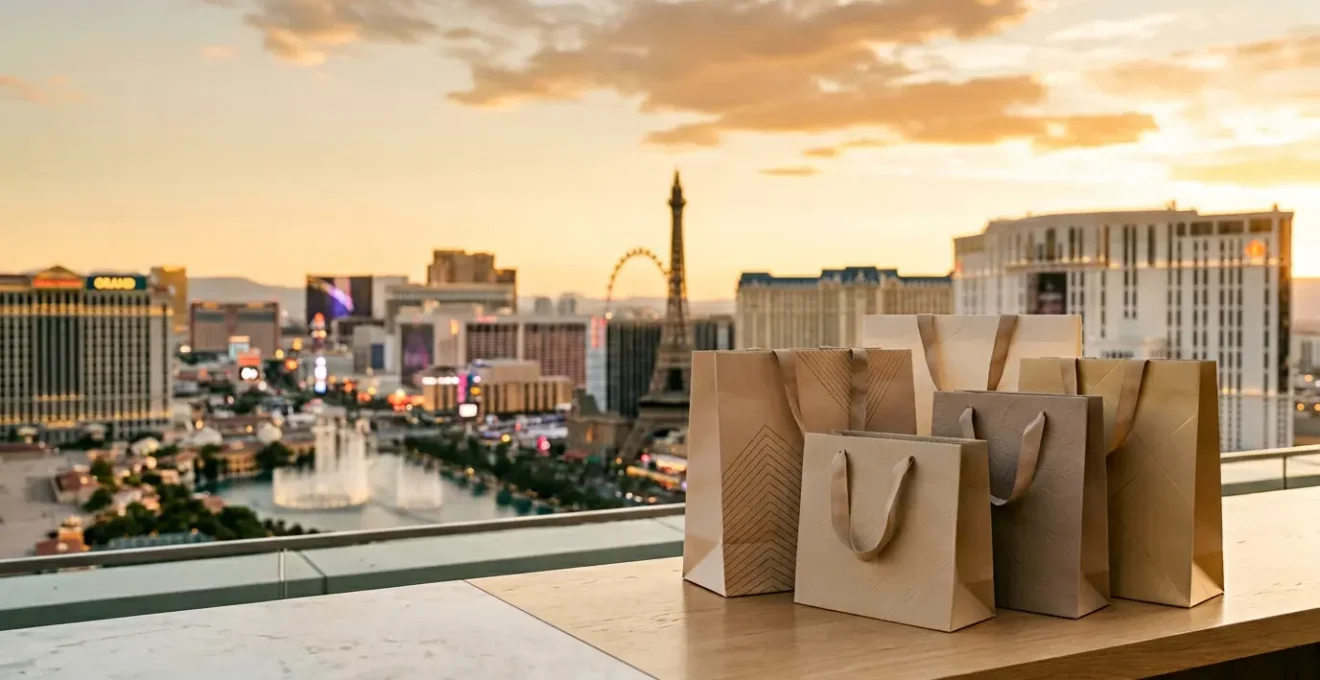
Contrary to popular belief, smart shopping in Vegas isn’t about finding sales—it’s about mastering the environment’s hidden psychological and logistical systems.
- Understand how casino psychology, mall design, and even air conditioning influence your spending decisions.
- Leverage strategic tipping and shipping as tactical tools to save more money than any coupon could.
Recommendation: Apply the ‘forensic shopping’ and ’24-hour rule’ frameworks to ensure every purchase is a savvy investment, not a vacation regret.
You’re a discerning shopper. At home, you navigate sales, identify quality, and curate a wardrobe with confidence. But Las Vegas is a different arena. The sheer scale of the luxury malls, the constant sensory input, and the intoxicating atmosphere can disarm even the most seasoned retail enthusiast. Suddenly, you find yourself questioning prices, battling crowds, and wondering if that sequined jacket is a brilliant find or a ‘vacation brain’ mistake.
Common advice tells you to hit the outlets or avoid hotel gift shops, but these are surface-level tactics. They don’t address the core of the issue: the entire Las Vegas Strip is a meticulously designed ecosystem engineered to separate you from your money, stylishly and efficiently. The real markup isn’t just on the price tag; it’s embedded in the psychology of the environment, the logistical challenges of a fly-in-fly-out trip, and the very air you breathe.
But what if you could turn this environment from your adversary into your ally? The secret to shopping the Strip like an insider isn’t about finding more discounts; it’s about developing your ‘Environmental IQ.’ It’s about understanding the systems at play—from the sales tax and shipping costs to the psychological triggers of a casino win—and leveraging them to your advantage. This guide isn’t a list of stores; it’s a playbook for mastering the art of the Las Vegas acquisition.
By understanding the unique mechanics of this retail landscape, you can navigate it with the same financial savvy and stylistic precision you command at home. We will explore the hidden costs, logistical hacks, psychological traps, and quality-control techniques that define truly successful Vegas retail therapy.
Summary: A Savvy Shopper’s Playbook for the Las Vegas Strip
- Why Shopping in Vegas Costs 8.38% More Than You Expect?
- How to Ship Your Shopping Spree Home to Avoid Airline Baggage Fees?
- Forum Shops or Crystals: Which Mall Fits Your Window Shopping Style?
- The Psychology of « Casino Winnings » That Leads to Bad Fashion Choices
- When to Visit Fashion Show Mall for End-of-Season Clearances?
- Why a $20 Tip to the Front Desk Works Better Than Politeness?
- Linen vs. Synthetic: Which Fabric Handles the Sweat-to-Freeze Transition Best?
- North Premium Outlets: How to Score Real Deals vs. « Made for Outlet » Trash?
Why Shopping in Vegas Costs 8.38% More Than You Expect?
The first surprise on your receipt isn’t a « tourist tax, » but a standard, non-negotiable one. Every purchase made on the Las Vegas Strip is subject to the Clark County sales tax. As a savvy shopper, the first number you need to internalize is the one that directly impacts your budget before you even consider a store’s markup. The baseline cost of every item is instantly inflated by the local tax rate.
Currently, that rate stands at a very specific figure. A review of Nevada’s tax regulations confirms the combined state and county rate is 8.375% for all retail sales in the area. This means a $1,000 handbag immediately becomes a $1,083.75 purchase at the register. Forgetting to factor this in is the most common budgeting error visitors make. It’s not a hidden fee, but its impact is often underestimated across multiple days of shopping.
However, it’s crucial to put this number in perspective. While it feels high, it’s competitive with other major US shopping destinations. New York City shoppers face a combined 8.875% tax, and those in Los Angeles contend with a 9.5% rate. So, while Vegas isn’t a tax haven, the initial sticker shock is on par with other luxury retail hubs. The real « Vegas markup » is more subtle, woven into the psychological and logistical challenges we’ll explore next, which is where true savings are found.
How to Ship Your Shopping Spree Home to Avoid Airline Baggage Fees?
The most significant hidden cost of a successful shopping trip often appears at the airport check-in counter. Airlines have transformed baggage into a major revenue stream, and an extra bag filled with your precious finds can easily wipe out the savings you so carefully secured. A successful shopping strategy must include a plan for getting your purchases home efficiently and affordably. This is a critical piece of logistical leverage.
Airlines are increasingly aggressive with their fees. Recent trends show that major US airlines have raised checked bag fees, with a first bag often costing $35-$45 and a second or overweight bag soaring past the $100 mark. This is where shipping becomes a tactical alternative rather than a mere convenience. The break-even point is typically when your purchases would either push your existing luggage over the 50lb weight limit or require a second checked bag entirely.
To make the right call, you need a decision framework. First, get a quote from the business center at your hotel; they offer convenience but often at a premium. For a more cost-effective solution, venture just off-Strip to a dedicated UPS Store or USPS location. Their flat-rate boxes can be a game-changer, often allowing you to ship up to 70lbs for a fixed price far below airline overweight fees. Before you buy, confirm the store’s return policy allows for mail-in returns, and always insure any shipment valued over $200. This foresight transforms a potential travel headache into a seamless part of your shopping experience.
Forum Shops or Crystals: Which Mall Fits Your Window Shopping Style?
Not all Vegas malls are created equal. They are distinct ecosystems, each designed to elicit a different psychological response. Choosing where to shop is as much about curating your mood as it is about the stores themselves. The two titans of Strip luxury, The Forum Shops at Caesars and The Shops at Crystals, offer a perfect case study in contrasting retail philosophies. Your choice between them depends on whether you seek high-energy « retail-tainment » or a serene, gallery-like sanctuary.

The Forum Shops are a masterclass in immersive, high-traffic spectacle. With its famous painted sky ceilings, animatronic statues, and direct integration with the bustling Caesars Palace casino floor, it’s an environment of constant stimulation. It’s vast, with over 160 stores, and the energy is palpable. Conversely, Crystals is an architectural statement. It is detached from the casino floor, filled with contemporary art, and designed with generous open spaces and natural light. It feels calmer, more exclusive, and encourages a slower, more contemplative pace of browsing its 50-plus high-luxury boutiques.
This table, based on information from the official Las Vegas visitor’s guide, breaks down the key differences to help you align your shopping style with the right environment.
| Feature | Forum Shops at Caesars | The Shops at Crystals |
|---|---|---|
| Atmosphere | High-energy retail-tainment, Roman theme | Serene architectural sanctuary, modern minimalist |
| Size & Stores | 160+ specialty shops | 50+ luxury boutiques |
| Casino Connection | Direct access to Caesars Palace casino floor | Detached from gaming, connected via Aria tram |
| Dining Options | Mix of food court and fine dining (15+ restaurants) | Limited upscale dining (4-5 restaurants) |
| Public Art | Animatronic shows, painted sky ceilings | Contemporary installations, 70-ft treehouse, water features |
| Crowd Density | High traffic, bustling energy | Lower density, spacious and calm |
| Seating Areas | Moderate, integrated with dining | Generous, gallery-style open spaces |
The Psychology of « Casino Winnings » That Leads to Bad Fashion Choices
One of the most powerful and insidious forces affecting your shopping judgment in Las Vegas has nothing to do with fashion. It’s the psychological phenomenon known as the « house money effect. » After an unexpected financial gain, like a jackpot at the slots or even a generous casino comp, your perception of that money changes. It doesn’t feel like your hard-earned salary; it feels like « free » money from the house, making you more likely to take risks with it—like splurging on an extravagant item you would never consider at home.
This isn’t just a feeling; it’s a documented cognitive bias. As Nobel laureate Richard H. Thaler’s foundational research on the topic found, people’s behavior shifts after a windfall. In his work, he noted that individuals tended to become more risk-seeking after experiencing an unexpected gain. This is the moment of maximum vulnerability for a shopper. The euphoria of winning can directly lead to a purchase driven by emotion rather than style or value, resulting in what can only be called a « bad fashion choice. » Acknowledging this psychological pull is the first step toward resisting it.
Interestingly, while this effect is well-documented in labs, some field research suggests a more complex reality. One study of actual casino players found that some gamblers became more cautious after a big win, highlighting that personal financial awareness can act as a buffer. The key is to cultivate that awareness with a conscious strategy. Achieving this emotional sobriety in shopping requires a firm set of personal rules.
Your Action Plan: The 24-Hour Rule for Emotional Sobriety
- Set a Cooling-Off Threshold: Mandate a 24-hour delay for any non-essential purchase over a set amount (e.g., $200) after any casino win or significant comp.
- Separate Your Budgets: Physically separate gambling winnings from your shopping money. Use a different pocket or a dedicated envelope to break the mental connection.
- Conduct an Emotional Check-In: Before buying, ask yourself: « Am I buying this because I genuinely love it, or because I feel like a high roller right now? »
- Take a Photo, Not the Item: Capture the item on your phone. Revisit the photo 24 hours later, far from the casino’s influence, to see if the desire remains.
- Apply the ‘Hometown Test’: Ask the final question: « Would I buy this at home for this price? » If the answer is no, it’s a hard pass.
When to Visit Fashion Show Mall for End-of-Season Clearances?
Timing is everything, especially at a retail behemoth like Fashion Show Mall. As the largest shopping destination on the Strip, its sheer scale—over 2 million square feet with 250+ stores—means that knowing *when* to go is as important as knowing *where* to go. While national sales cycles like late July and early January are reliable, the savviest shoppers overlay that knowledge with a Vegas-specific calendar.
The city’s unique rhythm is driven by its massive convention industry. The secret is to shop in the immediate aftermath of major trade shows. For example, target the week directly following CES in January or the MAGIC fashion trade show in February and August. During these events, stores stock up on full-priced inventory to appeal to the influx of visitors. Once the crowds depart, they are often quick to mark down the excess event-driven merchandise. Avoid the convention weeks themselves, when stores are at their busiest and least likely to offer deals.
For optimal timing, plan your visit for a Tuesday or Wednesday morning between 10 and 11 AM. At this time, you benefit from several factors: new markdowns from the weekend have just been processed, the crowds are minimal, and sales associates are more available to provide personalized attention or check for additional stock. For an even greater edge, use your hotel’s concierge. A quick call from them to the major department stores like Saks, Neiman Marcus, or Nordstrom can often yield information about upcoming private sale events not advertised to the general public.
Why a $20 Tip to the Front Desk Works Better Than Politeness?
In the service-driven economy of Las Vegas, politeness is expected, but a strategic tip is a tool. Thinking of a $20 bill passed to the front desk agent at check-in not as a bribe for an upgrade, but as a tactical investment in your shopping logistics, is an insider’s move. This single act establishes you as a guest worth paying attention to and unlocks a level of support that will become invaluable during a major shopping spree.

The initial tip, offered discreetly with your ID and credit card, immediately creates goodwill. This is your moment to build a support system. Mention that you’re in town for some serious shopping and will be receiving several packages. A front desk agent who has been tipped is far more likely to graciously accept, organize, and securely hold your deliveries without issue. This simple act can save you the immense hassle of coordinating with couriers or worrying about packages left in a massive hotel mailroom.
This initial investment pays dividends throughout your stay. It paves the way for later requests, such as securing extra storage space for your haul or getting prompt bellman assistance at checkout. Furthermore, you can leverage this relationship by asking your friendly agent for a « warm introduction » to the concierge. This secondary connection is your key to unlocking services like having them call stores to check on specific inventory, booking a personal shopper, or securing a last-minute reservation at a popular restaurant inside one of the malls. Remember to get the agent’s name; returning to them with small, subsequent tips for their help reinforces the relationship and ensures you receive priority service.
Linen vs. Synthetic: Which Fabric Handles the Sweat-to-Freeze Transition Best?
Dressing for a day of shopping in Vegas is a unique sartorial challenge. You’ll be transitioning between the blistering 110°F (43°C) heat of the Strip and the aggressively air-conditioned 68°F (20°C) interiors of malls and casinos. This constant, extreme temperature shock means your fabric choice is not just a matter of style, but of survival. The wrong material can leave you sweating outdoors and shivering indoors, a combination that quickly drains your shopping stamina. Your clothing must perform like technical gear.
Natural fabrics like linen and cotton are fantastic in the heat, offering excellent breathability. However, they provide almost no insulation and can retain moisture, leading to a chilling effect once you step inside. On the other hand, standard synthetics like polyester might resist wrinkles but can trap heat and odor outdoors. The true champion of this environment is a fabric that can regulate temperature in both extremes. This matrix breaks down how common fabrics perform in the Vegas climate.
| Fabric Type | Heat Performance (110°F Outdoor) | AC Performance (68°F Indoor) | Odor Resistance | Wrinkle Resistance |
|---|---|---|---|---|
| Linen | Excellent – Breathable, moisture-wicking | Poor – Provides no insulation, chilling effect | Fair – Requires frequent washing | Poor – Wrinkles easily |
| Cotton | Good – Breathable but retains moisture | Fair – Minimal insulation | Fair – Absorbs odors | Fair – Moderate wrinkling |
| Synthetic (Polyester blends) | Fair – Can trap heat and sweat | Good – Dries quickly in AC | Poor – Traps body odor | Excellent – Resists wrinkles |
| Merino Wool (Lightweight) | Excellent – Breathable, temperature-regulating | Excellent – Insulates without overheating | Excellent – Natural antimicrobial properties | Good – Naturally resists wrinkles |
The solution is a strategic layering system built around high-performance fabrics. Start with a base layer of lightweight merino wool or a technical moisture-wicking tee. Merino is the star player here: it’s breathable in the heat and insulating in the cold. Always carry a packable mid-layer, like a thin cashmere cardigan or a versatile pashmina, in your shopping tote. This is your primary weapon against the indoor chill. This approach ensures your comfort is never compromised, allowing you to focus on the task at hand: finding those perfect pieces.
Key takeaways
- Mastering the Vegas shopping ecosystem—its psychology, logistics, and timing—is more valuable than any single discount.
- Treat logistical elements like shipping and strategic tipping not as chores, but as integral parts of your budget strategy to maximize value.
- At outlet malls, a ‘forensic’ approach to quality inspection is essential to distinguish genuine mainline deals from inferior ‘made-for-outlet’ products.
North Premium Outlets: How to Score Real Deals vs. « Made for Outlet » Trash?
The promise of outlet shopping is tantalizing: designer brands at a fraction of the retail price. The Las Vegas North Premium Outlets, featuring 175+ outlets with purported savings up to 65%, is a mandatory stop for any deal-hunter. However, the savvy shopper knows that not all outlet merchandise is created equal. Many items are « made-for-outlet »—products manufactured specifically for these stores using lower-quality materials and simplified construction. The real art is distinguishing these items from true mainline overstock, which represents a genuine bargain.

To do this, you must adopt a forensic shopping mindset. Your eyes and hands are your best tools. Ignore the alluring « Compare At » price tags, which are often inflated and meaningless for made-for-outlet goods. Instead, focus on tangible evidence. A true mainline item that has been moved to an outlet will often have a price tag with multiple markdown stickers layered on top of each other. A single, clean price tag is a red flag.
Your inspection should go deeper. Examine the hardware: are the zippers from a reputable brand like YKK, or are they unbranded and flimsy? Feel the weight of the fabric and check the stitch density; made-for-outlet items often cut costs with thinner materials and wider, less durable stitching. Finally, use technology as your ally. Use an app like Google Lens to search for an image of the item. If it only appears on outlet-affiliated websites or has no history on the brand’s primary retail site, it was likely made for the outlet. If you find it in a past season’s lookbook on the main brand site, you’ve found a genuine deal.
Your Action Plan: The Forensic Guide to Outlet Shopping
- Tag Inspection: Look for multiple, layered markdown stickers. A single printed ‘compare at’ price suggests made-for-outlet.
- Label Forensics: Check the inner brand label for small, discreet symbols (dots, squares) that are often secret codes for outlet-specific production.
- The Digital Litmus Test: Use Google Lens to image-search the item. If it has no history on the brand’s main website, it’s not a mainline deal.
- Hardware Quality Check: Scrutinize zippers, buttons, and linings. These hidden details are where costs are cut on lower-quality versions.
- Seam and Fabric Density Test: Feel the material’s thickness and examine the stitches per inch. Thinner fabrics and wider stitching are red flags.
Now that you possess the insider’s playbook, you are equipped to navigate the Las Vegas retail landscape with precision and confidence. It’s time to put these strategies into practice. Shop with intelligence, style, and make your next Vegas haul your most savvy and satisfying one yet.