
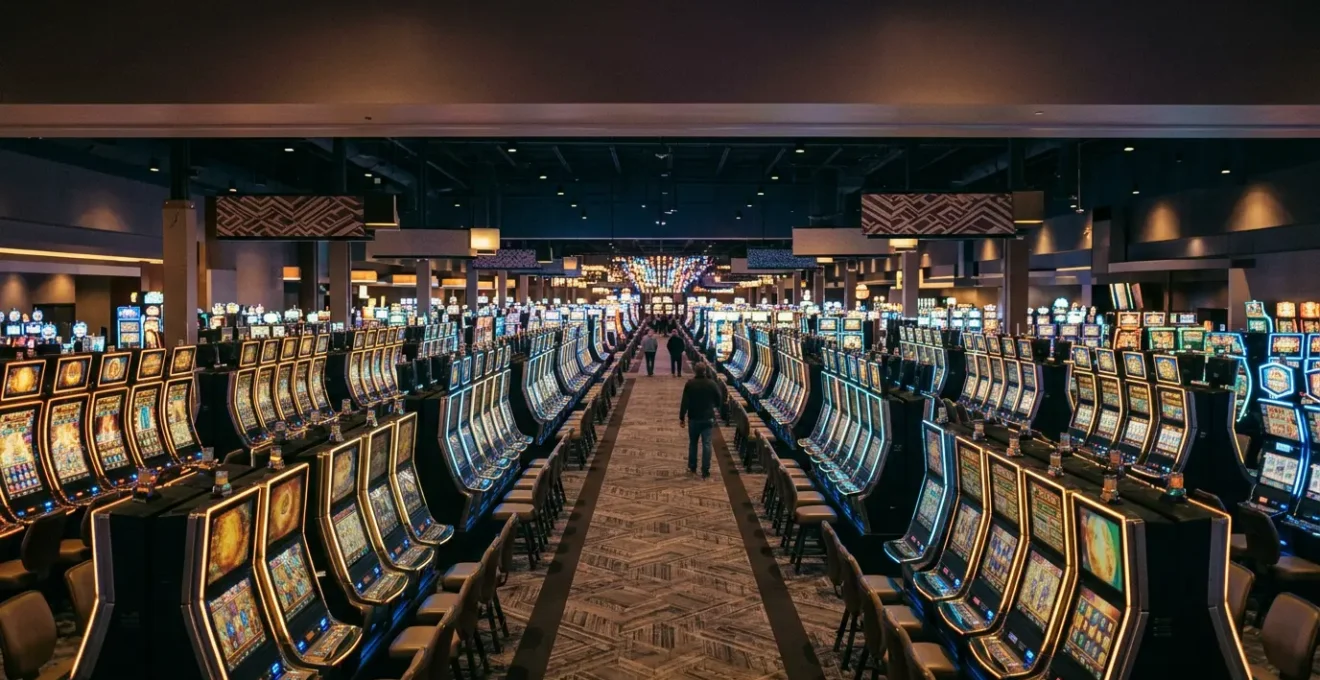
Contrary to popular belief, picking a « winning » slot isn’t about location or luck; it’s about understanding its core engineering and mathematical design.
- Slot machine placement is random; end-of-aisle machines are not « looser. » Their performance is dictated by a Random Number Generator (RNG), not location.
- Key metrics like Volatility (payout frequency) and RTP (Return to Player) are the true indicators of a machine’s behavior, not superficial branding or bet size.
Recommendation: Shift your goal from « finding a lucky machine » to « selecting a machine whose mathematical profile aligns with your budget and entertainment goals. »
The casino floor is an overwhelming sensory assault. Thousands of machines, a symphony of electronic jingles, and rows of flashing lights all blur into one intimidating question: where do you even start? Faced with over 2,000 options, most players fall back on long-standing myths. They search for the « hot » machine that just paid out, avoid the « cold » one, or gravitate towards the prominent slots at the end of an aisle, believing they hold a secret advantage. Others assume that the time of day or the size of the crowd influences their odds.
From a technician’s perspective, these strategies are based on flawed logic. The casino’s profitability is built on a foundation of precise mathematics and sophisticated psychological engineering, not on chance placements or lucky streaks. The idea that a casino would intentionally place higher-paying machines in certain spots is a relic of a bygone era; modern slots are governed by silicon chips and server-based settings that make such physical strategies obsolete.
But what if the real secret wasn’t about finding a lucky machine, but about learning to deconstruct its design? This guide provides a technician’s-eye view, moving beyond the myths to reveal the mechanical and mathematical truths. We will dissect the core concepts of volatility and RTP, expose the financial traps hidden in plain sight, and explore the psychological architecture designed to keep you playing. By understanding how a machine is built, you can transform from a hopeful gambler into an informed strategist.
This article demystifies the complex world of slot machines by breaking down their core components. The following sections will equip you with the technical knowledge needed to analyze a game’s true nature, from its mathematical programming to its psychological triggers, allowing you to make smarter, more informed decisions on the casino floor.
Summary: Decoding the Secrets of Slot Machine Selection
- Why Machines at the End of the Aisle Are No Looser Than Others?
- How to Understand « Volatility » Before You Insert Your $100 Bill?
- Wheel of Fortune vs. Generic Reels: Which Has the Better RTP?
- The « Max Bet » Error That Drains Bankrolls on Penny Slots
- When to Play a « Must Hit By » Progressive Slot?
- How Slot Sound Effects Are Tuned to Keep You Playing?
- Why the Triple Zero Wheel Is the Worst Bet in Las Vegas History?
- Orchestrated Atmospheres: Why You Lose Track of Time Inside a Casino?
Why Machines at the End of the Aisle Are No Looser Than Others?
The most persistent myth on the casino floor is that of the « loose » machine strategically placed at the end of an aisle to entice passersby. The theory suggests that visible wins in high-traffic areas create a contagious excitement. However, the mechanical reality of modern casinos renders this idea obsolete. Every single spin on a contemporary slot machine is determined by a computer chip called a Random Number Generator (RNG). This microprocessor cycles through billions of number combinations per second. The instant you press « spin, » the RNG selects a number that corresponds to a specific outcome on the reels. This outcome is completely independent of previous spins, the machine’s location, or the time of day.
From a casino management standpoint, randomizing machine payouts is far more efficient and secure than physically placing « looser » machines in specific spots. Slot floor managers can adjust the theoretical Return to Player (RTP) percentage across banks of machines from a central server, but they do so to manage overall revenue targets, not to create individual hot spots. As the gaming analyst known as the Wizard of Odds confirms, this theory has been thoroughly debunked.
In reality, independent research confirmed that either all machines are set to the same payback level or placement is random, and a casino slot machine technician confirms that the casino doesn’t put higher-paying slots in certain areas.
– Wizard of Odds, Slot Machine Returns (RTP) Analysis
The perceived « looseness » of a machine is a product of short-term variance, not deliberate placement. A player might witness a jackpot on an end-cap machine and attribute it to location, falling victim to confirmation bias. The truth is that the machine in the darkest, most secluded corner of the casino operates on the exact same mathematical principles. Focusing on location is a distraction from the factors that truly matter: a machine’s volatility and its programmed RTP.
How to Understand « Volatility » Before You Insert Your $100 Bill?
If placement doesn’t matter, what does? The single most important technical attribute to understand before playing a slot is its volatility, also known as variance. This metric has nothing to do with how « loose » or « tight » a machine is in the long run; instead, it defines the machine’s « payout rhythm. » Volatility tells you how frequently you can expect to win and how large those wins are likely to be. Ignoring this factor is the quickest way to mismatch a machine to your bankroll and playing style, leading to a frustrating and short-lived experience.
Volatility exists on a spectrum:
- Low-Volatility Machines: These games are designed for longer play sessions. They award wins frequently, but the payouts are typically small, often less than your original bet. They are great for players with a smaller bankroll who want to maximize their time on the machine.
- High-Volatility Machines: These are the jackpot-chasers. They feature long dry spells with very few wins, but they hold the potential for massive, life-changing payouts. They require a substantial bankroll and the patience to withstand significant swings.
- Medium-Volatility Machines: These offer a balance between the two, providing a mix of smaller, frequent hits and the occasional substantial bonus round or large line hit.
A machine’s paytable is the technical manual for diagnosing its volatility. A paytable crowded with many different winning combinations that pay out small amounts is a hallmark of a low-volatility game. Conversely, if you see a huge top-heavy jackpot and fewer, higher-paying mid-range combinations, you’re likely looking at a high-volatility machine.

As the image shows, the structure of the win combinations provides visual clues. Learning to read this structure is more valuable than any myth about a machine’s location. By understanding the payout rhythm you’re signing up for, you can align your expectations with the mathematical reality of the game.
Action Plan: Auditing a Slot’s Volatility Profile
- Assess the Paytable: Look at the gap between a 4-of-a-kind and a 5-of-a-kind win. A massive jump (e.g., 100 credits to 2,000 credits) signals high volatility.
- Identify the Jackpot Structure: Does it have a single, giant progressive jackpot? This almost always indicates a high-volatility design, as a portion of each bet feeds the top prize.
- Analyze Bonus Features: Are the bonuses simple « pick ’em » games with modest prizes (low volatility) or complex free-spin rounds with stacking multipliers that can lead to huge payouts (high volatility)?
- Check the Denomination: While not a perfect rule, penny slots with hundreds of paylines often have a lower volatility design to provide constant small wins and keep players engaged.
- Observe a Demo: If playing online, use the free-play mode for 50 spins. Note the frequency and size of the wins to get a practical feel for its rhythm.
Wheel of Fortune vs. Generic Reels: Which Has the Better RTP?
Once you understand a machine’s payout rhythm (volatility), the next critical piece of engineering to consider is the Return to Player (RTP). Expressed as a percentage, RTP is a theoretical calculation of how much of the total money wagered on a machine is paid back to players over millions of spins. If a machine has a 96% RTP, it means that for every $100 bet, it is programmed to pay back $96 on average over its lifetime. The remaining 4% is the house edge. While a good RTP is typically 96 percent or higher in the competitive online market, land-based casinos often have lower RTPs, sometimes dipping into the 88-93% range.
A common mistake players make is flocking to big, branded machines like Wheel of Fortune, The Walking Dead, or Game of Thrones. These games are visually spectacular and leverage popular culture to draw you in. However, that branding comes at a high cost. The game manufacturer has to pay a significant licensing fee to the brand owner. From a technician’s standpoint, this cost has to be recouped from somewhere, and it’s often done by lowering the machine’s RTP.
In contrast, non-branded, « generic » titles developed in-house by manufacturers like IGT, Aristocrat, or NetEnt don’t carry this financial baggage. Without the need to pay licensing fees, the manufacturer can afford to program a higher RTP, offering better long-term value to the player while still maintaining their profit margin. This is why some of the most enduring and popular slots among seasoned players are often the less flashy, generic-themed games with superior mathematical models.
Case Study: The Enduring Power of a High RTP in ‘Blood Suckers’
NetEnt’s « Blood Suckers » slot is a perfect example of a non-branded game thriving due to its superior engineering. Launched in 2013, this horror-themed game features a massive 98% RTP, a figure rarely seen in the industry. It offers engaging bonus features and a solid payout structure without relying on a famous movie or TV show. The game’s long-term popularity is not due to flashy graphics but to its mathematical generosity. By forgoing expensive licensing fees, NetEnt was able to build a game with a tiny 2% house edge, creating a cult following among players who prioritize mathematical value over pop-culture appeal.
While a branded slot might offer a more cinematic experience, a player focused on strategy should always prioritize the underlying math. The generic-looking machine in the corner might just offer the best value on the entire floor.
The « Max Bet » Error That Drains Bankrolls on Penny Slots
The term « penny slot » is one of the most misleading concepts on the casino floor. It creates a psychological illusion of low-cost entertainment, but in reality, these machines are often engineered to be some of the most expensive games to play. The « penny » simply refers to the base denomination, not the actual cost per spin. Modern penny slots can have 40, 50, or even hundreds of paylines, and they often require you to bet multiple credits per line. Hitting the « Max Bet » button on what you think is a cheap game can result in a spin costing $2, $5, or more.
This design creates a significant financial trap. Players are psychologically anchored to the « penny » label, making a $2.00 spin feel less significant than a single $1.00 bet on a dollar machine. Yet, they are risking more money on a machine that often has a lower Return to Player. To compensate for the low denomination and smaller individual wagers, casinos typically program penny slots with a worse house edge. While a dollar machine might offer a 95% RTP, penny slots can have an RTP as low as 86-93%.
The combination of a high cost-per-spin and a low RTP makes the « max bet » strategy on a penny slot a recipe for rapid bankroll depletion. You are wagering more money per spin for a smaller theoretical return. An informed player understands that the true cost of a machine is the bet per spin, not the denomination label on the glass.
The table below breaks down this hidden cost, showing how a « penny » slot can quickly become more expensive than a traditional quarter or dollar machine.
| Machine Label | Lines Active | Credits Per Line | Denomination | Actual Cost Per Spin | Credits Displayed |
|---|---|---|---|---|---|
| « Penny » Slot | 40 | 5 | $0.01 | $2.00 | 200 credits |
| « Penny » Slot (Max Bet) | 50 | 10 | $0.01 | $5.00 | 500 credits |
| Quarter Slot (Conservative) | 25 | 1 | $0.25 | $6.25 | 25 credits |
| Dollar Slot (Single Line) | 1 | 1 | $1.00 | 1 credit |
When to Play a « Must Hit By » Progressive Slot?
For the most part, every spin on a slot machine is a negative expectation bet; the house always has the edge. However, there is a rare and specific type of machine where the odds can temporarily shift in the player’s favor: the « Must Hit By » progressive. Unlike traditional progressives that grow indefinitely, these jackpots are programmed to guarantee a payout before the prize pool reaches a specific, visible dollar amount (e.g., « Must Hit By $500 »).
This creates a unique strategic opportunity. As the current jackpot amount gets closer and closer to its mandatory payout ceiling, the machine’s effective RTP for that specific period of play increases. At a certain point, the value of the guaranteed jackpot becomes large enough to overcome the machine’s base house edge, creating a positive expectation (+EV) scenario for the player. This is one of the few instances of true « advantage play » available on a casino floor, a concept well-known to professional gamblers.
As with any progressive game, at some point the jackpot becomes large enough to sway the odds in the player’s favor.
– Michael Shackleford (The Wizard of Odds), Must-Hit-By Progressives Analysis
The key is identifying the tipping point. While the exact math is complex, a common rule of thumb among advantage players is to start playing when the jackpot is within the final 10-15% of its cap. So, on a « Must Hit By $500 » machine, the game becomes strategically interesting when the meter climbs above $425-$450. The closer it gets to $500, the stronger the player’s advantage becomes. Finding a machine in this state is rare, as they are often swarmed by knowledgeable players, but it’s an opportunity worth looking for.
Real-World Example: Capturing a Positive Expectation Progressive
A player documented finding a Konami machine with a « Must Hit By $50 » progressive that was already at $48.50. Crucially, they observed that the meter increased based on the amount bet, not on winning spins, and it moved quickly—about one cent for every $2.50 played. With only $1.50 left until the cap and a rapid progression rate, the theoretical value was overwhelmingly positive. The player began playing and successfully won the progressive, demonstrating how identifying a machine close to its cap, combined with understanding its meter-move rate, creates a genuine, verifiable mathematical advantage.
Hunting for these opportunities requires patience and a keen eye, but it represents the pinnacle of strategic slot play—turning the casino’s own game mechanics against itself.
How Slot Sound Effects Are Tuned to Keep You Playing?
Beyond the raw mathematics of RTP and volatility, a slot machine’s engineering extends deep into the realm of psychology. The sound design is not an afterthought; it is a meticulously crafted tool designed to shape your betting behavior and emotional state. Casinos understand that sound can override rational thought, and they use it to encourage riskier decision-making and prolong play sessions. The cacophony of the casino floor isn’t random noise—it’s a carefully orchestrated symphony of persuasion.
One of the most powerful techniques is the use of celebratory sounds for « losses disguised as wins » (LDWs). An LDW occurs when a machine pays out an amount less than your total bet. For example, you bet $2.00 and win back $0.50. You have lost $1.50, but the machine celebrates with the same jingles, music, and flashing lights as a genuine win. This auditory reinforcement conditions your brain to feel rewarded even when you are losing money, blurring the line between winning and losing and encouraging you to keep spinning.
Research has scientifically validated this effect. Studies using eye-tracking technology have shown that engaging audio-visual cues can distract players from crucial information, like the actual odds of winning. When the brain is processing celebratory sounds and money-related imagery, its capacity for rational risk assessment is diminished.

As this image of a speaker suggests, the sound is an active, vibrating force on the casino floor. According to a study from the University of British Columbia, these auditory cues are not just background noise. Dr. Catharine Winstanley, the study’s senior author, found that these elements directly influence behavior, stating that people were paying less attention to information about their odds when these casino jingles accompanied the outcomes. The soundscape is engineered to keep your analytical brain offline and your emotional brain engaged.
Why the Triple Zero Wheel Is the Worst Bet in Las Vegas History?
To truly appreciate the mathematical landscape of slot machines, it’s useful to contextualize their house edge against other casino games. While a slot’s RTP can vary wildly, some games have a fixed, transparent, and often brutal mathematical structure. The most egregious example in modern casino history is the Triple-Zero Roulette wheel. This variation adds a « 000 » pocket to the standard American double-zero (« 0 », « 00 ») wheel, increasing the total number of pockets to 39 while keeping the payouts the same as a single-zero wheel (35-to-1 for a straight-up bet).
This single change has a catastrophic effect on the house edge. In traditional European (single-zero) roulette, the house edge is 2.7%. The American double-zero wheel, long considered a less favorable game, nearly doubles that to 5.26%. The triple-zero wheel, however, skyrockets the house advantage to a staggering 7.69%. This means for every $100 you bet, you are mathematically expected to lose $7.69. It is one of the worst bets you can make on a casino floor, far exceeding the edge on games like Blackjack, Craps, or Baccarat when played with optimal strategy.
Comparing these fixed odds helps put slot machine RTPs into perspective. A slot with a 96% RTP carries a 4% house edge, making it a mathematically superior bet to double-zero roulette and vastly better than triple-zero roulette. However, a low-performing penny slot with an 88% RTP has a 12% house edge—even worse than the triple-zero wheel. This comparison underscores why understanding a slot’s programmed RTP is not just an academic exercise; it’s a critical tool for financial self-preservation.
The following table starkly illustrates where these different games fall on the spectrum of value, demonstrating the cost of making uninformed choices.
| Game Type | House Edge | Cost Per $100 Wagered | Equivalent Hourly Cost (60 bets/hour) |
|---|---|---|---|
| Triple-Zero Roulette | 7.69% | $7.69 | $461.40 |
| Double-Zero Roulette | 5.26% | $5.26 | $315.60 |
| Typical Penny Slot (Low) | 9% | $9.00 | ~$360 (var.) |
| Typical Penny Slot (High) | 14% | $14.00 | ~$560 (var.) |
| Average Slot Machine | 5-10% | $5-$10 | $300-$600 |
| 96% RTP Slot | 4% | $4.00 | $240 |
Key Takeaways
- The location of a slot machine is irrelevant; its performance is governed by a Random Number Generator (RNG) and its programmed RTP.
- Volatility (payout frequency and size) and RTP (long-term payback percentage) are the two most critical metrics for selecting a machine that fits your goals and budget.
- Branded slots often have lower RTPs to cover licensing fees, while « penny slots » can be deceptive, carrying a high cost-per-spin and poor odds.
Orchestrated Atmospheres: Why You Lose Track of Time Inside a Casino?
The final layer of engineering to understand is the casino environment itself. The maze-like layouts, the absence of clocks and windows, and the constant, low-level hum of activity are all part of a deliberate design strategy known as « sensory immersion. » The goal is to make you lose track of time and detach from the outside world, keeping you in a state of continuous play. Sound plays a pivotal role in this orchestrated atmosphere, influencing not just your risk tolerance but your very perception of time.
Research has shown that the type and tempo of ambient music can significantly distort a player’s estimation of how long they’ve been gambling. A study published in the Journal of Environmental Psychology found that slow-tempo music, particularly when played at a high volume, leads players to underestimate the duration of their play session. Your brain gets absorbed in the « flow » of the game, and the slow, steady audio environment fails to provide the temporal cues that would normally signal the passage of time. An hour can feel like twenty minutes, leading you to play—and lose—far longer than you originally intended.
This environmental manipulation is the macro version of the psychological tricks embedded within each individual machine. It’s a holistic system designed to maximize « time on device. » While the quality of audio can enhance enjoyment for many players—with over 70% of players saying it impacts their enjoyment—that enjoyment is a carefully engineered byproduct of a system designed for profit. The pleasant atmosphere is not an act of hospitality; it is a tool of retention.
Recognizing that the entire environment is a piece of psychological architecture is the final step in becoming an informed player. You are not just playing against a machine; you are playing inside a machine. By being aware of these subtle influences, you can consciously re-assert control, set firm time and loss limits, and walk away when you’ve reached them, regardless of how pleasant the atmosphere might feel.
The next time you walk onto a casino floor, do so not as a hopeful participant, but as a cool-headed analyst. Look past the flashing lights and brand names. Instead, evaluate a machine’s volatility, seek out its RTP, understand its true cost-per-spin, and remain consciously aware of the environmental psychology at play. This shift in perspective is the only strategy that truly puts you in control.