
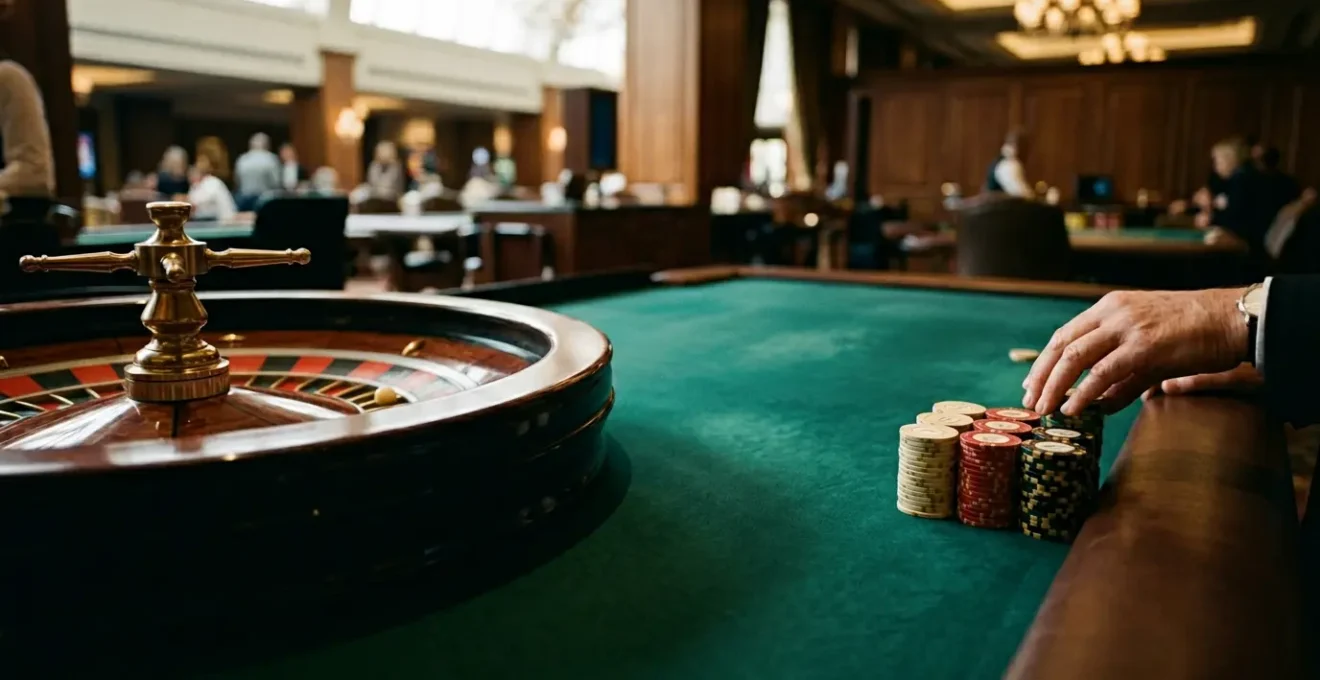
The secret to leaving the roulette table happy isn’t a « winning system, » but understanding you’re paying for entertainment and knowing how to manage that cost.
- The wheel you choose (single-zero is a must!) has a far bigger impact on your long-term results than any betting pattern.
- Negative progression systems like Martingale are a mathematical trap, designed to accelerate you toward the table limit or an empty wallet.
Recommendation: Stop chasing wins and start managing your « entertainment cost » per hour by choosing the right game, understanding the odds, and setting firm limits.
Picture the scene: the vibrant energy of the casino, the mesmerizing spin of the roulette wheel, the collective gasp as the ball settles. It’s a thrill social gamblers love. The problem? That thrill often ends too quickly, especially at a $25 minimum table where a session bankroll can evaporate in what feels like minutes. Many players look for complex betting systems or « guaranteed win » strategies, hoping to find a secret code to beat the house. They might tell you to « just bet on black » or double your bet after every loss.
But what if the key isn’t about finding a magic formula to win, but about fundamentally reframing the goal? As a casino math teacher, I’m here to tell you the house always has an edge. You cannot beat the math. However, you absolutely can manage it. The real strategy is to minimize the « cost of entertainment » by understanding the game’s mathematical structure and your own psychology. It’s about buying the most time, the most fun, and the most thrilling moments for your budget, not about finding a mythical path to riches.
This guide will walk you through the essential mathematical and psychological truths of roulette. We will dissect the good, the bad, and the outright terrible bets, explore common psychological traps, and even touch on lessons we can learn from other casino games. By the end, you’ll be equipped to sit down at that $25 table not as a hopeful victim, but as an informed player in control of your experience.
Summary: A Math Teacher’s Guide to Bankroll Longevity at the Roulette Table
- Why the Triple Zero Wheel Is the Worst Bet in Las Vegas History?
- How to Use the Martingale System Without Hitting the Table Limit?
- European vs. American Roulette: Which Wheel Cuts the House Edge in Half?
- The « Guaranteed Win » Fallacy That Sells PDF Guides for $50
- When to Place Your Chips to Avoid Annoying the Croupier?
- Why Machines at the End of the Aisle Are No Looser Than Others?
- The Psychology of « Casino Winnings » That Leads to Bad Fashion Choices
- Slot Floor Secrets: How to Pick a Winning Machine Among 2,000 Options?
Why the Triple Zero Wheel Is the Worst Bet in Las Vegas History?
Alright class, let’s start with the most important lesson in « Mathematical Hygiene. » Before you even think about your bet, you must choose your table. Your single most impactful decision is avoiding the Triple Zero (0, 00, 000) roulette wheel. Think of the house edge as an unavoidable « tax » on every dollar you wager. On a standard American double-zero wheel, this tax is 5.26%. Annoying, but a known quantity. However, some casinos introduced the triple-zero wheel, which dramatically increases that tax without offering you any better payouts.
The math is brutal and simple. By adding that third zero pocket, the house edge skyrockets. We’re not talking about a small jump; it’s a massive leap to a 7.69% house edge. This means that for every $100 you bet, the casino mathematically expects to keep $7.69, compared to $5.26 on a standard wheel. This is a 46% increase in the casino’s favor, and it’s a cost you pay for with your bankroll’s lifespan. It is, without a doubt, one of the worst bets you can find on the entire casino floor.
Let’s make this tangible. A detailed analysis of expected hourly loss puts this in stark perspective. Playing at a $25 minimum table with about 60 spins per hour, your expected loss on a double-zero wheel is about $79. On a triple-zero wheel, that same hour of play is projected to cost you $115. That’s an extra $36 vanishing from your pocket every hour for the exact same « fun. » Choosing a triple-zero wheel is like volunteering to pay nearly 50% more for the same product. As your teacher, I’m telling you: just walk away.
How to Use the Martingale System Without Hitting the Table Limit?
Here’s a question I get all the time: « What about the Martingale system? Just double your bet after every loss. You have to win eventually, right? » This leads us to our second lesson: betting systems don’t defeat math, they just provide a structured way to lose your money. The Martingale is particularly seductive because it feels intuitive. It promises to recoup all your losses plus a small profit with a single win. The problem? It’s a direct path to one of two catastrophic events: hitting the table limit or completely draining your bankroll.
Imagine starting with a $25 bet. You lose. Now you bet $50. Lose again. $100. Then $200, $400, $800… Notice how quickly that escalates? After just six consecutive losses, you’re needing to bet $1,600 on a single spin to stick to the system. Most tables have a limit of $2,000 or $5,000, which you can hit surprisingly fast. Gambler’s intuition often underestimates the probability of long losing streaks. As noted in a mathematical analysis of the Martingale system, the reality is far harsher.
A streak of 6 losses in a row occurs approximately 84% of the time during 200 plays, and 10 consecutive losses have an 11% chance in the same session—probabilities far higher than most players intuitively believe.
– Wikipedia contributors, Martingale betting system mathematical analysis
So, how do you use the Martingale system without hitting the table limit? The only correct answer is: you don’t. It’s a mathematical trap. Instead of trying to find a « safe » way to use a flawed system, a smarter player accepts that short-term wins are possible, but the long-term risk of ruin is unacceptably high. Your goal is to maximize time at the table, and the Martingale is designed to do the exact opposite by either forcing a massive win or a swift, total loss.
European vs. American Roulette: Which Wheel Cuts the House Edge in Half?
Now that we’ve established that the triple-zero wheel is a financial black hole, let’s look at the best-case scenario. This brings us to a fundamental choice every informed player must make: seeking out European Roulette. The difference is subtle but mathematically profound. An American wheel has 38 pockets (1-36, plus 0 and 00). A European wheel has only 37 pockets (1-36, plus a single 0). Removing that one « 00 » pocket is the single most beneficial structural change for the player.
By removing that pocket, the house edge plummets from 5.26% to just 2.70%. That’s not a small adjustment; it literally cuts the casino’s advantage by nearly half. This single difference dramatically improves your odds and extends the life of your bankroll. For players making even-money bets (like red/black or odd/even), some European tables offer rules like « La Partage » or « En Prison. » With these rules, if the ball lands on zero, you either get half your bet back or it stays for the next spin. This is a huge boon for the player, as it further reduces the house edge on those specific bets to a mere 1.35%.
This isn’t just abstract math; it has a direct and significant impact on your wallet, as the data clearly shows.
| Roulette Type | Number of Pockets | House Edge (Standard) | House Edge (With La Partage/En Prison) | Expected Loss Per 100 Spins at $25/Spin |
|---|---|---|---|---|
| European Roulette | 37 (single zero) | 2.70% | 1.35% (even-money bets only) | $67.50 |
| American Roulette | 38 (double zero) | 5.26% | Not available | $131.50 |
| Difference | 1 extra pocket | +2.56% | — | +$64 (95% more costly) |
As you can see from this comparative analysis, playing on an American wheel is almost twice as costly over the long run. If your goal is to make your bankroll last, finding a single-zero European wheel is not just a preference; it’s a strategic imperative.
The « Guaranteed Win » Fallacy That Sells PDF Guides for $50
If you spend enough time searching for roulette strategies online, you’ll inevitably encounter a cottage industry of scams. These often come in the form of a PDF guide, a software program, or a « secret method » for sale, all promising the one thing that is mathematically impossible: a guaranteed win. These systems prey on the hope that there’s a loophole in the game that only a select few know about. They are, without exception, a fallacy built on flawed logic and designed to separate you from your money before you even get to the casino.
These scams often use sophisticated language, talking about « predicting algorithms » or « exploiting dealer signatures. » They will show you videos of their system working flawlessly in demo mode, building false confidence before asking for payment for the « real money » version. Remember: roulette is a game of independent events governed by physics and certified Random Number Generators (in online versions). There is no pattern to exploit. Each spin is a fresh start, completely disconnected from the one before it.
The sellers of these systems are not expert gamblers; they are expert marketers. They understand player psychology better than they understand probability. Protecting your bankroll starts with protecting yourself from these predators. Before you ever consider paying for a system, you must become adept at spotting the red flags.
Your Action Plan: Spotting a Roulette System Scam
- Check for « guaranteed win » claims: Legitimate strategies discuss managing risk, not promising certainty. Any mention of a « 100% success rate » is an immediate disqualification.
- Investigate « software flaw » claims: Online casino RNGs are rigorously tested and certified by third-party auditors. The idea of a simple « loophole » is a fantasy designed to sound technical and believable.
- Beware of the « demo mode » trap: If a system works perfectly in a free demo but requires payment for real play, it’s likely a trigger number scam designed to show you wins on a non-randomized trial.
- Verify testimonials: Many scam sites use paid actors or stock footage. Use a reverse-image search on screenshots of « happy customers » to see if they appear on other, unrelated sites.
- Research the seller: Legitimate gambling educators have public reputations. Scammers hide behind aliases and anonymous websites. Look for independent reviews from trusted sources.
When to Place Your Chips to Avoid Annoying the Croupier?
Let’s shift from pure math to table etiquette. While it won’t change the house edge, being a good table-mate makes the experience more pleasant for you, the other players, and the dealer (or croupier). One of the biggest sources of friction at a busy table is timing. A croupier’s job is to run a smooth, efficient game. When players disrupt that flow, it can create tension. The most common mistake is placing bets late.
The rule is simple: place all your bets before the croupier waves their hand over the table and announces, « No more bets. » Once the ball is spinning, you have a generous window to place your chips. Get your bets down clearly and quickly. Don’t be the person trying to frantically slide a chip onto the layout at the last second. This can lead to your bet being disallowed, or worse, cause confusion and disputes if it’s a winning number. If you can’t reach a spot, don’t throw your chips. Place them on the felt in front of you and politely ask the croupier to place them for you, stating the number and type of bet clearly (e.g., « $25 on 17 straight up »).

Another key moment is after the ball has landed. Do not touch your chips or place new bets. The croupier will first place a dolly (marker) on the winning number, then sweep away all the losing bets, and finally pay out the winners. Only after all winning bets are paid and the dolly is removed from the table does the next round of betting begin. Trying to collect your winnings early or placing bets for the next spin prematurely is a major breach of etiquette. Patience is part of the game. A good player respects the process and the professionals running the table.
Why Machines at the End of the Aisle Are No Looser Than Others?
Now, let’s take a brief field trip over to the slot machine aisles to learn a universal casino lesson. A persistent myth in casino lore is that slot machines placed in high-traffic areas, like the end of an aisle, are « looser » (have a higher payout percentage) to attract players. This is a classic example of confirmation bias and a misunderstanding of how modern casinos operate. The payout percentage of a slot machine is determined by a microchip called a Random Number Generator (RNG), and it is the same regardless of its physical location on the floor.
This myth is fueled by the gambler’s fallacy—the desire to find patterns in random events. Players see someone win big on an end-cap machine and their brain incorrectly forms a causal link: « That machine is in a good spot, therefore it pays out more. » The reality is that more people play those machines simply because they are more visible, so naturally, more visible wins will occur there. You just don’t notice the many, many losses on that same machine.
This brings us to a critical principle that applies equally to roulette. Players often look for patterns in the roulette wheel’s history, thinking a number is « hot » or « due. » This is the same fallacy as the « loose » slot machine. Each spin of the wheel is an independent, random event. The ball has no memory. Believing a machine’s location or a number’s recent history influences the next outcome is a surefire way to make poor decisions. True strategy is based on the unchangeable math of the game, not on imagined patterns or lucky geography.
The Psychology of « Casino Winnings » That Leads to Bad Fashion Choices
Let’s talk about one of the most dangerous psychological traps in the casino: the « House Money Effect. » This is the cognitive bias that leads us to treat money we’ve won differently from money we brought with us. When you’re up $500, that money doesn’t feel « real. » It feels like the casino’s money, or « house money, » that you’re just playing with. This mental accounting error makes you far more likely to take bigger risks, make foolish bets, and, metaphorically speaking, make « bad fashion choices »—like blowing it all on a high-risk bet or a ridiculously overpriced item in the casino gift shop.
This is where players who were disciplined on the way up become reckless. They might abandon their strategy of small outside bets and start throwing chips on single numbers, thinking, « It’s not my money anyway. » Or worse, they might start aggressively using a system like the Martingale, feeling invincible. This is a fatal error. The money in your chip rack is 100% yours the moment it’s pushed to you. It has the same value as the cash in your wallet. Treating it as disposable « play money » is the fastest way to give it all back to the house.
The best way to combat this psychological flaw is with a physical system. Before you even sit down, decide on a win goal (e.g., « If I get up by $300, I’m setting that aside »). When you hit that goal, physically take those chips off the table. Put them in your pocket. Do not touch them again. This simple action breaks the « house money » spell. It turns abstract « winnings » back into tangible « money. » Your original stake is for playing; your secured winnings are for leaving with. This discipline is what separates social gamblers from those who consistently go home broke.
Key takeaways
- Your most important decision is choosing the right table; a single-zero (European) wheel is vastly superior to any double or triple-zero wheel.
- Betting systems like Martingale do not beat the math; they are a form of volatility that accelerates your journey toward either the table limit or an empty wallet.
- You must actively combat the « house money effect » by mentally and physically treating casino winnings as your own money, not as disposable play funds.
Slot Floor Secrets: How to Pick a Winning Machine Among 2,000 Options?
We end our class with one final trip back to the slot floor, not to pick a machine, but to appreciate the beautiful transparency of the game we’ve been studying: roulette. The title of this section is a trick question. The secret to « picking a winning machine » is that, for the player, there is no secret. It’s a black box. You put your money in and hope the hidden math is in your favor. You don’t know the machine’s exact Return to Player (RTP), you don’t know its volatility, and you have zero strategic control over the outcome beyond pressing « spin. »
This is where roulette, for all its built-in house advantage, shines as a game for the thinking player. Unlike a slot machine, a roulette table has no secrets. The math is laid bare for everyone to see. You know the exact house edge based on the number of zeroes on the wheel. You can calculate the precise probability and payout of every single bet on the board. You have complete strategic control over your volatility; you can choose to play it safe with low-risk outside bets or chase a big payout with high-risk inside bets.
This transparency is empowering. It allows you to be a true manager of your entertainment budget. While a slot player is guessing, a roulette player is calculating. While a slot player hopes for luck, a roulette player manages risk. The game provides all the information you need to make the best possible decisions for your personal risk tolerance and bankroll.
| Game Attribute | Roulette (Table Game) | Slot Machines | Advantage for Cautious Player |
|---|---|---|---|
| House Edge Transparency | Fixed and known: 2.7% (European) or 5.26% (American) | Hidden RTP, varies 85-98%, rarely disclosed | Roulette (complete transparency) |
| Bet Outcome Predictability | All probabilities calculable (e.g., red/black = 48.65%) | Opaque algorithm, RNG results unknowable | Roulette (mathematical certainty) |
| Volatility Control | Player chooses: inside bets (high volatility) vs outside bets (low volatility) | Machine determines volatility, no player control | Roulette (strategic control) |
| Cost Per Hour at $25 Budget | Predictable based on bet choice and wheel type | Highly variable; hidden RTP makes comparison difficult | Roulette (predictable budgeting) |
Your goal was to learn how to make your bankroll last. The answer isn’t a betting system, but a mindset shift. By applying these lessons—choosing the right game, understanding the real cost of your bets, and managing your own psychology—you are no longer just a gambler; you are an informed player taking control of your entertainment. Apply this knowledge on your next casino visit.