
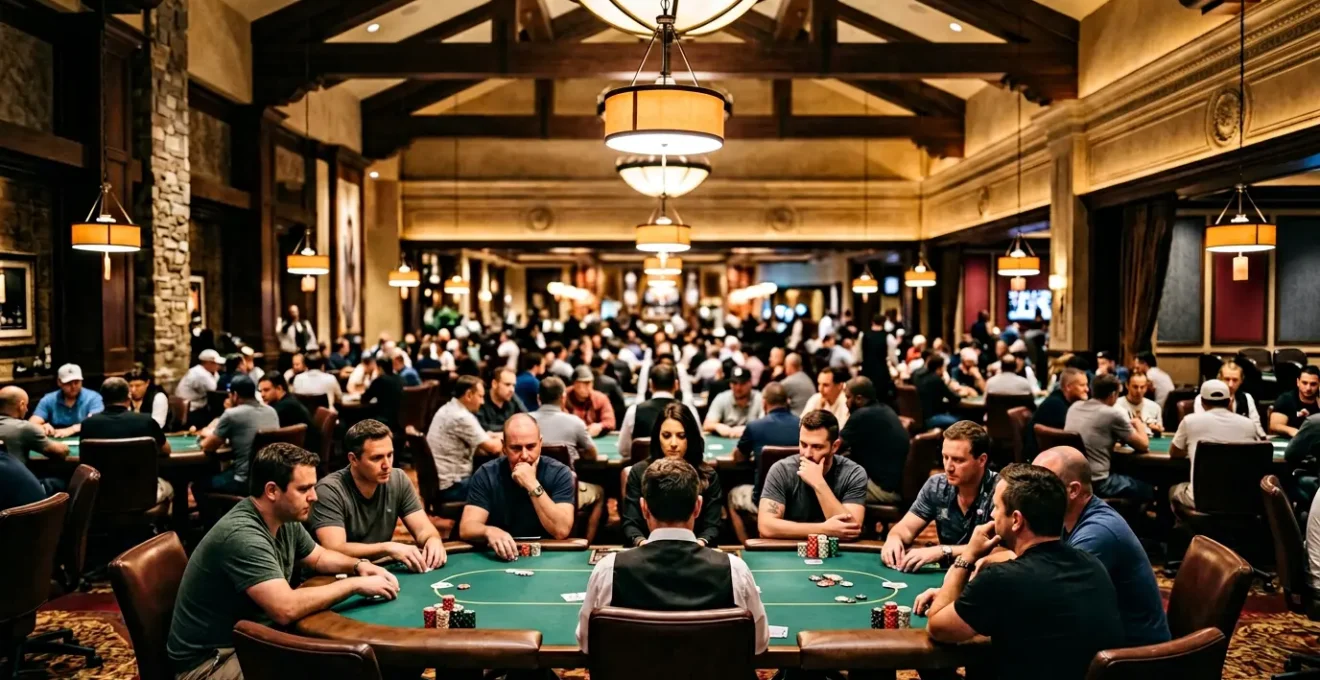
Winning at live poker like Bellagio isn’t about card skill alone; it’s about systematically exploiting environmental factors that online players ignore.
- Your most significant edge comes from rigorous table selection, targeting tables with loose, recreational players (VPIP > 30%).
- Strategic timing is non-negotiable; your highest potential profit windows are late nights on weekends and during major non-poker events.
Recommendation: Treat the poker room as a dynamic system to be analyzed. Your biggest profits are generated from decisions made before you are even dealt a hand.
The transition from the digital felt to the opulent poker rooms of the Bellagio is a sensory jolt. The clean, mathematical precision of your online HUD is replaced by the clatter of chips, the murmur of cross-talk, and the imposing physical presence of your opponents. For the online player accustomed to multi-tabling in silence, this environment can feel chaotic and intimidating. The fear isn’t about knowing hand rankings; it’s about looking like a « fish » out of water, making a procedural mistake, or having your physical tells read like a book.
Most advice for this transition centers on basic etiquette: don’t act out of turn, protect your cards, use the « one chip rule. » While necessary, this is remedial. It’s advice for tourists, not for a serious player looking to protect their edge. The real challenge—and the greatest opportunity—lies not in adapting to social norms, but in mastering the physical and environmental metagame. Your online analytical skills are your greatest asset, but they must be recalibrated to process a new set of data points.
The difference between a winning and losing live player is often found in the margins. It’s the ability to identify « profit leakage » caused by poor environmental decisions. This guide is an analytical framework for that transition. It treats the Bellagio floor as a complex system to be decoded and exploited. We will deconstruct the critical variables: identifying profitable tables, leveraging technology to your advantage, managing the unique psychological pressures of live play, and understanding that the most crucial decisions you make happen far away from the cards themselves.
This article provides a systematic approach to navigating the live poker ecosystem. Below, the table of contents outlines the key strategic pillars we will analyze, from selecting the most profitable seat to implementing mental stop-losses that protect your bankroll from the inevitable swings of the game.
Summary: Poker Room Intensity: How to Play Live at Bellagio Without Looking Like a Fish?
- Why Sitting at the Wrong Table Costs You $200 per Hour?
- How to Use the Bravo Poker App to Jump the Waitlist?
- Cash Games or Daily Tournaments: Which Builds a Bankroll Faster?
- The « Tilt » Mistake That Destroys a 3-Day Win Streak in 1 Hand
- When to Hit the Tables to Find the Most Intoxicated Tourists?
- Why Your Gambling Budget Lasts 2x Longer on Fremont Street?
- How to Set « Reality Checks » on Your Phone to Break the Trance?
- Roulette Table Strategy: How to Make Your Bankroll Last at a $25 Minimum Table?
Why Sitting at the Wrong Table Costs You $200 per Hour?
In online poker, game selection is often reduced to picking a stake and number of players. In a live environment like the Bellagio, table selection is the single most important decision you will make, with a direct and massive impact on your win rate. Playing at a table of tight, competent regulars versus a table of loose, recreational tourists is the difference between grinding out a small profit and having a session where you print money. The failure to differentiate between these is a catastrophic profit leak.
The concept of « game selection » must be expanded to include the entire table ecosystem. An online player’s analytical mind should be constantly scanning for data. How many players are seeing the flop? Are there large stacks, indicating winners, or a sea of short stacks from players constantly rebuying? Is the mood social and boisterous, or quiet and studious? These are your live-action HUD stats. Strategic analysis confirms that effective table selection can improve a player’s win rate by a staggering 5 to 10 big blinds per 100 hands. At a $1/$3 game, that’s a swing of $15-$30 per hour based on this decision alone.
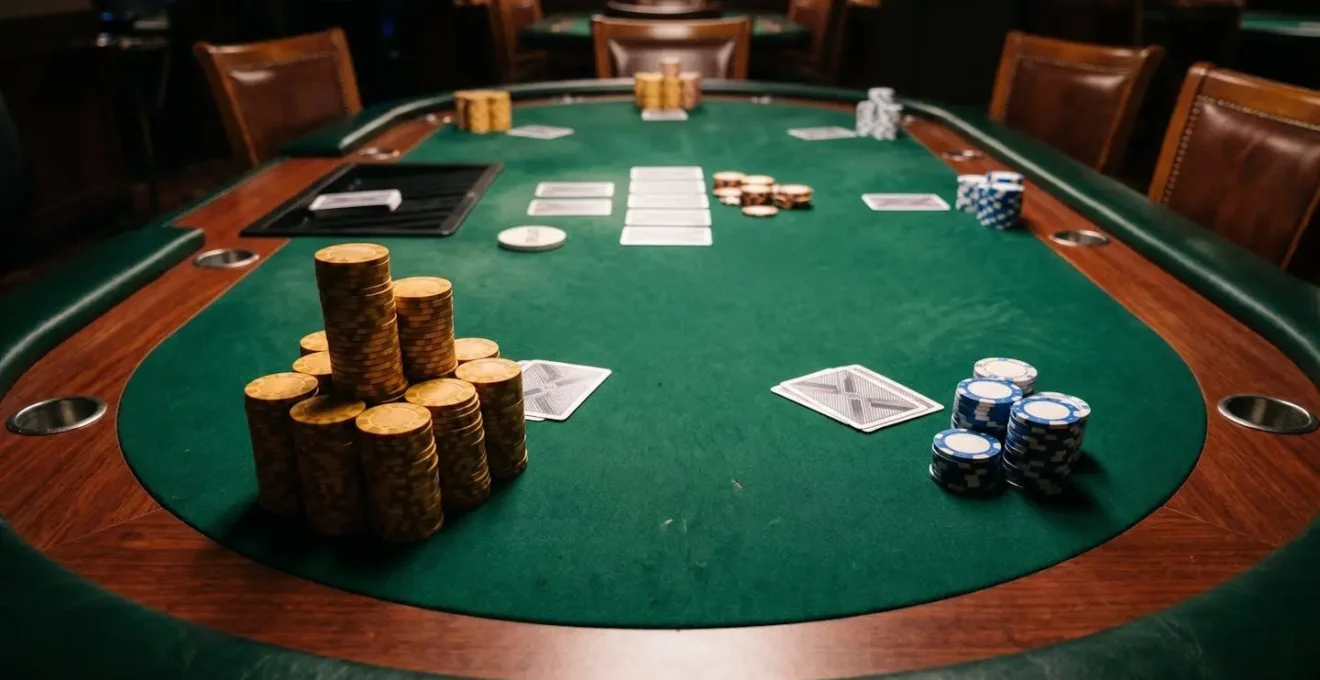
As the image above illustrates, a poker table is an ecosystem defined by stack sizes and player dynamics. Your job is to identify the tables with the most « prey » and fewest « predators. » To do this systematically, you must develop a mental checklist of red and green flags to deploy as you scout the room.
- Green Flag: A high players/flop percentage (over 30%) indicates a loose, action-heavy table.
- Red Flag: A low players/flop percentage (below 20%) signals a tight table likely full of other regulars.
- Green Flag: Players with a high VPIP (Voluntarily Put Money in Pot) above 40% but a low PFR (Pre-Flop Raise) below 10% are classic « calling stations »—your primary source of profit.
- Red Flag: A table with multiple players exhibiting tight VPIP/PFR ratios (e.g., 15/12) is a clear sign of skilled opponents.
- Green Flag: Weekend sessions, especially late at night, filled with an intoxicated, social atmosphere are prime hunting grounds.
Systematically scanning the room for these flags before you even put your name on a list is the first and most critical application of your analytical skills in the live arena. It is the foundation of a profitable session.
How to Use the Bravo Poker App to Jump the Waitlist?
Time spent waiting for a seat is time you aren’t earning. In a high-value environment like Las Vegas, efficiency is key. The Bravo Poker Live app is not merely a convenience; it is a critical strategic tool for reconnaissance and time management. Most players use it passively to check wait times, but a serious player uses it actively to optimize their entire session schedule across multiple properties. The app allows you to see every game, in every room, in real-time, turning the entire Strip into a single, analyzable ecosystem.
The core strategic advantage is the ability to sign up for waitlists remotely. As Genesis Gaming Solutions, the app’s creator, notes on their official platform, « At participating poker rooms, you can even join waiting lists directly from the app. » This means you can add your name to the Bellagio’s $2/$5 list while finishing a meal at the Wynn, minimizing dead time and maximizing your hours at the felt. A systematic approach to using the app transforms it from a simple directory into a command center for your Vegas operations.
Follow this protocol to leverage the app for maximum efficiency:
- Download and Link: Before your trip, download the free Bravo Poker Live app and link your player’s card from major casinos like Bellagio, Aria, and Caesars Palace.
- Cross-Reference Data: Use the app to simultaneously compare wait times across multiple rooms. A 45-minute wait at Bellagio might be a 10-minute wait at Aria. This allows you to pivot to the most immediately profitable opportunity.
- Remote Sign-up: Sign up for your target game’s waitlist before you even leave your hotel room or current location. This effectively lets you « jump the queue » of players physically present.
- Set Notifications: Configure push notifications so you don’t miss your seat call. A missed call can mean another hour of waiting.
- Scout Active Games: Use the app to view the number of active tables for a given stake. A room with 15 active $1/$3 tables offers far better game selection than a room with only two.
By treating the Bravo app as a data-gathering and deployment tool, you replace passive waiting with active, strategic session planning, a hallmark of a professional mindset.
Cash Games or Daily Tournaments: Which Builds a Bankroll Faster?
A common dilemma for players is whether to focus on cash games or the daily tournaments offered by rooms like the Bellagio. From a bankroll-building perspective, the answer is unequivocally cash games. While tournaments offer the alluring fantasy of a single massive score, they are a brutal, high-variance endeavor. Even seasoned professionals only cash in a fraction of the tournaments they play, with competitive poker analysis suggesting that a 15-20% in-the-money rate is a strong performance. This means accepting long, demoralizing stretches of zero return.
Cash games, by contrast, are a lower-variance, steadier path to profit. They allow for more control over your session duration, buy-in amounts, and, most importantly, table selection. In a tournament, you are locked in for hours, often forced to play short-stacked, and at the mercy of your table draw. In a cash game, if your table is bad, you can get up and move. This flexibility is a massive strategic advantage that directly translates to a more stable, predictable win rate.
The following table breaks down the fundamental differences from a bankroll management and strategic perspective. For an analytical player, the choice depends on their tolerance for variance and their primary goal: steady income or a low-probability shot at a life-changing score.
| Factor | Cash Games | Tournaments |
|---|---|---|
| Variance | Lower variance, steadier results | High variance with occasional big scores |
| Bankroll Required | 40-100 buy-ins | 100-300 buy-ins |
| Time Commitment | Flexible – play any duration | Fixed – typically 10-12 hours |
| Profit Pattern | Consistent small wins | Long losing streaks with rare large spikes |
| Skill Depth | Deep stack strategy (100+ BB) | Multiple stack depths (short to deep) |
| Session Control | Leave anytime, rebuy allowed | Bust = session over |
| ROI Potential | Lower but steady | Higher but volatile |
For a player transitioning from online play, cash games provide a much more stable environment to acclimate to live dynamics. The skills of deep-stacked play are more directly transferable, and the ability to manage session length and leave a losing situation is a crucial safety valve that tournaments remove.
The « Tilt » Mistake That Destroys a 3-Day Win Streak in 1 Hand
Tilt is the silent killer of poker bankrolls. It is an emotional and cognitive breakdown that turns a thinking player into a gambler. You can play three full days of perfect, A-game poker, accumulating a significant profit, only to see it all vanish in a single, tilt-fueled hand. For the analytical online player, understanding and controlling tilt is not a soft skill; it is a critical system-level defense mechanism. Its danger is quantifiable; a peer-reviewed study in behavioral addiction research found a strong r = 0.49 correlation between tilt frequency and indicators of problem gambling.
Tilt is a form of cognitive hijack where emotional responses override logical decision-making. As one research team specializing in behavioral addiction describes it, « Tilt leads to a loss of control over the game, a loss of emotional regulation, higher cognitive distortion, and a loss of money. » You stop playing your cards and start playing your emotions—frustration after a bad beat, entitlement to win a pot, or anger at an opponent. This emotional state leads to objectively terrible plays: chasing draws with bad odds, over-valuing marginal hands, or making massive bluffs with no logical basis.
Because you cannot eliminate bad beats or variance, the only solution is to build a robust, pre-planned system for identifying and mitigating tilt before it takes control. This is not about « staying calm »; it’s about implementing a hard-and-fast protocol, much like a pilot running through a pre-flight checklist. The goal is to externalize the decision-making process before your judgment is compromised.
Your Tilt Prevention Protocol Checklist
- Identify Early Warning Signs: Before your session, define your personal tilt triggers. This could be physical tension in your jaw or shoulders, a tendency to make rushed decisions, or the first impulse to chase a long-shot draw out of frustration.
- Deploy Tactical Resets: At the first sign of a trigger, implement a pre-planned action. This can be a 60-second stand-up break between hands, a controlled breathing exercise (box breathing: 4 seconds in, 4 hold, 4 out, 4 hold), or simply stepping away to get water.
- Establish Hard Stop-Losses: This is the most critical step. Before you sit down, define an unbreakable stop-loss. This should be both monetary (e.g., losing two or three full buy-ins) and emotional (e.g., experiencing three consecutive bad beats that feel tilting). When this limit is hit, you must quit for the day, no exceptions.
- Focus on Process, Not Outcome: Train your mind to evaluate the quality of your decisions, not the short-term result of a single hand. Playing a hand correctly and losing is a success. Playing a hand terribly and getting lucky is a failure. This long-term mindset builds resilience.
- Utilize Bankroll Buffers: Proper bankroll management (having 40+ buy-ins for your stake) is itself a tilt-prevention tool. It creates a psychological buffer, making any single loss feel insignificant in the grand scheme.
Implementing a strict, non-negotiable tilt protocol is the single greatest thing you can do to protect your bankroll and ensure your long-term survival in the game.
When to Hit the Tables to Find the Most Intoxicated Tourists?
If table selection is choosing *where* to play, strategic timing is choosing *when* to play. A serious player understands that not all hours are created equal. Your goal is to be at the table when the ratio of recreational, emotionally-driven players to serious, thinking players is at its absolute highest. This means synchronizing your sessions with the rhythm of Las Vegas tourism, not your own personal convenience. The softest, most profitable games are a direct result of targeting these peak windows.
The ideal opponent is a tourist on vacation. They are there for entertainment, not to earn a living. They are more likely to be drinking, less concerned with optimal strategy, and playing with a « fun » budget they are prepared to lose. Your job is to structure your playing schedule to maximize your exposure to this player type. This often means adopting a nocturnal schedule and avoiding the times when the tables are populated by other grinders and local regulars. Weekday mornings, for instance, are notoriously tough, filled with pros starting their « workday. »

The most lucrative sessions often happen in the deep hours of the night, when decision-making is clouded by fatigue and alcohol. To systematically exploit this, you must identify the peak windows for recreational player traffic.
- Weekend Nights (Friday-Sunday): This is the prime time. The majority of tourists with regular jobs arrive and are looking to celebrate. The hours between 10 PM and 3 AM are the sweet spot.
- Post-Event Rushes: Correlate your playtime with major city events. After a Vegas Golden Knights game ends, or after a major concert lets out, the casino floors are flooded with excited, often intoxicated, patrons looking for action.
- Major Convention Windows: Target times during large, non-poker conventions (like CES or other tech conferences). Attendees are often playing on corporate expense accounts and are far less risk-averse.
- Holiday Weekends: Three-day weekends and major holidays (like New Year’s Eve or Super Bowl weekend) bring a massive influx of celebration-mode players, creating exceptionally soft game conditions.
Adjusting your sleep and playing schedule to attack these specific windows is a professional-level adjustment that provides a significant and consistent edge over players who just play whenever they feel like it.
Why Your Gambling Budget Lasts 2x Longer on Fremont Street?
While the Bellagio represents the pinnacle of poker luxury, it is also a high-stakes environment where even the « small » games are filled with competent players. For an online player looking to get their live-poker sea legs, diving directly into a Bellagio $1/$3 game can be an expensive and intimidating trial by fire. A more strategic approach involves using Downtown Las Vegas, specifically Fremont Street, as a lower-cost training ground. The key concept here is « cost-per-hour of practice. »
Fremont Street as a Training Ground Strategy
The Golden Nugget on Fremont Street offers a strategic contrast to Strip poker rooms like Bellagio. While Bellagio’s 1/3 no-limit is the most popular cash game with professional-level competition, Fremont properties provide lower-stakes tables (often $1/$2) with more relaxed atmospheres. This creates an ‘entertainment-per-hour’ calculation advantage: lower table minimums mean recreational players can practice live poker mechanics for a fraction of the cost. This allows you to build confidence in handling chips, reading physical tells, and understanding the flow of a live game before moving to the high-intensity Strip environment where even the baseline 1/3 game attracts experienced regulars.
Starting on Fremont Street allows you to work through the inevitable beginner mistakes at a much lower cost. A mistake that costs you a $300 pot at Bellagio might only cost you $100 at the Golden Nugget. This significantly reduces the psychological pressure and allows you to focus on learning rather than on the fear of losing a substantial amount of money. It is a calculated, low-risk way to beta-test your transition to live play. You can spend a day or two Downtown, honing your physical mechanics and getting comfortable with the live dynamic, before graduating to the bigger games on the Strip with your confidence and bankroll intact.
This approach reframes the choice of venue from one of simple preference to one of strategic bankroll management and skill acquisition. It is a grinder’s approach: minimize risk and cost during the learning phase to maximize profit during the performance phase.
How to Set « Reality Checks » on Your Phone to Break the Trance?
Long poker sessions can induce a trance-like state. You can become so absorbed in the flow of hands that you lose perspective on your own performance, the state of the game, and even the passage of time. This is dangerous. It’s in this « poker trance » that tilt can quietly take root, or you might fail to notice that your profitable table has been taken over by a new lineup of sharks. As renowned mental game coach Jared Tendler defines it, « I define tilt as experiencing negative emotions that remove you from your logic centers which leads to making sub-optimal, unthinking, losing plays. » Breaking this trance requires an external, objective interruption.
A « reality check » is a pre-scheduled, mandatory moment of self-assessment. It forces you to zoom out from the hand-to-hand minutiae and evaluate the bigger picture. The most effective way to implement this is to use a tool you already have: your phone. Setting a simple, repeating timer creates an unavoidable external trigger that forces you to run a mental diagnostic. This is not a suggestion; it is a system. It prevents you from drifting into a state of autopilot where costly mistakes are made.
The « Three-Question Orbit Alarm System » is a simple but powerful protocol:
- Set a Repeating Timer: Before your session begins, set a vibrating, silent alarm on your phone for every 30 minutes.
- Answer Three Mandatory Questions: When the alarm goes off, you must mentally answer these questions with brutal honesty:
- (1) Am I still playing my A-game, or am I tired, distracted, or frustrated?
- (2) Am I still having fun, or does this feel like a frustrating grind?
- (3) Who is the target (the « fish ») at this table right now?
- Take a Mandatory Break if Necessary: If you cannot give a clear, positive answer to all three questions—especially if you cannot identify a clear target—you must take a mandatory 10-minute break away from the table. Walk around, get some air, and reassess if you should continue playing at all.
- Protect Winnings: Apply reality checks even when you are winning. « Winner’s tilt »—the feeling of invincibility that leads to playing overly loose and giving back profits—is just as dangerous as losing tilt.
This system provides the structured self-awareness that is often the first casualty of a long, grueling session. It is your defense against the slow degradation of your decision-making quality.
Key Takeaways
- Your primary source of profit in live poker is not complex strategy, but relentless and disciplined game selection.
- The environmental metagame—exploiting timing, location, and player psychology—offers a greater edge than any single poker move.
- Mental and emotional control is a system, not a feeling. Implementing hard stop-losses and reality checks is the only reliable defense against tilt.
Roulette Table Strategy: How to Make Your Bankroll Last at a $25 Minimum Table?
As a poker player, your edge comes from making better decisions than your opponents over the long run in a game of incomplete information. It is a game of skill. Roulette, in stark contrast, is a game of pure, unadulterated chance with a fixed, unbeatable mathematical edge for the house. The question of « how to make your bankroll last » at a roulette table has only one intellectually honest answer for a thinking player: you can’t, in the long run. The game is designed to slowly but surely grind you down.
The American roulette wheel has 38 pockets (1-36, plus 0 and 00). A winning bet on a single number pays 35-to-1, but the true odds are 37-to-1. This discrepancy creates a house edge of 5.26%. This means that for every $100 you bet, you are mathematically expected to lose $5.26. There is no betting system, no money management strategy, and no mystical insight that can overcome this fundamental math. The wheel has no memory, and every spin is an independent event.

The only « strategy » for roulette is to reframe it for what it is: a pure entertainment expense. You are paying for the thrill of watching the ball spin. The correct way to approach it is with a strict entertainment budget, separate from your poker bankroll. Decide *in advance* the maximum amount you are willing to lose for this form of entertainment (e.g., $100). Play until that money is gone, or until you hit a lucky win that you are smart enough to walk away with. Making your bankroll « last longer » simply means making smaller bets to maximize the number of spins you get for your money.
For a serious poker player, the most effective roulette strategy is to watch a few spins, appreciate the spectacle of pure chance, and then walk back to the poker room where your decisions actually matter. Your time and money are far more profitably invested in a game where you can exert a skill-based edge, however small, over the long term.
Ultimately, mastering the Bellagio floor means focusing your energy and bankroll where you have a tangible edge. Analyze the system, control your variables, and leave the games of pure chance to the tourists. This analytical discipline is what separates a vacationing gambler from a profitable poker player.