
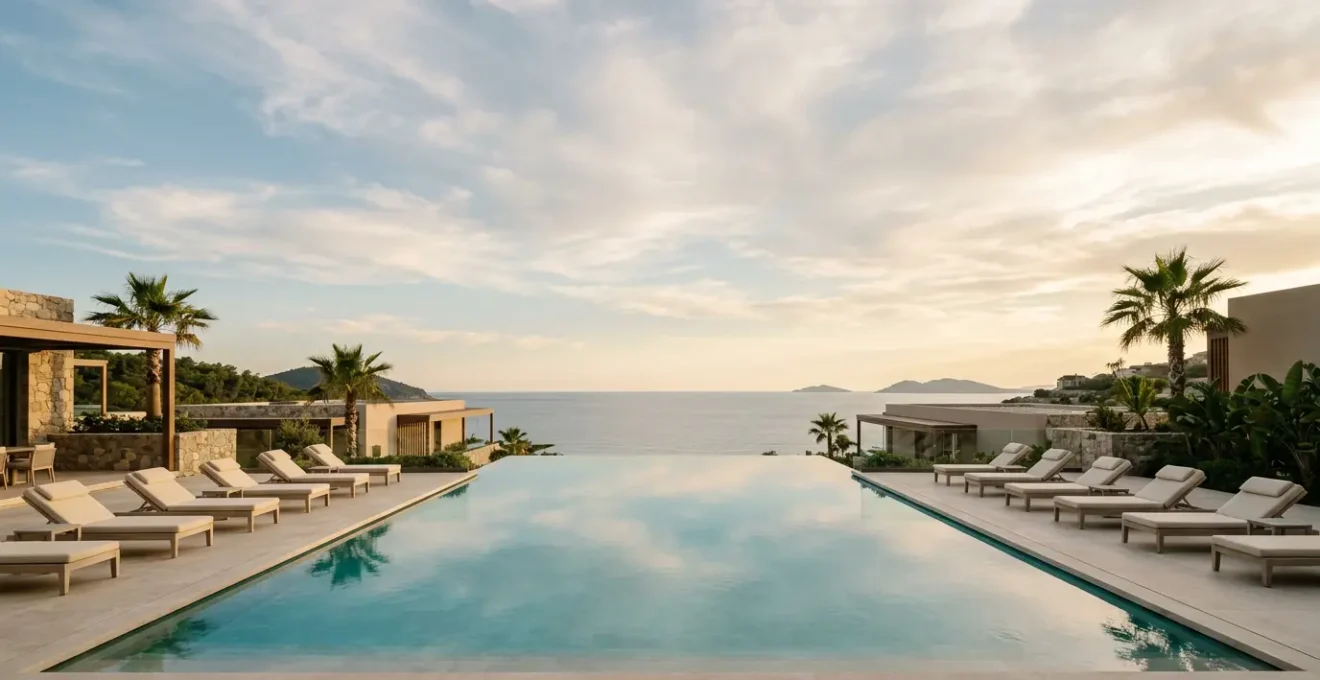
The « adults-only » label on a hotel is often a marketing suggestion, not a legal guarantee of peace.
- True tranquility comes from distinguishing between a hotel’s flexible ‘policy’ and a legally-mandated age restriction enforced by law.
- A resort’s atmosphere—whether for partying or relaxation—is an architectural choice revealed through its amenities, marketing language, and even its dining hours.
Recommendation: Stop relying on generic labels. Instead, conduct ‘policy forensics’ before booking by verifying age rules in writing and auditing the resort’s operational signals to secure a genuinely child-free escape.
The scene is painfully familiar. You’ve paid a premium for an « adults-only » resort. You’ve settled into your poolside lounge chair, cocktail in hand, book open, ready to finally exhale. Then, you hear it: the distant-but-approaching shriek of a child, followed by the cannonball splash that sends chlorinated water across your sunglasses. The « adults-only » promise was limited to your specific pool, a small oasis in a sprawling family-friendly property. Your tranquility is shattered.
The common advice—travel off-season, read reviews—is a flimsy shield against this holiday disappointment. The truth is, the travel industry’s use of « adult-only » is inconsistent and often misleading. This isn’t about disliking children; it’s about protecting the sanctity of a planned romantic and quiet escape, a need felt by an increasing number of travelers. In fact, a recent report shows that 34% of multigenerational travellers aged 50+ prefer adults-only settings, highlighting a clear demand for genuine peace.
But what if the key to securing that peace wasn’t just hoping for the best, but knowing exactly what to look for? The secret lies in moving beyond the marketing and becoming an expert in what we’ll call ‘policy forensics.’ It’s about learning to decode the difference between a legally-enforced, property-wide age restriction and a simple hotel policy that can be bent or is limited to a single area. It’s about understanding the ‘vibe architecture’ that dictates whether a space is built for raucous parties or serene relaxation.
This guide will equip you with the tools to do just that. We will dissect the legal nuances that create true adult sanctuaries, show you how to analyze a resort’s atmosphere before you book, and provide actionable strategies for everything from pool etiquette to securing the most peaceful dinner reservation. This is your masterclass in guaranteeing tranquility.
To navigate this essential knowledge, the following sections will provide a detailed roadmap. You will learn to identify the subtle but crucial signals that separate a truly adult-focused resort from one that simply has an « adult section, » ensuring your next romantic getaway is exactly what was promised.
Summary: The Definitive Guide to Securing a Genuinely Child-Free Vacation
- Why « Circa » is the Only True 21+ Resort in Las Vegas?
- How to behave at « European Style » Pools Without Being Awkward?
- Adult Pool Party vs. Adult Quiet Pool: Which Matches Your Vibe?
- The Mistake of Booking a Room for Your 20-Year-Old at an 21+ Hotel
- When to Book a Table to Avoid Families Dining Early?
- How to Identify if a Resort is « Party-Centric » or « Relaxation-Focused »?
- Cabana or Daybed: Which Offers Necessary Shade for Pale Skin?
- Resort Atmospheres: How to Choose a Hotel That Matches Your Party Vibe?
Why « Circa » is the Only True 21+ Resort in Las Vegas?
The most common trap for tranquility-seekers is the « resort-within-a-resort » model. Many properties in destinations like Las Vegas boast an « adults-only pool » or an « adults-only tower, » but these are merely islands of calm in a sea of family-friendly chaos. The lobbies, restaurants, and casinos remain open to all ages, completely dissolving the sense of a cohesive, adult-focused escape. This is a classic case of a flexible hotel ‘policy’ masquerading as a firm rule.
The critical difference—and the core of our ‘policy forensics’ approach—is understanding when an age restriction is a legal mandate rather than a simple management choice. This is where Las Vegas’s Circa Resort & Casino provides the definitive case study. It isn’t just ‘adult-friendly’; it is a property-wide, legally-enforced 21+ environment.
Case Study: Circa Las Vegas’s Legally-Mandated 21+ Policy
When Circa opened in 2020, it established itself as the only truly 21+ resort in Las Vegas, not by choice, but as a condition of its business. The Nevada Gaming Commission approved Circa’s gaming license with the explicit stipulation that the entire building operates as an adults-only property. This requirement is not a flexible hotel policy that can be waived; it is enshrined in gaming law. This legal backing means the 21+ rule applies non-negotiably across every facility: the casino floor, all hotel rooms, most restaurants, and the famous Stadium Swim pool complex. An ID check isn’t just a suggestion; it’s a legal requirement for entry, guaranteeing zero ambiguity and zero exceptions.
This distinction is everything. A hotel ‘policy’ can have exceptions for certain guests or may only apply to a specific venue. A legal mandate, tied to a gaming or liquor license, is absolute. It means the entire resort ecosystem—from the check-in desk to the furthest pool chair—is designed for and exclusively occupied by adults. Identifying this legal foundation is the first and most powerful step in guaranteeing a child-free environment.
How to behave at « European Style » Pools Without Being Awkward?
Once you’ve found a genuinely adult-focused resort, you may encounter another term that causes hesitation: the « European-style » or « toptional » pool. For many, this conjures images of awkwardness or discomfort. However, understanding the established etiquette transforms these spaces from intimidating to liberating. The core principle is that these pools are designed for relaxation and body positivity, not for spectacle or voyeurism.
The term « European-style » is simply code for an environment where women have the option to sunbathe topless, as is common on many beaches in Europe. The key word is optional. There is absolutely no pressure or expectation to participate. The atmosphere is built on mutual respect and a collective agreement to protect everyone’s privacy and comfort. In fact, the most awkward behavior is not choosing one way or the other, but failing to respect the space’s social contract.
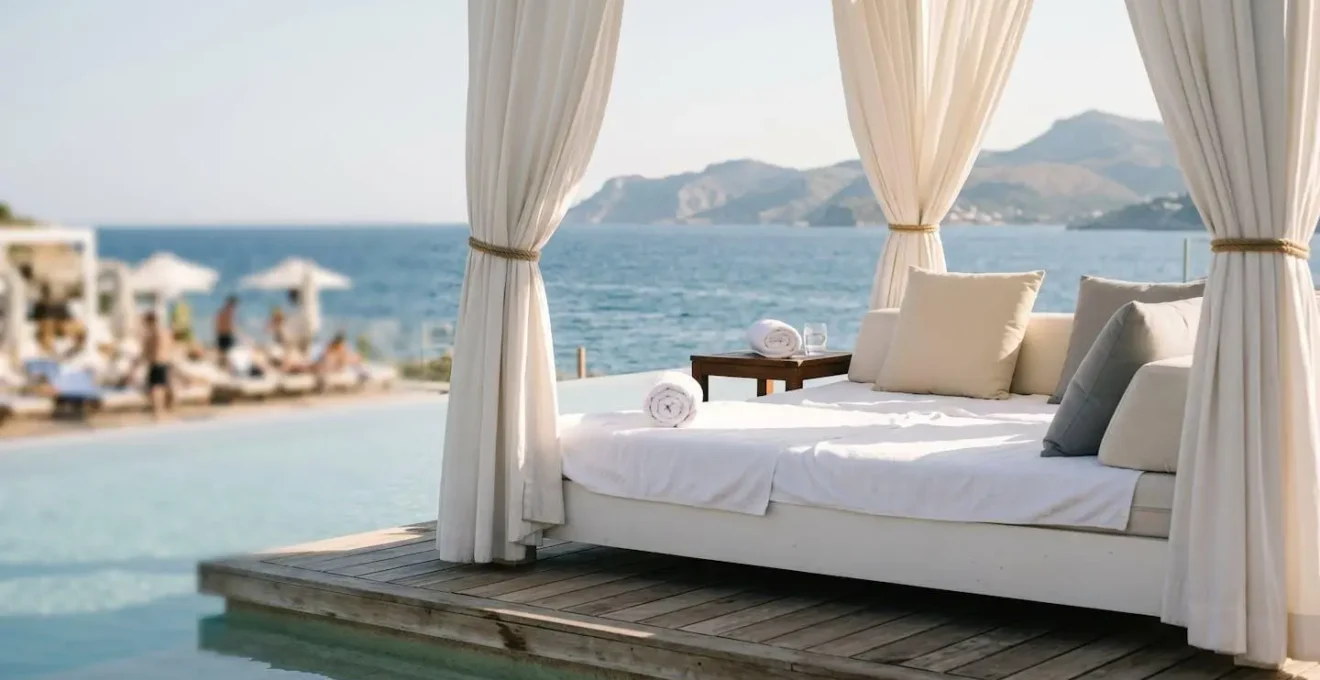
As the image of this secluded daybed suggests, the goal is to create your own zone of comfort. The strictest rules at these pools are aimed at preventing gawking and protecting privacy. Security is often quick to enforce a strict no-photography policy, and any overt staring or unwanted attention will result in immediate removal. The unwritten rule is to act as if you are in any other serene pool setting: read your book, listen to your music, and focus on your own relaxation. The environment is about a shared freedom, and respecting that freedom is the only requirement.
European-Style Pool Etiquette: Your Guide to Confidence
- Respect « Toptional » as Optional: The choice to go topless is a personal one for women. Wear what makes you comfortable; there is no pressure either way.
- Enforce a Strict No-Photography Zone: To protect everyone’s privacy, put your phone away. Security will enforce a strict no-photo policy, and you should too.
- Mind Your Gaze: Do not stare or leer. These are spaces for relaxation, not voyeurism. Treat everyone with the same casual respect you would in any other social setting.
- Maintain Personal Space: Unwanted advances or non-consensual touching are illegal and will lead to immediate ejection from the property. This is a non-negotiable rule.
- Observe the Vibe: Upon arrival, gauge the atmosphere. Some pools are serene and quiet (like at Wynn), while others might have a more social, party-like feel. Adjust your behavior accordingly.
Adult Pool Party vs. Adult Quiet Pool: Which Matches Your Vibe?
Not all adult pools are created equal. Securing a child-free space is only the first step; the next is ensuring the « vibe » of that space aligns with your definition of a vacation. The difference between an « adult pool party » and a « quiet adult pool » is as vast as the difference between a nightclub and a spa. Choosing the wrong one can be just as disruptive to your peace as a screaming child. This is where you must analyze the resort’s ‘vibe architecture’—the deliberate design and marketing choices that shape the guest experience.
A pool party environment is built for high-energy socializing. Think large, central pools with swim-up bars, booming sound systems with live DJs, and a calendar packed with events like mixology classes or celebrity appearances. The marketing language will be filled with buzzwords like « Day Club, » « Bottle Service, » and « Events. » Social media will be flooded with images of large groups, dancing, and champagne showers. This is an experience designed for extroverted, social energy.
Conversely, a quiet pool is architected for serenity. It often features multiple smaller, secluded pools, soft, ambient music (if any), and an emphasis on wellness. The marketing will use words like « Serenity, » « Tranquil, » or « Wellness. » The focus is on luxurious seating, attentive but discreet service, and amenities that promote relaxation. Instead of DJ booths, you’ll find private plunge pools, yoga pavilions, and guests quietly reading books. This is an environment engineered for introverted peace and romantic connection.
To avoid a costly mismatch, you must learn to read these signals before you book. The following table breaks down the key indicators that will help you diagnose a resort’s true poolside intentions.
| Indicator Type | Party Vibe Signals | Relaxation Vibe Signals |
|---|---|---|
| Marketing Buzzwords | ‘Live DJ,’ ‘Events,’ ‘Bottle Service,’ ‘Day Club,’ ‘Beach Balls’ | ‘Serenity Pool,’ ‘European-Style,’ ‘Private Plunge Pools,’ ‘Wellness,’ ‘Tranquil’ |
| Acoustic Architecture | Single large centralized pool with swim-up bar, air-rattling sound system | Multiple smaller secluded pools, subdued music, quiet zones |
| Room Category Focus | High percentage of multi-bedroom suites, basic rooms for groups | Heavy promotion of private plunge pool suites, wellness rooms, honeymoon villas |
| Instagram Analysis | Guest photos show DJ booths, bottle service, crowded dancing | Guest photos show books, quiet cocktails, empty lounge chairs |
| Activities Calendar | ‘Mixology classes,’ ‘Beach volleyball tournaments,’ ‘Pool parties’ | ‘Guided nature walks,’ ‘Stargazing,’ ‘Yoga,’ ‘Pottery classes’ |
The Mistake of Booking a Room for Your 20-Year-Old at an 21+ Hotel
Perhaps the most brutal and financially painful lesson in ‘policy forensics’ comes from misunderstanding strictly enforced age minimums. Imagine this scenario: you’ve planned a celebratory trip, booking a non-refundable room at a chic 21+ hotel for yourself and your 20-year-old family member. You arrive at the front desk, luggage in tow, only to be flatly denied check-in. Your vacation is over before it began, and your money is gone.
This isn’t a rare occurrence; it’s a standard operating procedure at properties with legally mandated age restrictions. Hotels are not being difficult; they are complying with the law. To them, checking in an underage guest could mean risking their gaming or liquor license—a catastrophic business risk they will never take. They will refuse entry, and because the age requirement was disclosed in the booking terms (even if buried in fine print), they are under no obligation to refund your prepaid, non-refundable booking.
The Real Cost of an Age-Restriction Denial
The financial fallout from being denied check-in is a cascading crisis. As a detailed analysis of hotel age requirements highlights, travelers not only forfeit the entire cost of the original denied reservation but are also forced to find last-minute alternative lodging. This emergency booking often comes at hugely inflated rates, sometimes two or three times the normal price. Furthermore, any prepaid transfers, tours, or activities tied to the original location are also lost. In destinations like Las Vegas or Miami, this single mistake commonly results in cumulative losses of $1,000 to $3,000, turning a dream vacation into a financial nightmare.
The only way to prevent this disaster is through proactive, documented verification. Never assume. Before making any non-refundable payment, you must get the hotel’s age policy—for all guests in the room—in writing.
The Pre-Travel Age Verification Checklist
- Initial Contact: Send an email to the hotel with the subject « Age Policy Verification for Reservation #[Confirmation Number] ».
- Clarify the « All Guests » Rule: Ask specifically: « Can you confirm if every guest in the room must be 21+, or only the lead booker? » This is the most crucial question.
- Determine the Policy’s Authority: Inquire: « Is this age requirement mandated by local law/gaming license, or is it a hotel policy? » This tells you how rigid the rule is.
- Understand the Financial Risk: Ask: « What is your refund policy for prepaid, non-refundable bookings if a guest does not meet the age requirement at check-in? »
- Request Written Confirmation: Conclude with: « Please provide this confirmation in writing via email for my records. » Save this email with your travel documents as proof.
When to Book a Table to Avoid Families Dining Early?
Your quest for tranquility extends beyond the pool deck and into the dining room. Even at a resort with a mixed-age clientele, you can strategically create an adult-only dining experience. The key is to understand and leverage cultural dining rhythms. In most Western cultures, families with young children dine early. By simply timing your reservation correctly, you can effectively sidestep the peak family rush and ensure a more sophisticated, adult atmosphere for your meal.
The « safe » time for an adult-focused dinner varies by country and region. In the United States or the UK, where families often eat between 5:30 PM and 7:30 PM, a reservation at 8:30 PM or later is a reliable bet for a quieter experience. In Spain or Italy, where the entire dining culture skews later, you’ll need to push your booking to 9:30 PM or even 10:00 PM to ensure you’re dining primarily with other adults.
Beyond timing, your choice of restaurant venue can act as a natural filter. Upscale restaurants with long, fixed tasting menus (prix fixe) are less appealing to families due to their length and cost. Venues that heavily promote their wine-pairing programs are implicitly targeting an adult audience. Likewise, booking seats at a chef’s counter or the main bar often places you in a de facto adult-only zone, even within a larger restaurant. Always scrutinize a restaurant’s marketing; if they advertise a « kids’ menu » or « family-friendly » atmosphere, it’s a clear signal to book elsewhere for a romantic evening.
This table provides a general guide to global dining hours, helping you schedule your romantic dinner for when the ambiance is just right.
| Region/Country | Family Dining Peak Hours | Safe Adult Dining Hours | Cultural Notes |
|---|---|---|---|
| United States / UK | 5:30 PM – 7:30 PM | 8:30 PM or later | Families dine early; late bookings ensure adult atmosphere |
| Spain / Italy | 8:00 PM – 9:00 PM | 9:30 PM – 10:00 PM | Later dining culture; even families eat later, but 9:30+ skews adult |
| France | 7:00 PM – 8:00 PM | 8:30 PM – 9:00 PM | Traditional dining hours; later slots more sophisticated |
| Northern Europe (Scandinavia) | 5:00 PM – 6:30 PM | 7:30 PM or later | Very early family dining culture; 7:30+ ensures fewer children |
| Asia Pacific | 6:00 PM – 7:30 PM | 8:00 PM or later | Varies by country; later hours generally more adult-focused |
How to Identify if a Resort is « Party-Centric » or « Relaxation-Focused »?
The promise of « adults-only » can mean two vastly different things: a non-stop party or a tranquil sanctuary. Arriving at a « serenity » resort when you wanted a DJ, or vice-versa, is a recipe for vacation disappointment. To avoid this, you must become adept at reading a resort’s DNA before you ever step foot on the property. This involves looking past the glossy brochure photos and auditing the resort’s core operational and marketing choices, which reveal its true identity.
A relaxation-focused resort invests in the tangible assets of tranquility. Its ‘vibe architecture’ is built around amenities that encourage quiet contemplation and wellness. The spa will not be an afterthought but a centerpiece, featuring extensive hydrotherapy circuits, a robust schedule of yoga and meditation classes, and luxurious treatment rooms. This is a place where the quality of the massage oil is a more important detail than the volume of the sound system.

The resort’s activities calendar is another powerful litmus test. A relaxation-focused property will offer activities like guided nature walks, stargazing sessions, pottery classes, or private cooking lessons. These are experiences designed for connection and quiet enjoyment. In contrast, a party-centric resort’s calendar will be filled with mixology competitions, beach volleyball tournaments, and foam parties. Neither is inherently better, but they cater to fundamentally different desires. Your mission is to audit these signals to ensure a perfect match.
Your Pre-Booking Vibe Audit
- Room Category Analysis: Analyze the room types. A high percentage of multi-bedroom suites or basic group-friendly rooms signals a party focus. Heavy promotion of private plunge pool suites, wellness rooms, or honeymoon villas indicates a relaxation focus.
- Amenities Audit: Examine the spa and gym in detail. A massive hydrotherapy circuit and a daily yoga schedule signal relaxation. A tiny, overlooked spa with a few treadmills suggests a party focus where wellness is a low priority.
- Activities Calendar Litmus Test: Scrutinize the included activities. « Mixology classes » and « beach volleyball tournaments » are for a high-energy social crowd. « Guided nature walks » and « stargazing » target guests seeking quiet experiences.
- Influencer Partnership Analysis: A crucial piece of data from a report on hospitality trends can be applied here; see who the hotel partners with. If the resort’s Instagram is filled with festival-going party crews, expect a party atmosphere. If they partner with solo wellness and luxury travelers, expect relaxation.
- Soundtrack Investigation: Does the resort promote its « Resident DJs »? Does it have public Spotify playlists filled with high-BPM electronic music? This is a strong, unambiguous indicator of a party atmosphere.
Cabana or Daybed: Which Offers Necessary Shade for Pale Skin?
For couples seeking romantic seclusion by the pool, especially those with fair skin, the choice between a daybed and a cabana is more than a simple preference—it’s a strategic decision for comfort and health. While both offer a step up from a standard lounge chair, they serve very different needs when it comes to providing reliable, all-day shade.
A daybed, typically furnished with an umbrella, offers flexibility. You can angle the umbrella to track the sun’s path, providing targeted shade at different times of the day. However, this coverage is limited and requires constant adjustment. On a windy day, the umbrella may be ineffective or even a hazard. It provides minimal privacy and exposes you to the elements. Its primary advantage is its lower cost.
A cabana, on the other hand, is the ultimate investment in poolside comfort and sun protection. Its fixed roof structure provides guaranteed, consistent shade from the hot midday sun. The enclosed sides with curtains offer unparalleled privacy, creating a personal lounge where you can relax, nap, or enjoy a meal away from prying eyes. They also provide a crucial shield from the wind. While the upfront cost is higher, many cabana rentals include a significant food and beverage credit, which can make the « true cost » surprisingly comparable to a daybed once you factor in a day’s worth of drinks and lunch. For anyone prioritizing sun safety and privacy, the cabana is the undisputed winner.
| Variable | Cabana | Daybed with Umbrella |
|---|---|---|
| All-Day Shade | ✓ Winner – Fixed roof structure provides consistent shade from 10 AM to 6 PM | ✗ Umbrella angle requires adjustment as sun moves; limited coverage |
| Adjustable Shade / Sun Tracking | ✗ Fixed structure; cannot reposition | ✓ Winner – Umbrella can be angled to track sun path throughout day |
| Privacy | ✓ Winner – Enclosed sides with curtains, secluded atmosphere | ✗ Open seating, visible to all pool guests |
| Wind Protection | ✓ Winner – Solid walls shield from breeze and provide climate control | ✗ Fully exposed to wind and elements |
| Included Amenities | ✓ Typically includes mini-fridge, fan/misting system, TV, dedicated server, food/beverage credit | ✗ Basic seating only; beverages/food ordered separately |
| Cost (Typical Range) | $300 – $800 per day depending on location and day of week | $50 – $150 per day |
| True Cost Analysis | Often includes $150-$250 F&B credit, reducing net cost significantly | No included credit; all purchases additional |
For the ultimate shade optimization, you can elevate your planning. By using a sun-path tracking app (like Sun Seeker) and cross-referencing it with the resort’s pool map, you can identify which specific cabana number will offer the best natural shade during your preferred hours. Request that specific cabana when booking to fully engineer your day of shaded bliss.
Key Takeaways
- Legal is Greater Than Policy: A true ‘adults-only’ guarantee comes from legally-mandated age restrictions (like a gaming license), not from flexible hotel policies that apply only to certain areas.
- Vibe is by Design: A resort’s true atmosphere—party or relaxation—is revealed by its physical design, amenity investments (spa vs. DJ booth), and activity calendar, not by its marketing slogans.
- Proactive Verification is Protection: Never assume age policies. Always get written confirmation before making a non-refundable booking to avoid disastrous financial consequences and vacation-ruining denials at check-in.
Resort Atmospheres: How to Choose a Hotel That Matches Your Party Vibe?
Throughout this guide, we’ve focused on securing tranquility. But for many couples, an « adults-only » escape is about finding the right kind of energy, whether that’s a high-octane party or a sophisticated social scene. The same ‘policy forensics’ we use to find quiet can be used to find the perfect party. The key is to look for deliberate signals of a party-centric ‘vibe architecture.’ You are not just looking for a hotel; you are auditioning a venue for your vacation experience.
The most obvious indicators are auditory. Does the resort’s website or social media heavily promote « Resident DJs »? Is there a link to a Spotify playlist filled with high-BPM electronic music? This is the resort telling you, unequivocally, that it is a space for loud music and dancing. The pool area will be another major clue. A single, large, centralized pool with a prominent swim-up bar and extensive bottle service menu is designed for large-scale mingling and social performance, not for quiet reading.
Pay close attention to the social proof. Scour tagged photos on Instagram and reviews on TripAdvisor. Are the guests predominantly large groups of friends, bachelor/bachelorette parties, and festival-goers? Do reviews frequently mention « loud music until late, » « party crowd, » or « great for groups »? These are not complaints; they are testimonials to the resort’s true character. For the party-seeker, these are glowing endorsements. For the tranquility-seeker, they are clear red flags.
Red Flag Checklist for Relaxation-Seekers Avoiding Party Hotels
- The DJ Signal: The hotel actively promotes « Resident DJs » or has public Spotify playlists filled with high-energy electronic music.
- Influencer Affiliation: The resort’s social media shows partnerships with festival-going influencer crews or celebrity party hosts.
- Room & Package Structure: A high percentage of multi-bedroom suites and the advertisement of « spring break packages » are geared toward groups.
- The Central Pool Test: The primary pool is a single, large, centralized space featuring a prominent swim-up bar and obvious bottle service options.
- Activity Calendar Clues: Marketing materials and calendars emphasize « Events, » « Day Clubs, » « Beach Volleyball Tournaments, » or « Mixology Classes » over quiet pursuits.
- Reviewer Chatter: TripAdvisor or Google reviews consistently mention « loud music, » « party crowd, » or « bachelor/bachelorette groups. »
- Photographic Evidence: Guest photos predominantly show crowded pool scenes, DJ booths, and high-energy crowds rather than quiet relaxation and empty spaces.
Your well-deserved peace, or your perfect party, is not a matter of luck; it’s a result of deliberate choice. Use these strategies on your next booking and transform your hope for the ideal adult getaway into a well-executed guarantee.